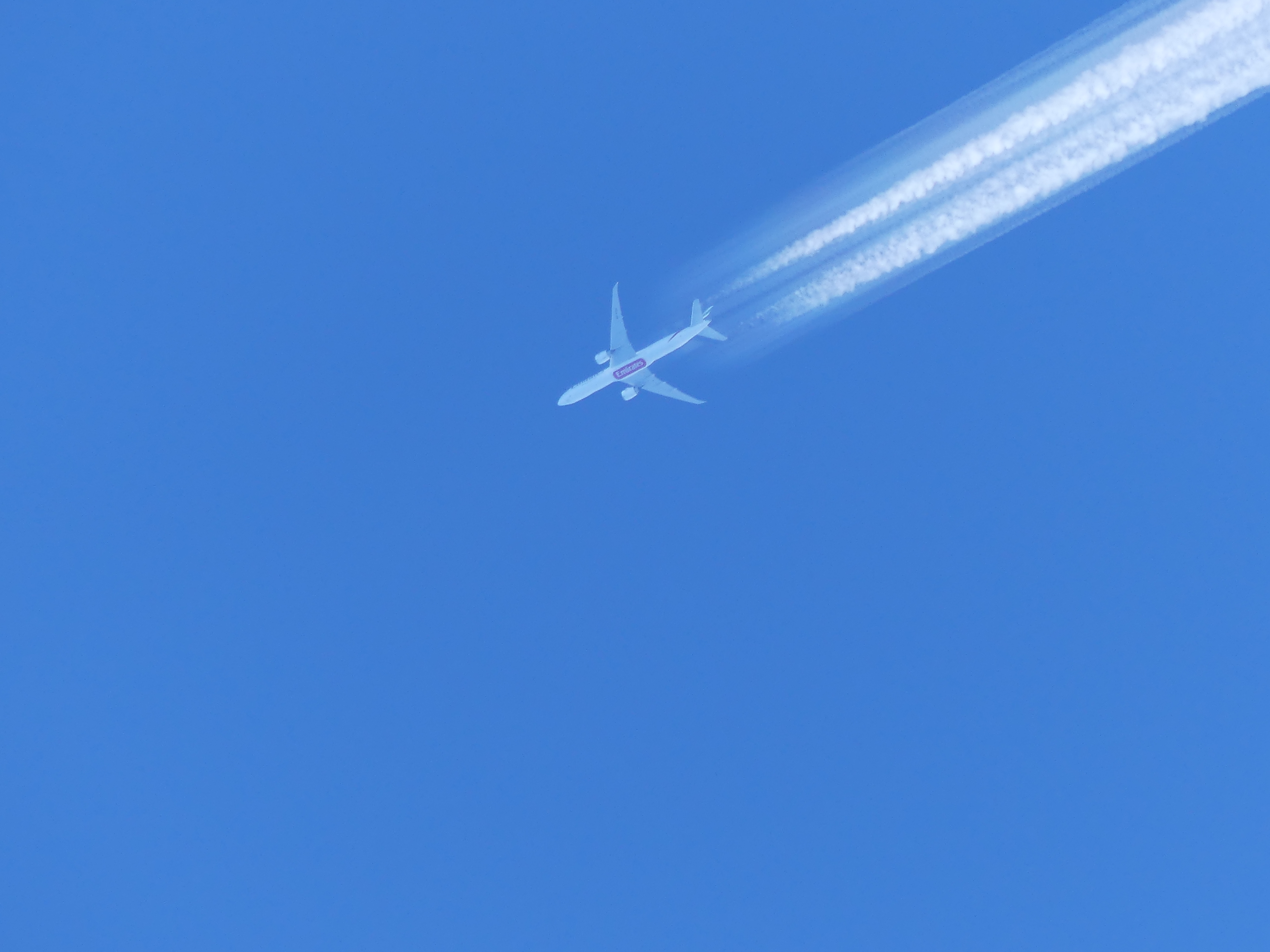
Look up for a second. If a plane happens to pass overhead, it might leave a thin white line behind. For most people, that’s a plane. For a surprisingly large minority, it’s an assault on their free will.
The story goes like this: that thing in the sky isn’t harmless water vapour, it’s a secretly sprayed cocktail of aluminum, barium and strontium. Sometimes it’s meant to manipulate the climate, sometimes to cull the population, and in its darkest version, to make us docile. A remote-controlled humanity, dispensed on a scheduled flight, served over the breakfast table.
That sounds like a footnote for cranks. It isn’t. In a 2011 international survey, nearly 17 percent of respondents thought a secret large-scale spraying program was true or at least partly true. A representative US poll in 2016 put it at around 10 percent who fully agreed, and over 30 percent who considered it at least somewhat true. That’s not a handful of cranks. That’s a stadium.
What makes chemtrails interesting, then, is less the theory itself, which falls apart fast, and more its history. How does a piece of trivial physics, a streak of ice six miles up, turn into a global narrative about mind control? The road runs through a misread military paper, a late-night radio show, a German weather report, and finally through the thing we’d rather not face: that reality is sometimes more disturbing than the conspiracy.
What actually happens up there
Let’s start with the disappointment. A contrail is water. Burn kerosene in a jet engine and out come carbon dioxide, soot and water vapour. At cruising altitude, five to seven miles up, it’s minus 40 to minus 50 degrees. The hot vapour latches onto the soot particles, condenses, and freezes into ice crystals in a fraction of a second. Whether that happens at all is governed by a dry little formula with a dry little name: the Schmidt-Appleman criterion.
The real fight isn’t over how they form. It’s over how long they stick around. Believers pin their strongest argument on one observation: one streak is gone in seconds, another hangs there for hours and fans out wide. Surely there must be something in it.
There is something in it. Water. More precisely, humidity decides. If the air at altitude is dry, the streak evaporates immediately. If it’s saturated with ice, it stays and spreads into an artificial cirrus cloud, one that meteorologists have classified as its own cloud type since 2017: cirrus homogenitus. A joint fact sheet from four US agencies put it plainly back in the year 2000: persistent contrails are mostly made of water already present along the flight path. The engine only supplies a small part.
In other words, the same streak, sometimes short, sometimes long, doesn’t prove two different payloads. It proves two different weather conditions. The theory isn’t undone by a counterargument. It’s undone by a weather report.
The birth of a theory
Every good conspiracy story needs a founding document that looks real. Chemtrails found theirs in 1996. A group of officers wrote a paper, as part of an Air University study program, with the grand title „Weather as a Force Multiplier: Owning the Weather in 2025.” In it, they play through how weather might one day be used militarily.
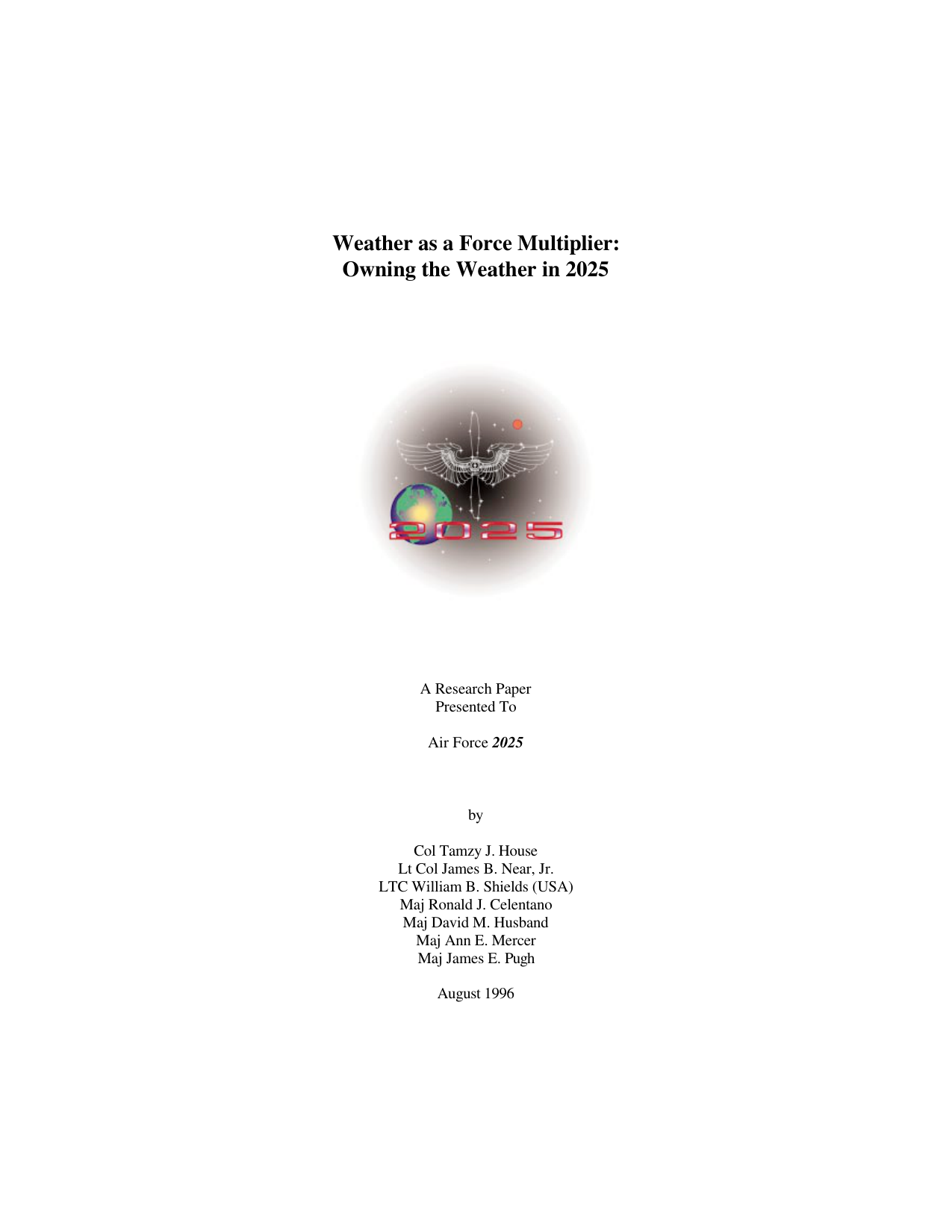
Anyone who actually reads the paper finds a note on the opening pages that believers diligently skip. It was produced „in the academic freedom of a Department of Defense school,” does „not reflect the official position of the US Air Force,” and contains „fictional representations of future situations and scenarios.” It’s a term paper about the day after tomorrow. Somehow it became Exhibit A for a covert operation that’s supposedly still running. It’s a bit like treating a high-school essay on time travel as proof there’s a DeLorean sitting in your garage.
The rest was handled by radio and the early internet. In the late nineties the term floated around online forums, and from 1999 the late-night US radio host Art Bell carried it into millions of bedrooms. In 2001 the word even made it into a bill: Congressman Dennis Kucinich introduced the „Space Preservation Act,” which listed „chemtrails” verbatim among the „exotic weapons systems” to be banned, right next to psychotronic and tectonic weapons. Kucinich had only submitted the text, not written it, and in later versions the word disappeared again. For the scene, the damage was long done: it was there in black and white in a congressional document. That tectonic weapons were on the same list bothered no one.
From weather to mind control
A conspiracy theory isn’t a fossil, it’s an organism. Chemtrails mutated happily. Sometimes it was weather manipulation, sometimes secret population control, sometimes climate steering. But the darkest variant is the one that gives this article its name: mind control.
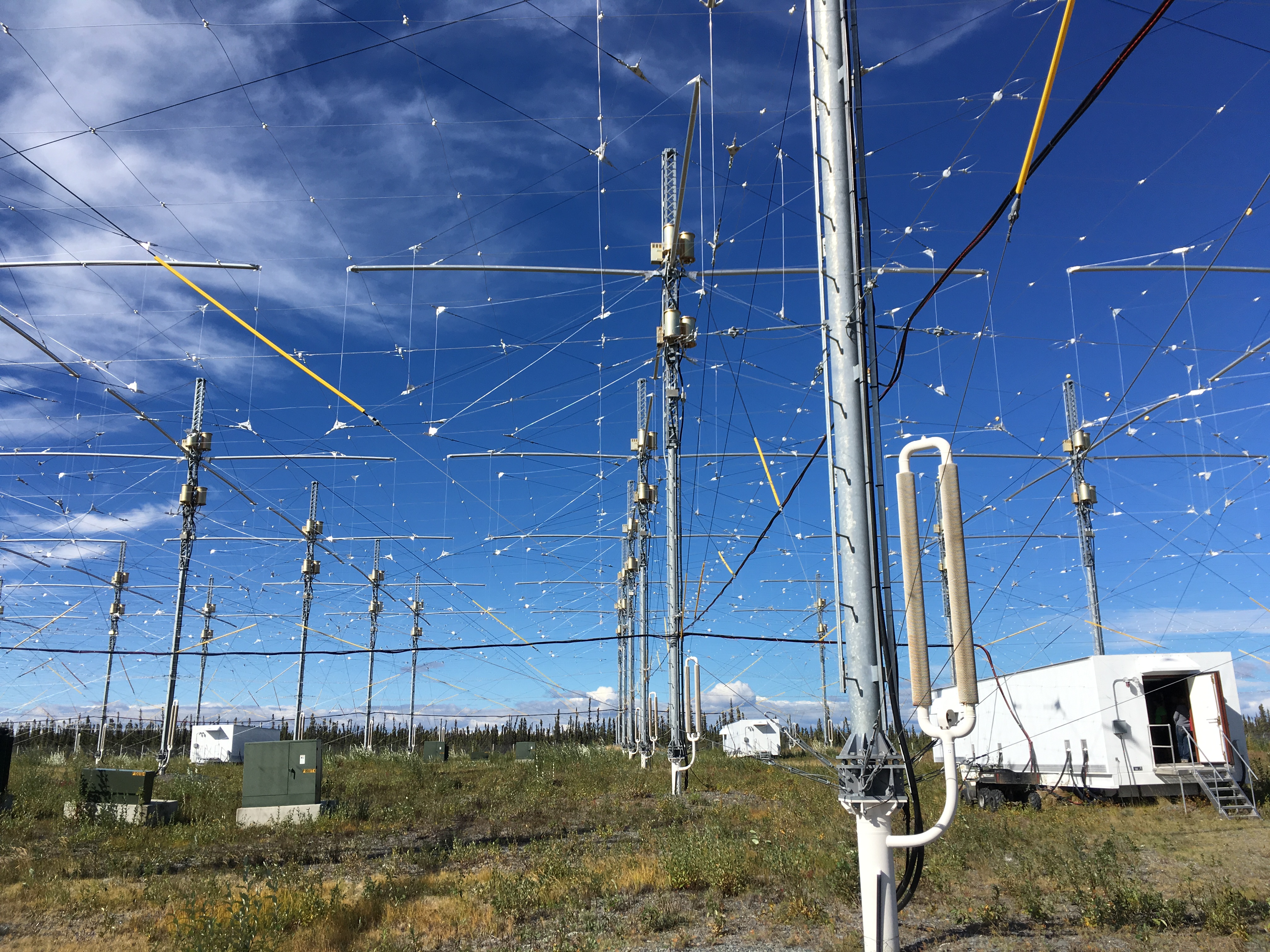
In this version, believers link the streaks to HAARP, a real research facility in Alaska. The sprayed metals, the story goes, were meant to amplify its electromagnetic effect and make the population „docile, sedated and controlled.” Aluminum as a sedative drip, delivered at cruising altitude.
What makes this variant so durable is its anchor in something true. There really was a state program for manipulating consciousness. It was called MKUltra, ran from 1953 to 1973 under the CIA chemist Sidney Gottlieb, experimented with LSD and other substances, and most of its files were destroyed in 1973. It came to light anyway, through the Church Committee and a Senate hearing in August 1977. That borrowed credibility is exactly the trick. The logic goes: they tried it once, so they’re still doing it, only now from the sky. That MKUltra targeted individuals in back rooms and never sprayed a country with aluminum mist gets lost in the echo. There is no evidence for airborne mass sedation. There’s only a destroyed archive, and destroyed files are to a conspiracy theory what gasoline is to a bonfire.
What the science says
For a long time, research ignored the topic the way you ignore a mosquito until it gets loud enough. Then, in 2016, the first proper study appeared. Christine Shearer and colleagues surveyed 77 experts, atmospheric chemists and geochemists, exactly the people who would be first to find traces of a global spraying program. 76 of them found nothing. The supposed evidence, they concluded, was explained by ordinary contrail formation and poor data collection.
Poor data collection is a polite phrase here. When believers report „elevated aluminum levels” in soil and water samples, they often collect them in a mason jar with a metal lid. One surveyed expert put it dryly: „I cannot imagine a worse protocol for collecting a sample. The data would be totally worthless.” On top of that, aluminum is the third most common element in the Earth’s crust. Finding it in the soil is about as surprising as finding sand at the beach.
In Germany the answer is just as clear. The Federal Environment Agency, backed by the national weather service, the aerospace center and air traffic control, states there is no evidence whatsoever, neither for sprayed chemicals nor for noticeably altered contrails. A 2024 report by the German Parliament’s research service neatly classifies the hypothesis as a conspiracy theory, and delivers, in passing, the finest punchline of the whole debate: according to the IPCC, contrails don’t cool the climate, they warm it, accounting for roughly 35 percent of aviation’s climate impact. A secret program meant to cool the planet would therefore have picked, of all things, the tool that heats it up.
That leaves the skeptics’ favorite argument: who’s supposed to keep all this secret? The physicist David Grimes did the math in 2016. His model, calibrated against real cases like the NSA surveillance that a single man named Snowden blew open after barely six years, shows that the more people are in on it, the faster a secret bursts. A worldwide spraying program would need tens of thousands of pilots, mechanics, fuelers and controllers over decades. It wouldn’t just have to poison the sky, it would also have to suspend human talkativeness. The latter is considerably harder.
The German thread
You might think this is an American problem, imported with late-night radio. But the theory took root in the German-speaking world early. The starting gun was an article in 2004 with the fittingly apocalyptic title „The Destruction of the Sky,” in the magazine „Raum & Zeit.”
The German scene really got a boost from a real incident. On January 14, 2009, the ZDF weather report showed strange parallel streaks on the radar image. For many, this was finally the proof. The federal government had to address the matter in a parliamentary inquiry and explained, in printed paper 16/12178, that it was chaff: military radar decoys made of aluminum-coated glass fibers, probably released over Dutch territory and carried into western Germany by high-altitude winds. The irony: there really was aluminum in the sky, just not poison aimed at the population, but training material that has, in principle, been banned over Germany since 1998. Sometimes the boring truth is almost as absurd as the conspiracy, only it’s verifiable.
Politically, the topic surfaced across the party spectrum, which is rarely a good sign. In 2007 the FPÖ questioned the Austrian agriculture ministry, followed by inquiries from the NPD in Mecklenburg-Vorpommern, a CDU member in Lower Saxony, and in 2023 the AfD in Saxony, there with the keyword population reduction attached. Each time the answers amounted to the same thing: no evidence. As alleged proof, the scene likes to point to a 1990 US patent on weather modification, the Welsbach patent, and to photos of supposed spray nozzles inside aircraft. A fact check with an aviation professor cleared that up too: what looks like a nozzle battery in the fuselage of an Airbus A320 is drain ports and pressure equalization. Not every opening in an aircraft is a weapon. Most of them are just hardware doing its job.
Why the theory won’t die
By rights, the matter should have been settled with fact sheets, agency statements and one clear study. It wasn’t. The theory’s heyday ran from 2010 to 2018, fueled by social media and by films like „What in the World Are They Spraying?”, which dressed the old poison narrative in a more modern geoengineering costume.
Then the pandemic arrived, and conspiracy theories grow in a crisis like mushrooms after rain. Chemtrails merged with 5G fears, anti-vaccine sentiment and Bill Gates narratives. When a cold snap knocked out the Texas power grid in February 2021, a Facebook post went viral that, in all seriousness, accused the US president of manipulating the weather via chemtrails. Studies from that period show the link soberly: people who got their information mainly from social media were more likely to believe such stories.
The bitter part is that real geoengineering research exists, and that it unwittingly plays into the theory’s hands. Harvard’s SCoPEx project set out to study how aerosols behave in the stratosphere, as a possible tool against global warming. It ran completely transparently, with its own oversight committee, and was shut down in March 2024 without a single open-air experiment ever taking place. It’s exactly this open, inconclusive research that gets reinterpreted in the forums as a confession. One analysis found that around 60 percent of the online debate about geoengineering tipped into the conspiratorial. Serious science thinking out loud about emergency brakes for climate change sounds, to a suspicious ear, a lot like a confession.
And so the topic is currently riding its next wave. High-reach voices like Tucker Carlson are picking it up again, and politicians like Robert F. Kennedy Jr. and Marjorie Taylor Greene are dragging it back onto the big stage. The theory is practically immortal because it doesn’t want to be falsifiable: if the sky shows no streaks, the sprayers are resting. If it shows some, they’re spraying. Both confirm the thesis. A claim that everything proves is a claim that nothing can disprove.
What’s left
I’ll admit a certain fondness for this topic, and not because I believe in the streaks, but because the story says so much about us. Chemtrails are, at their core, not a statement about the sky, but about the distrust on the ground. They demand remarkably little: a bit of skepticism toward authorities, which any healthy person should have, a brain that detects intent in random patterns, and an internet that instantly connects every suspicion with the like-minded.
What’s truly unsettling isn’t that people believe in sprayed mind control. It’s that the sober truth is often harder to bear than the conspiracy. Nobody is steering us with aluminum from six miles up. We’re steered far more cheaply, by an algorithm that knows which post makes us angry and shows it to us for exactly that reason. Real mind control doesn’t need an aircraft. It fits in your pocket, and we bought it ourselves.
So go ahead, look up again. That streak is water. The thing to worry about is the device you’ll use to upload a photo of it.