Step up to the rim for the first time and you catch your breath. A thousand feet below your feet lies a sheet of water that no photograph ever gets right. Not turquoise, not an ordinary lake blue, but a deep, saturated indigo that looks almost artificial. Visitors instinctively check their phones, convinced the camera is broken. It is not.
What strikes you most at Crater Lake in southern Oregon is the silence. No creek trickles in, no river rushes out. The water simply sits there, locked inside a bowl of volcanic rock whose rim climbs some 300 metres above the surface. This is no ordinary lake. It is the water-filled scar of a catastrophe that people watched with their own eyes. Four things define it: a mountain that swallowed itself, a legend that is really an eyewitness account, water of almost unreal purity, and a log that has refused to sink for more than a hundred years.
A Mountain That Swallowed Itself
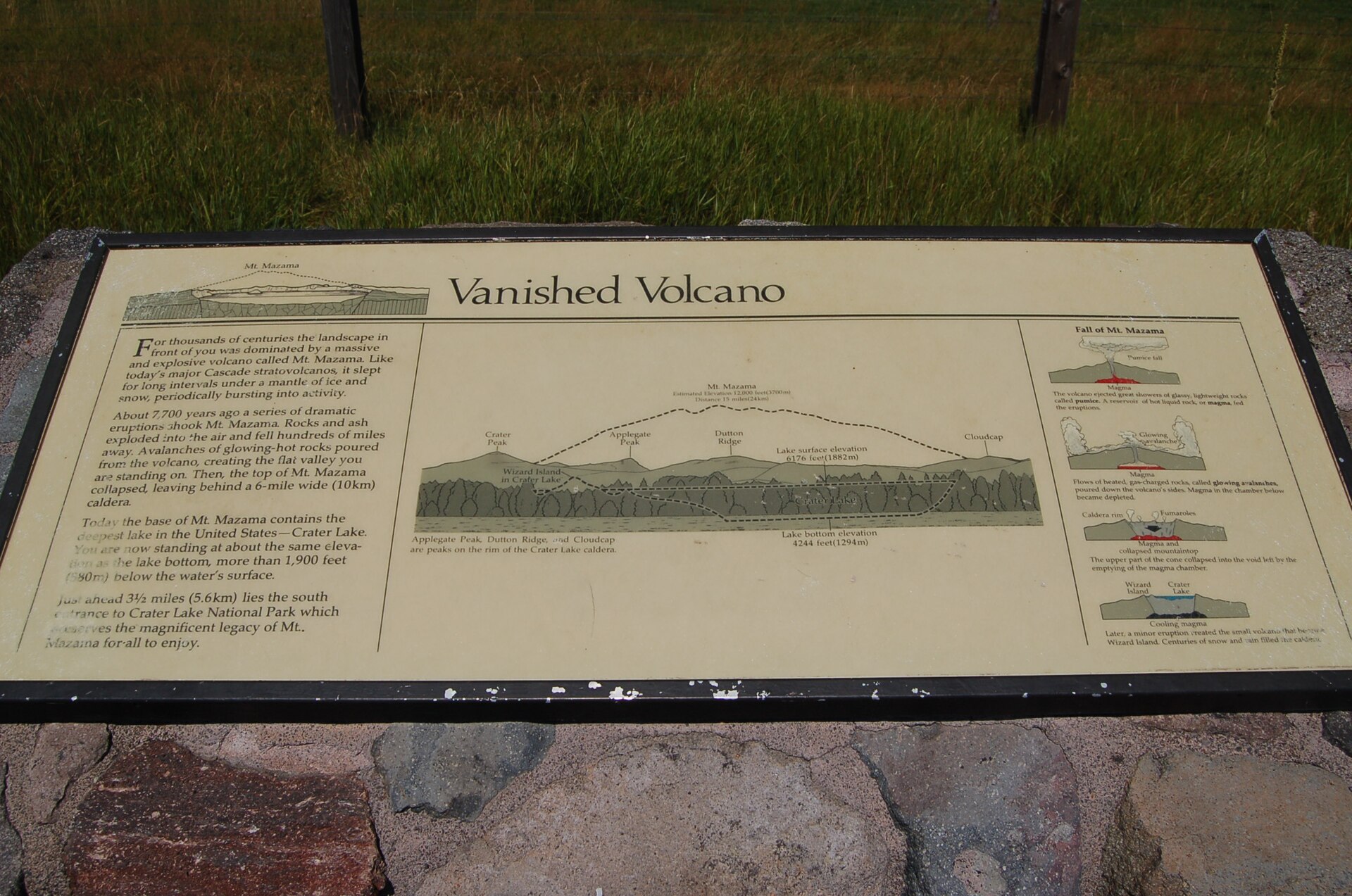
Around 7,700 years ago there was no lake here, but a volcano. Mount Mazama, a good 3,600 metres tall, a giant of the Cascade Range. Then it erupted, and not in any ordinary fashion. The mountain hurled out such vast quantities of ash and pumice that it emptied its own magma chamber. What was left could no longer carry the weight of the summit. Mazama collapsed in on itself.
What remained was a caldera, a huge collapse basin several kilometres wide. Geologists draw a clean distinction between this and a crater in the strict sense: a crater is blasted out, a caldera caves in. So the name Crater Lake is, strictly speaking, a small misnomer, but it is more than 150 years old and no one is going to change it now.
Over the following centuries the basin filled. Not from rivers, but from rain and snowmelt alone. Drop by drop, winter after winter, until a balance was reached between what fell from the sky and what evaporated and seeped away. From the wound of a dead mountain came the deepest body of water in the United States.
That a volcano once stood here is still felt in the water. Hydrothermal vents rise from the lake bed, confirmed in 1988 and 1989 when researchers pushed all the way to the bottom with a submersible. Mazama sleeps, but it is not dead.
Llao Against Skell, or: The Day the Sky Buried the Mountain
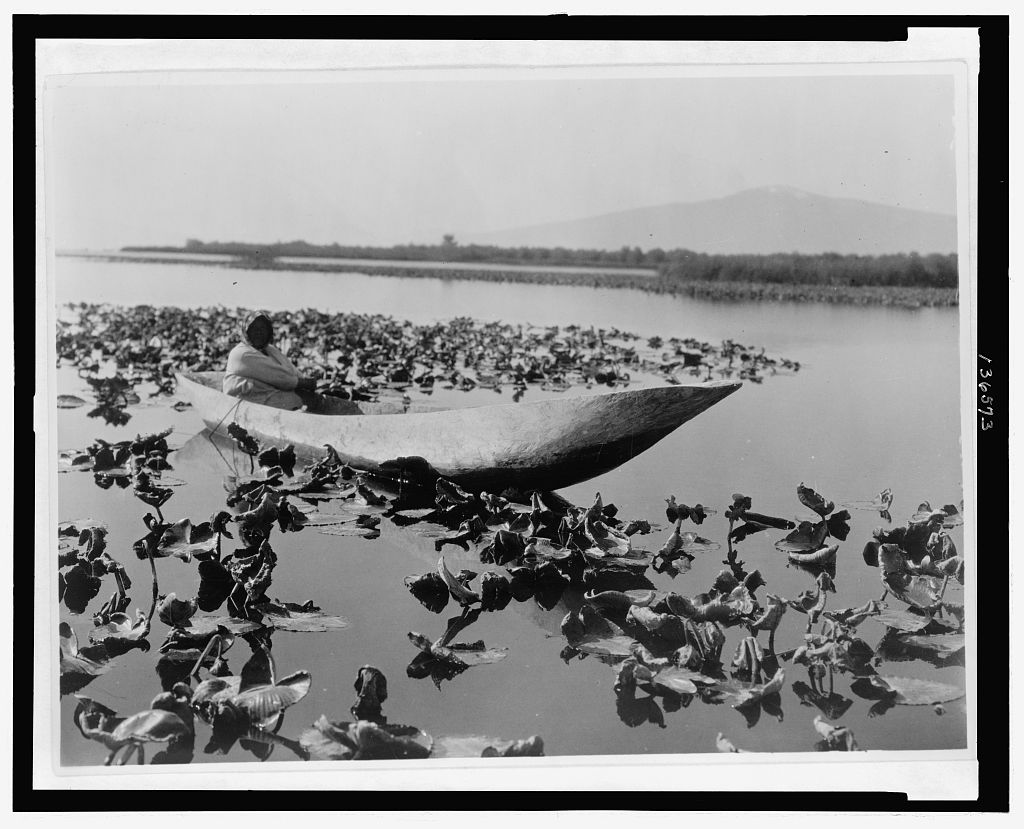
The most remarkable thing about the fall of Mount Mazama is that someone was there to see it. The ancestors of the Klamath, the Makalak people, had lived in the region for thousands of years. Archaeologists have found sandals and tools beneath the ash layers of the eruption, silent proof that people were here when the mountain came down.
Those people told of what they had seen. Over generations it became a legend. Llao, chief of the world below, dwelt inside the mountain. Skell, chief of the world above, stood on distant Mount Shasta. Llao fell in love with Loha, the chief’s daughter, and when she rejected him he swore to destroy her people with fire. The two spirits hurled red-hot rocks at one another, the earth shook, fire rained from the sky. Two medicine men threw themselves into the pit of fire to save their people. Skell, moved by their courage, drove Llao back into the mountain and brought the summit crashing down on top of him. Then he filled the dark hole with blue water, so that peace might settle over it.
You need not be a volcanologist to recognise the eruption in every line of this story. Researchers call this geomythology: a real geological event, preserved in the storytelling of a people. The legend of Llao and Skell is therefore one of the oldest surviving eyewitness descriptions of a volcanic eruption anywhere, passed down across nearly 8,000 years. For the Klamath the place remained sacred. Some refuse to this day even to look at the lake, because an old belief holds that the sight of it brings death.
The Clearest Blue in North America
Today Crater Lake is famous above all for one thing: its water. At roughly 592 metres, just under 1,943 feet, it is the deepest lake in the United States and one of the deepest in the world. Even the first survey in 1886 came close: the geologist Clarence Dutton, sounding with pipe and piano wire, measured a depth of 608 metres, a remarkably accurate estimate for the method of the day. Sonar confirmed 589 metres in 1959.
The real treasure is the clarity. Because no river carries in sediment or nutrients, hardly any algae grow to cloud the water. Researchers measure visibility with a Secchi disk, a white disk lowered until the eye loses it. At Crater Lake it typically vanishes only at 28 to 34 metres in summer. It is one of the clearest freshwater bodies on Earth.
From that purity comes the colour. Pure, deep water swallows the long wavelengths of light, the reds, oranges, yellows and much of the green. What remains is the short-wavelength blue, scattered back to the surface. The deeper and cleaner the water, the more complete this filtering effect. The eye sees a luminous indigo that is closer to human perception than to any camera sensor.
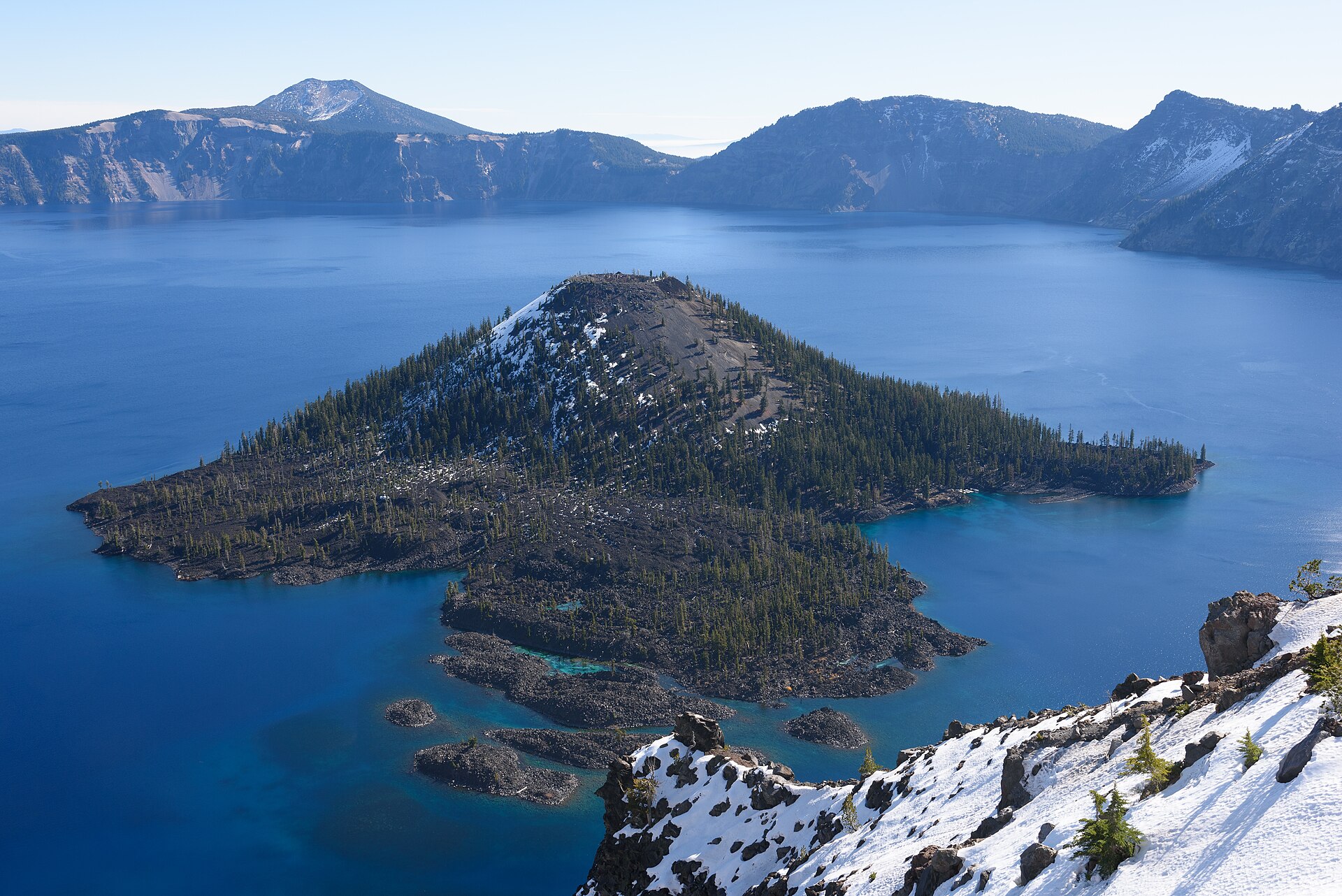
A second, younger volcanic cone rises from the water: Wizard Island, a cinder cone that built up inside the basin after the great collapse and today stands 234 metres above the lake. The purity is not quite flawless, mind you. Salmon and trout were introduced between 1888 and the 1940s, the one human intervention that science holds against the otherwise pristine lake.
The Old Man Who Will Not Go Under
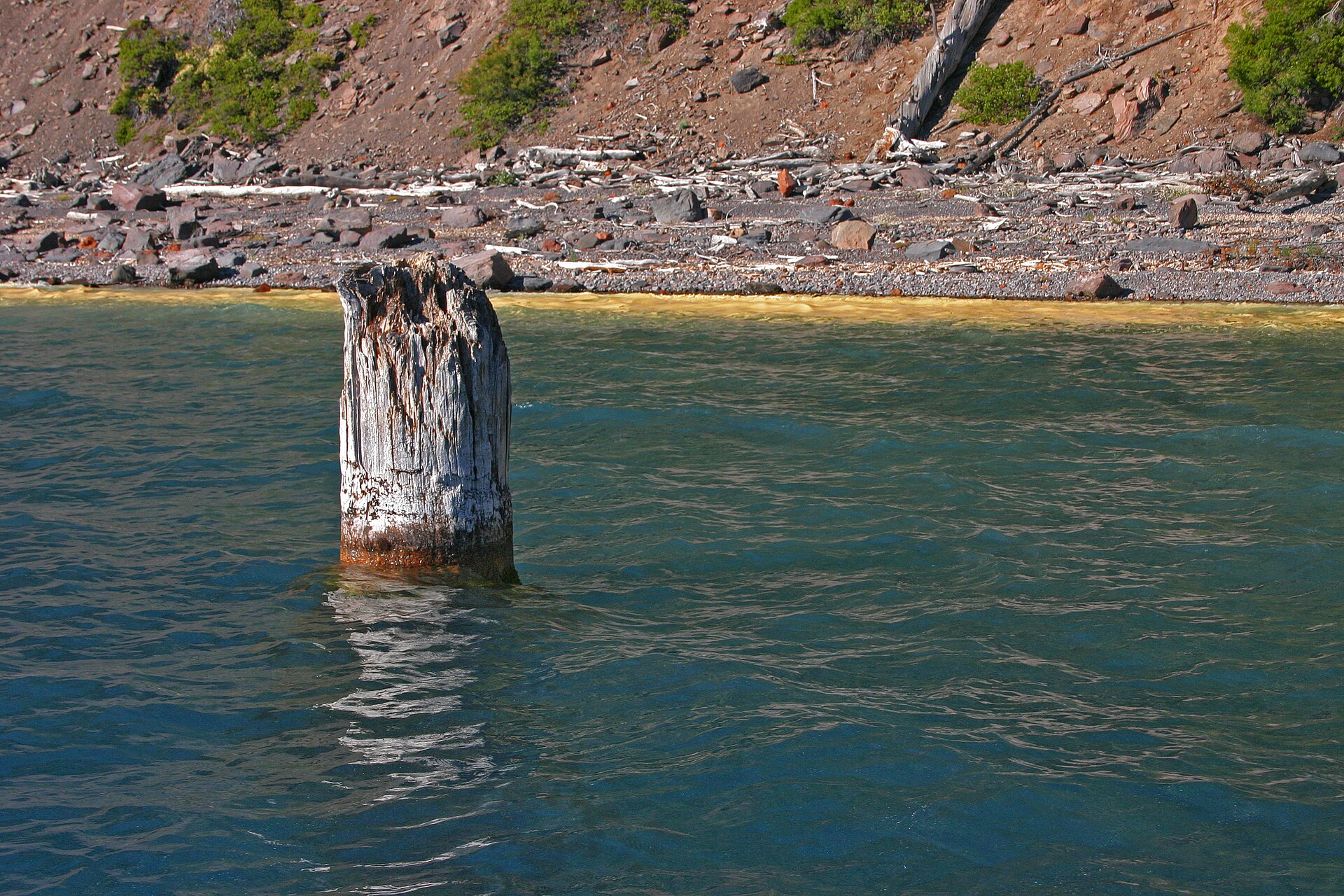
And then there is the old man. For more than a hundred years a mountain hemlock trunk has drifted upright through the lake, its upper end rising about 1.2 metres out of the water, the rest pointing down into the depths. They call it the Old Man of the Lake. The geologist Joseph Diller first noted it in 1896, and it has been part of the furniture ever since.
An upright floating log should not really exist. How it holds its pose is explained by a wick effect: the lower end has grown waterlogged and heavy over the decades in the cold water, while the upper end stays dry and light, so the trunk balances like a buoy. The icy, pure water has preserved it anyway. Radiocarbon dating showed the tree to be more than 450 years old.
The Old Man does not stay in one place. In 1938 the park naturalist John Doerr and ranger Wayne Kartchner tracked its wanderings for three months at the request of a federal inquiry. The result: 62.1 miles in a single summer, up to 3.8 miles on one day, at times against the wind. Doerr even used the trunk as an instrument to measure the wind currents inside the basin.
Stories cling to the old man. The best known dates from 1988. When the submersible team mentioned above moored the trunk as an obstacle, a storm reportedly rolled in at once, snow fell in August, and the expedition stalled. Only when the Old Man was set free again did the weather clear. Add to that the usual suspects of any remote place: reports of Bigfoot, of lights in the sky, of ghostly campfires on Wizard Island. There is no evidence for any of it, and the park rightly files it under lore, not fact. Aquatic biologist Scott Girdner sums the trunk up like this: “He has character, a story, and history that is part of the park.”
What Remains
Crater Lake is several things at once, and that is what makes it so peculiar. It is the grave of a mountain that wiped itself out 7,700 years ago. It is the sacred place of a people who witnessed that destruction and preserved it in a legend, long before geology had a word for it. It is a scientific marvel whose purity and depth have few equals. And it is a stage for a log that has defied the simple laws of physics for generations.
Perhaps that is exactly why the Klamath held it sacred and some would not look at it. A place where a mountain vanished and a lake rose out of nothing does not fit neatly into a single box. You stand at the rim, look down into that impossible blue, and understand for a moment why stories have been told here for 7,700 years.