Some places you know before you ever see them. The Urologist’s Villa was one of them. Anyone in Germany with even a passing interest in abandoned houses has crossed paths with it: that grand piano in the ocher room, that armchair in front of the bookshelf, that examination chair under the operating light. Photographed a thousand times, uploaded a thousand times, always the same three shots. This site has had a piece of mine about the house since 2017, and quite a bit of it was wrong.
On May 16, 2026, it burned down.
Twelve Minutes
We picked it up in 2017 on the way back from eastern Germany, after a week above and below ground. A stopover, nothing more. Saturday, September 9, a quarter past three in the afternoon, according to the metadata. Twelve minutes later I was back outside.
That was not the house’s fault.
The scene called her the urbex whore. It fits. She made the rounds of every group, every forum, every YouTube channel. At some point she was even on Google Maps, with a name, with a pin, for everyone. A location that, by the scene’s code, only gets passed along quietly sat on the map like a bakery.
When we walked in, three other groups were in the house. Three. People stood in each other’s shots, waited for the next guy to clear the room, and listened through the wall to somebody discussing exposure times. There was nothing to experience. There was only a list to work through.
And then there was the guy with the grand piano.
After we had finished our round, he started pushing the thing across the room. For a better photo. A grand piano weighs several hundred pounds, and that weight sits on three casters made for nudging it an inch at a time, not for shoving it across a floor I would not recommend to any adult wearing a backpack. Lateral force snaps doweled piano legs. He moved it anyway, because the light was off. Not the room, not thirty years of decay. The light.
I hope the shot turned out. Otherwise it would hardly have been worth dragging the last intact object in this house across the floor so it looks better in your feed.
One of the blogs says somebody carried a mummified dog through the house for a shot. I don’t know if that’s true. It just didn’t surprise me.
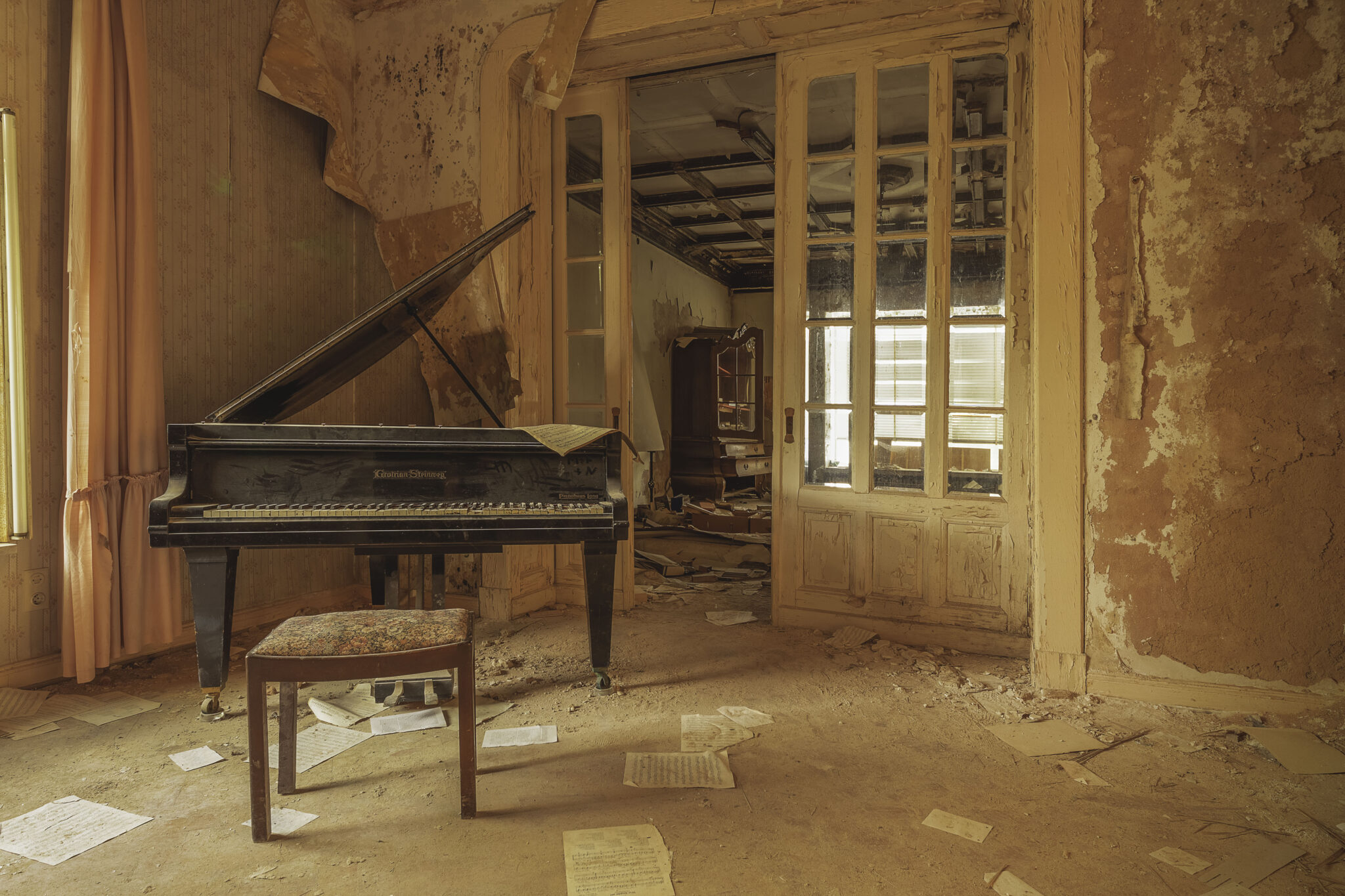
*September 9, 2017: lid open, stool in front, sheet music on the floor.*
It’s a grand, by the way. Not an upright. Piano is technically correct, it’s the umbrella term for both, and that’s exactly why it says nothing. The difference isn’t in the furniture, it’s in how the strings sit: horizontal in a grand, vertical in an upright. Anyone who photographs a place to death might be expected to know the difference.
The Staircase Lies
In February 2019 I went back. A Sunday afternoon in the middle of winter, half past one, and this time nobody else was in the house. That is the real oddity: on a Sunday at half past one, the crowd should have been there. It wasn’t. Even a place everyone knows has dead hours; they just don’t fall where you’d expect them. I had forty-five minutes, almost four times as long as the first visit, and only then did I actually see the house.
Starting with the staircase, and that’s where the first claim in circulation about this house falls apart. The story goes: a majestic staircase, Art Nouveau and Neoclassicism in harmonious combination.
That attribution does not describe a single element that was still there.
The marker isn’t the material, it’s the cross-section. A Gründerzeit railing, from Germany’s late-1800s boom years, is curved too and made of metal too, but it consists of solid, symmetrical, ornamentally cast balusters. What stood here was thin round-bar steel in an asymmetrical sweep. Add a glass-block window and red floral wallpaper hanging off the wall in long strips. The same picture throughout the house: wood paneling in the bedroom, wingback chairs, a canopy, brass chandeliers. There’s a German term for all of it, and it is not flattering: Gelsenkirchener Barock, the mock label for postwar faux-period pomp.
The building itself may well be old. After the fire, hessenschau, the regional public broadcaster’s news show, called it a Gründerzeit villa, and there’s no contradiction in that. A Gründerzeit shell with a Wirtschaftswunder interior, furniture from West Germany’s postwar boom, is the default state of any old house that stayed lived-in. What’s debunked is not the building. What’s debunked is what the scene says about the rooms.
I retold it wrong myself for years. You walk through a house, your head is on the tripod, and the rest you take from whatever you read beforehand.
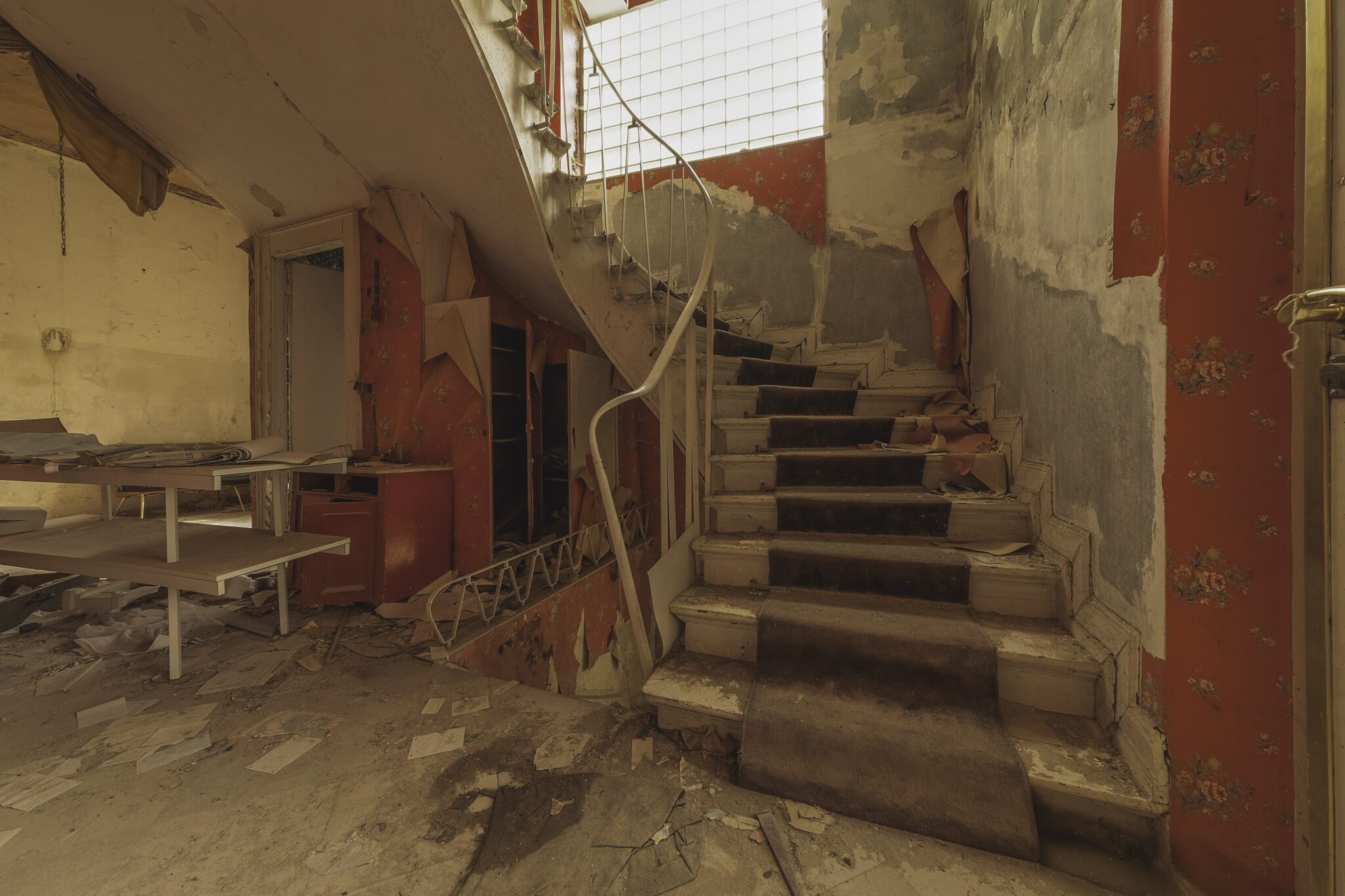
*September 9, 2017: thin round-bar steel instead of cast balusters. That is not the turn of the century.*
The library smelled of wet paper. That’s not a figure of speech, that’s the smell: books that have soaked up moisture swell, the pages ripple, and then it tips into something sweetish. The shelves ran to the ceiling, some of the books lay on the floor, the bottom rows were soaked through. In front of them, the armchair. If you’ve seen one photo from this house in the past ten years, it was probably this armchair.
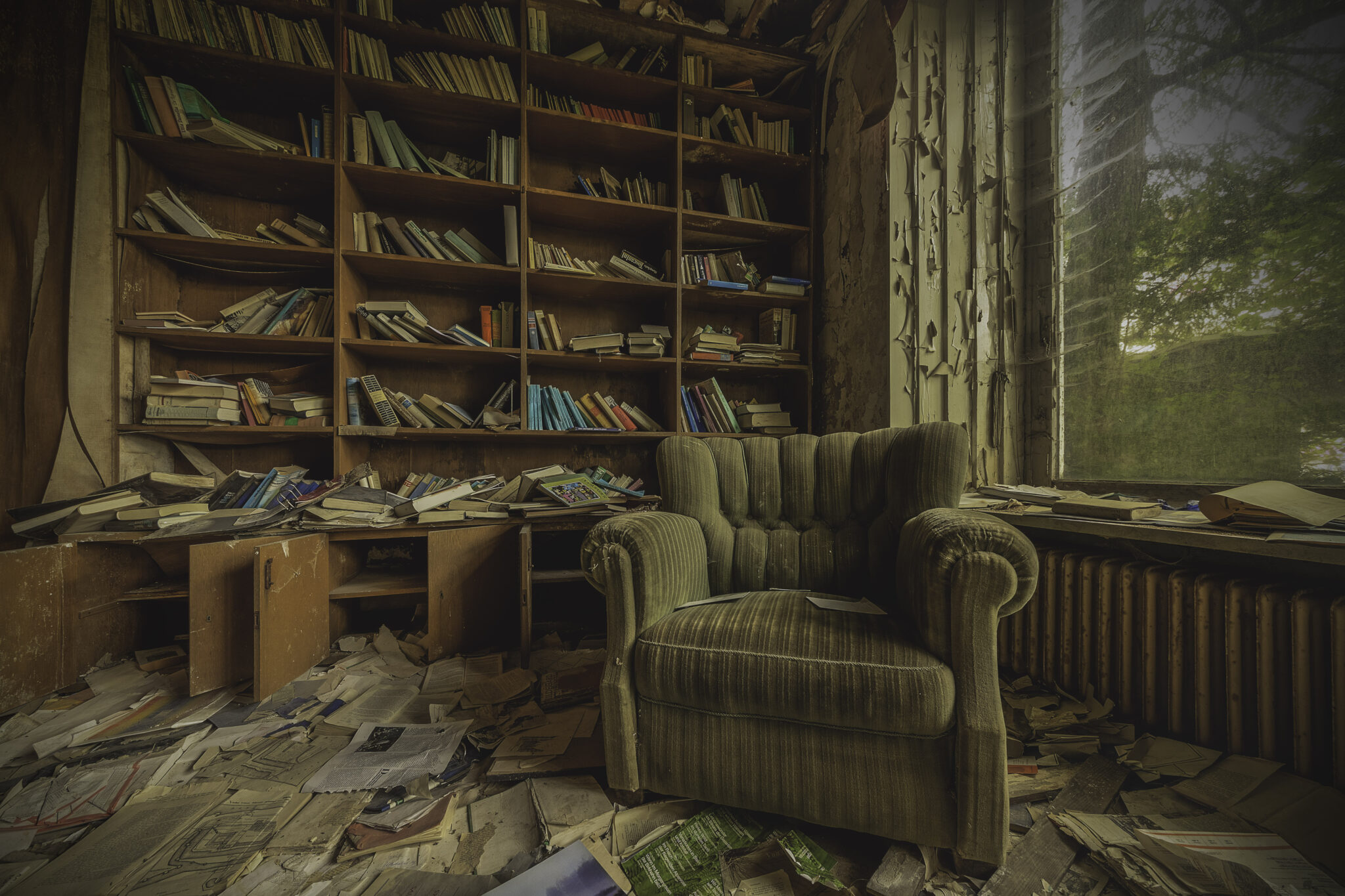
*September 9, 2017: the most famous armchair in the German urbex scene.*
Two Doors Down from the Grand Piano
Behind a door with a frosted glass pane, the living quarters ended and the practice began. You notice it in the temperature. Tiled rooms with north-facing windows are cold even in summer, and in February the chill comes up through your soles.
The rusted operating table that shows up in every other caption does not exist. It isn’t a table, it’s a chair: an examination chair with stirrups and a basin underneath. And it used to be enameled. Frame, joints and crank have rusted through; only the seat still holds. The vinyl on it is hard and cold and doesn’t give a fraction of an inch under your finger. It smells of old rubber and dust.
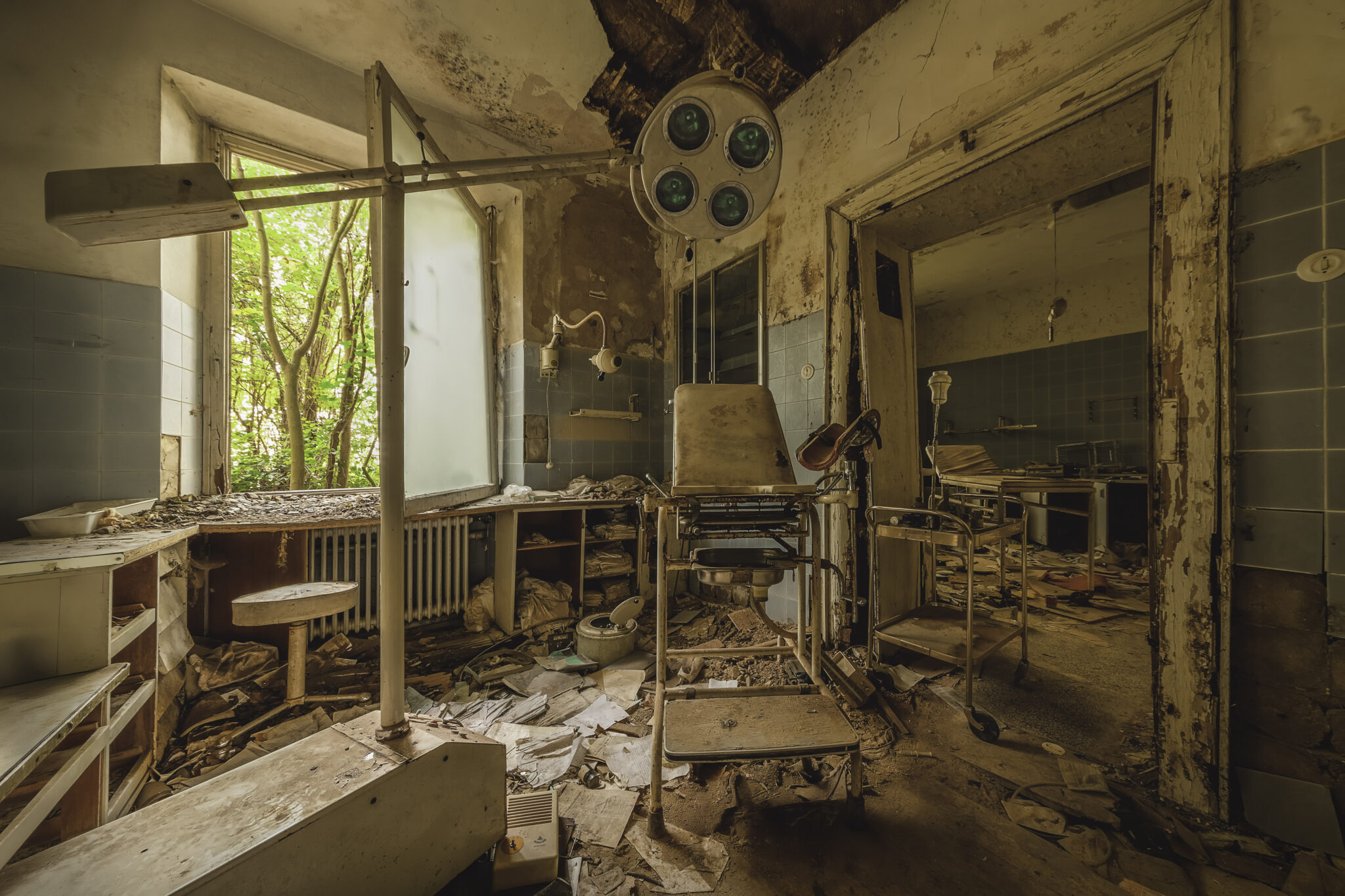
*September 9, 2017: examination chair with stirrups, the four-lamp light above it.*
What stood next to it, I misnamed for years myself. The cart is not a privacy screen but a two-tier instrument cart. And the stand in the next room, which I took for an IV pole, holds a glass vessel in a wire basket: an irrigator, for flushing. That’s better evidence than the chair, because gynecologists use examination chairs with stirrups too. The irrigator, the four-lamp light and the plumbed-in sluice sink together add up to a practice where things were flushed and instruments were used. Which specialty, the chair doesn’t say. hessenschau does.
Next door, the actual treatment room, tiled green up to shoulder height, a padded examination couch. And everywhere, in both rooms, on the floor: files. Patient records, index cards, prescriptions, photographs mixed in.
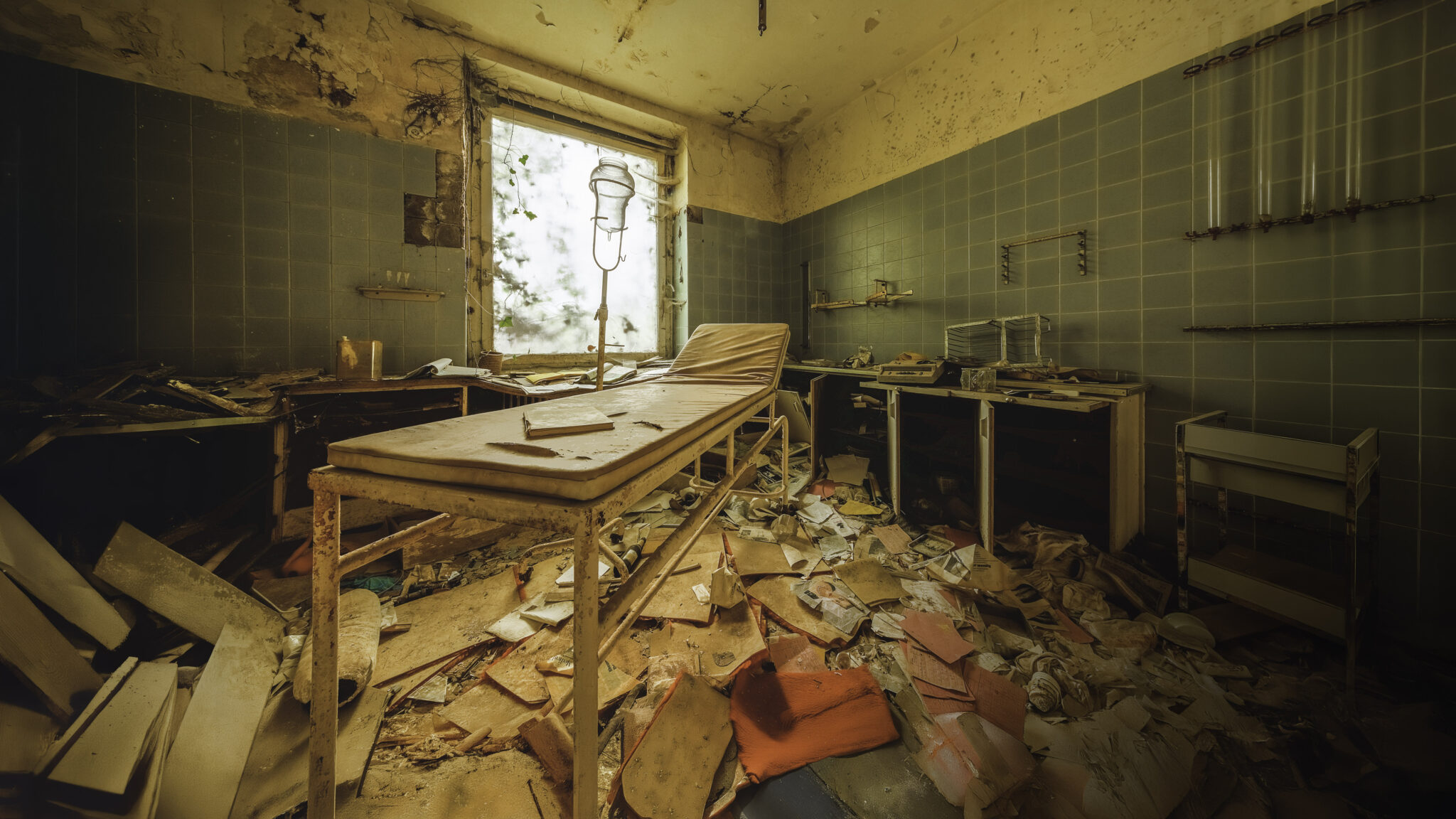
*September 9, 2017: the irrigator by the window, the files on the floor.*
That is exactly what sets this house apart from other abandoned homes. In a farmhouse like Maison Limmi, what’s left at the end is china in the cupboard and a bed in the room. Here stood a device people were examined on, two doors down from the grand piano the same family played.
Upstairs, the bedroom. A double bed under a fabric canopy, wood paneling on the wall, a chandelier. And feathers. Not a few feathers, a carpet of feathers, wall to wall, ankle-deep in the corners. Somebody slit the beds open, and it wasn’t the passage of time, it was somebody with a knife. You don’t move through that quietly. Feathers rustle under your soles, and every step puts more dust into the air that then sits in your nose for a while. Above the bed, somebody else sprayed “I ♥ U” onto the fabric.
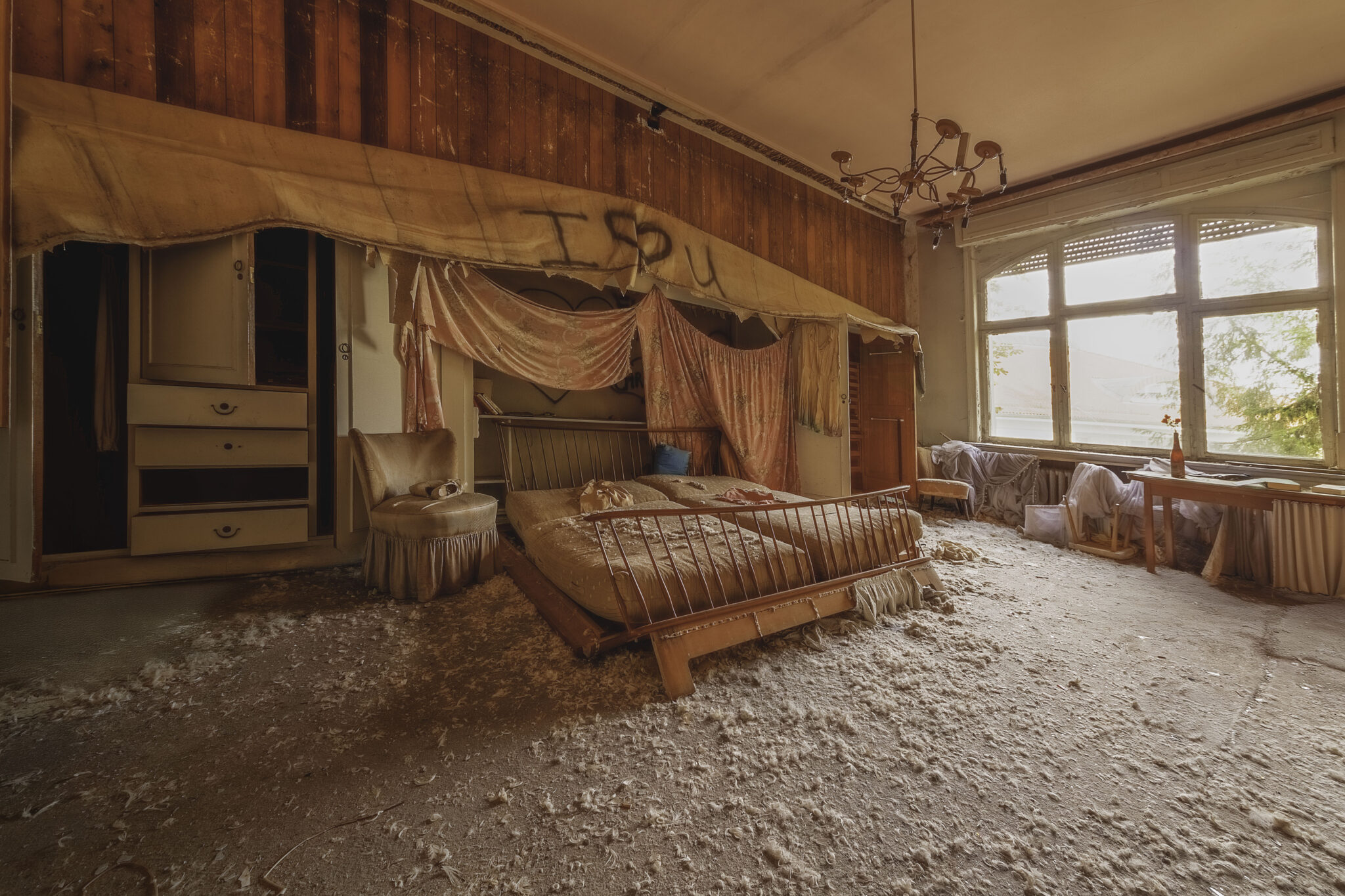
*September 9, 2017: somebody slit the beds open.*
Back downstairs, I took a closer look at the grand. The fallboard says Grotrian-Steinweg in Fraktur, the old German blackletter, and next to it, smaller, a dealer’s name: Pianohaus Lang. Grotrian-Steinweg is an old-line maker from Braunschweig. There was and is a Pianohaus Lang in Munich, Nuremberg and a few other cities, none in Northern Hesse. What that means, I don’t know: secondhand dealers add their decal after the fact too.
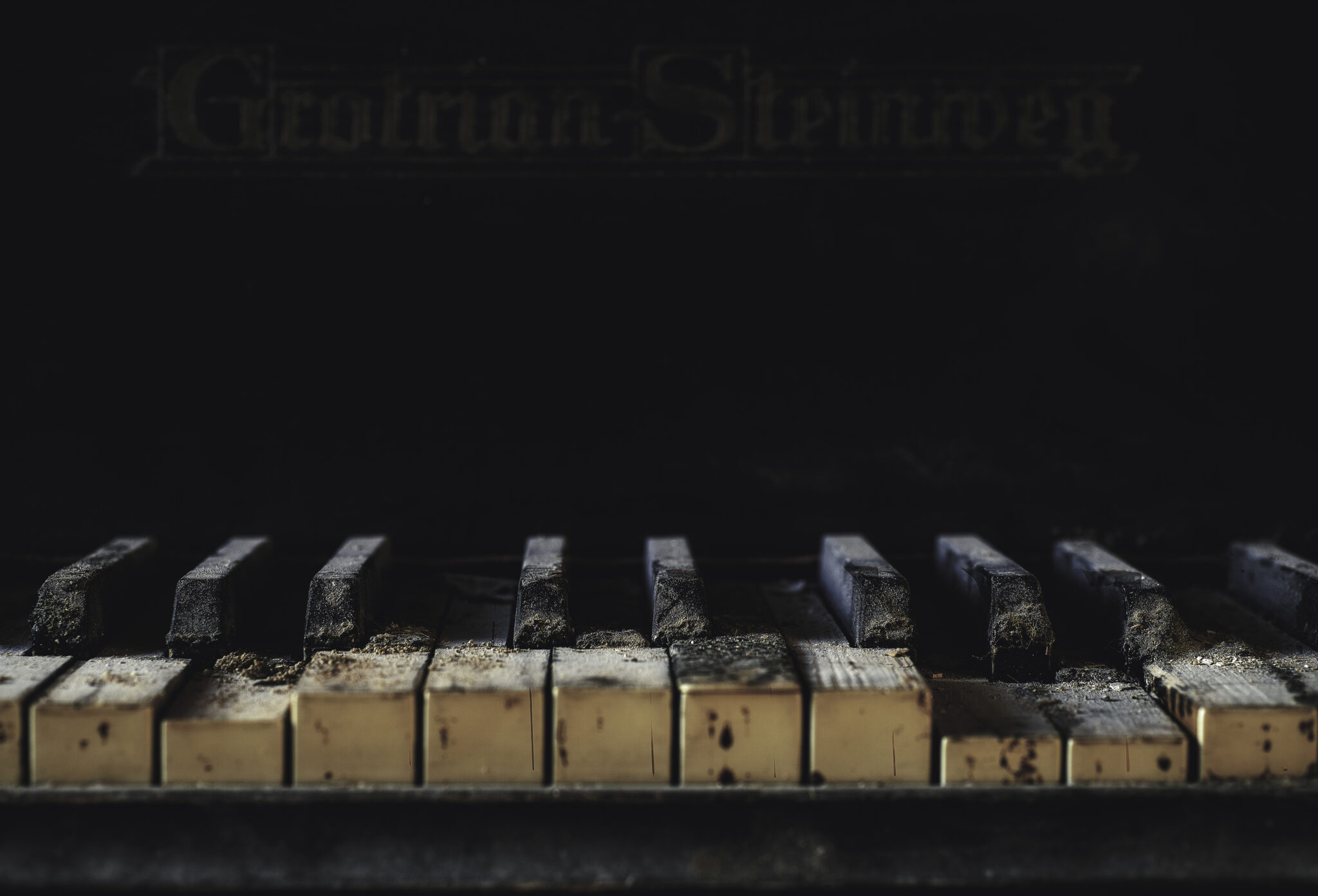
*February 17, 2019: the lettering on the fallboard. The serial number sat under the lid.*
What I did not photograph is the serial number. On a grand it’s stamped into the cast-iron plate, under the open lid, and with it you could have dated the instrument to the exact year. Grotrian keeps a public list for that to this day. The lid stood open. I didn’t think of it. One clue remains: the company only started using the hyphenated spelling around 1920; before that, a comma sat between the names.
The Story Everyone Tells
A bundle of stories has been circulating about this house for years. The doctor died, his wife went into a nursing home, the house has stood empty ever since. The heirs renounced the estate because the family was buried in debt. The daughter killed herself in the villa. The couple was divorced. In the uglier corners of the internet, the whole thing goes by Horror Villa or Dr. Pain’s villa.
One of these stories can be put away without a single source, using the German Civil Code. Had the heirs renounced, the estate would, a few steps down the line, have fallen to the state. Then there would be exactly one decision-maker, and a house with exactly one decision-maker does not sit empty for thirty years. That it did is the proof that nobody renounced. On May 16, 2026, hessenschau reported that the property, about a fifth of an acre, belongs to a group of co-owners. That fits: under German law, a community of heirs has to decide unanimously, and one person is enough to block. And the partition auction that any co-heir could have requested at any time stood open for thirty years and was never taken. That is not incompetence. That is indifference.
The rest is settled not by a legal provision but by two people who at some point actually looked into it. Not with a camera, with the papers lying in the house. These are two blogs, not official records, and I can verify none of it. What speaks for them is not that they agree, it’s that they name evidence you could theoretically check: an invitation to a silver wedding anniversary, a gravestone, bank statements. Which the legend never did.
According to that research, the daughter who supposedly killed herself is alive. The couple, it says, was never divorced; the divorce papers making the rounds belonged to one of the sons. And the story of the wife in the nursing home, the one everyone retells by now, doesn’t belong to this house at all but to the villa next door. I can prove not one of these sentences. I’m writing them down anyway, because a legend nobody contradicts gets harder with every retelling.
And this is where it gets uncomfortable.
For years, the nursing home story existed in exactly one place: the scene. In May 2026 it appeared on hessenschau. Where it came from, the report doesn’t say. I never asked the newsroom, so I don’t know whether it was researched or picked up. I only know it was never substantiated anywhere before, and now it sits in a public broadcaster’s report.
That made it quotable. I took two sentences from that same report myself; they’re further up this page: that the building is a Gründerzeit villa, and that the house was still furnished when it burned. Both are probably true. That is exactly the point. The mechanism doesn’t ask whether a sentence is true. It asks whether it can be retrieved.
The name itself is invented too. There never was an Anna L. Code names are standard in the scene; I use one myself on this site: Villa Woodstock isn’t called that because anyone there was named Woodstock. Only my reason is protection, and with this house, according to the research that wrote the code name down, it was the opposite: the real family name was held back so the location could be sold to other lost-place visitors. If that’s true, it’s the same tool put to the reverse purpose. And by now the invented name has picked up an invented doctorate. A woman who never existed, with a title she never had, in a house where her husband practiced. The address of this article carries it too, by the way. The German original’s has since 2017.
May 16
In the early hours of Saturday, May 16, 2026, at 1:26 a.m., the alarm came in. When the fire department arrived, the roof was fully involved. Some sixty firefighters, a drone with a thermal camera, and a defensive line to keep the fire off the landmarked villa next door. It didn’t spread. Nobody was hurt; nobody was in the building. That’s what the fire-service magazine 112-Magazin wrote the same day.
By the end, the basement sat under firefighting foam. So the fire made the whole trip from top to bottom, through three floors, and for that it needed material. It had it. I inventoried it myself two sections ago without noticing: floor-to-ceiling shelves full of books, files covering the floors, wood paneling, a fabric canopy, carpet runners in the staircase, ankle-deep feathers. That’s not an interior. That’s a fire-load inventory.
Two days later, hessenschau reported: arson. Whether deliberate or negligent was left open. No leads on a perpetrator. Both upper floors burned out, the roof open to the sky, the building would have to be demolished.
That “open” is worth more than it looks. Had accelerants been found, or multiple points of origin, it wouldn’t say “open”, it would say “deliberate”. Which makes the most likely case in an empty, unsecured house frequented by photographers not the arsonist with intent. It’s the tossed cigarette.
The villa wasn’t alone in this. Between May 16 and 20, four lost places burned in Hesse. Police looked into a connection; a spokesman told the public broadcaster Hessischer Rundfunk he considered it unlikely because the sites are far apart. That is not a good argument. Cases get linked by method, not by distance, and there is a connection that needs no serial arsonist: copycat fires after prominent coverage are a documented mechanism. Four fires in five days, after the FAZ, one of Germany’s national dailies, and hessenschau had reported on the first.
Since then, silence. The timestamp on the hessenschau piece hasn’t moved since May 19; the scene documentation that tracked this place most closely, not since the 18th. What sits behind the regional press’s paywalls, I haven’t seen. As of mid-July 2026, it is not publicly known whether the ruin has been demolished, and the investigation has made no reported progress.
The grand was inside when it burned. Spruce, felt, steel strings, and at the center a cast-iron plate, 150 to 330 pounds. Cast iron melts at around 2,100 degrees Fahrenheit. A room fire tops out at 1,500 to 1,800. The piano is gone, no way around that, but it wasn’t the fire that took it apart. It was the roof falling on it from three levels up, and nine hours of hose water after that.
That is why the serial number isn’t gone. It’s stamped into a plate that survived, and it now lies under the rubble of a house nobody demolishes because nobody agrees. It didn’t burn. It’s buried, for the same reason the house spent thirty years rotting.
What Remains
Two houses stand there side by side, in the same landmarked ensemble. One is restored. The other is the burned-out shell.
Heritage protection was never the lever many people take it for. An ensemble listing protects the outward appearance, and the duty to maintain comes with a reasonableness proviso. Not a single clause likely ever applied to the piano, the paneling or the examination chair. The lever would have been the building authority’s power to order the site secured. Except a cost order from the building authority lands on the same co-owners who couldn’t agree for thirty years. The Schachtrupp Villa also stood empty for decades while people talked about it. Houses rarely decay spectacularly. They decay because nobody decides, and often because too many would have to decide at once.
I have twenty-two pictures of this house. That’s all there will ever be.


The villa didn’t die of decay. Decay would have carried her another thirty years. She died of a chain that started with an inheritance dispute, ran through a pin on a map, dragged through a few thousand uploads and ended one night in May with someone dropping something. Every link in that chain was harmless on its own. I was one of them, for twelve minutes, camera in hand.
What stays with me most, though, isn’t the piano. It’s the files. Under German law, doctor-patient confidentiality doesn’t end with the doctor’s death; it passes to the heirs. For thirty years, the medical histories of strangers lay in an open house that somebody walked through every weekend, photographing and uploading. The three people who couldn’t agree on a sale were, for that same stretch, responsible for a standing violation nobody ever reported. No curse, no Dr. Pain. Just a duty nobody carried out.
The fire took care of the one thing nobody had taken care of in thirty years.
Leave things where they stand. And if you find paper with strangers’ names in a house like this, don’t photograph it.
A story has since come out of this house. The grand piano on the first floor is at its centre: Strains of Eternity.