On April 1, 2004, the BBC reported that nuclear physicists at Aldermaston, home of Britain’s atomic weapons establishment, had proposed in 1957 to keep a nuclear landmine warm with live chickens. According to the Associated Press (AP), The Times ran the story on its front page and asked the obvious question itself: “Is today the day to reveal the chicken-powered nuke?” Professor Peter Hennessy, curator of an exhibition at Britain’s National Archives, told the paper, as the BBC reported: “It is not an April Fool. These documents come straight from the archives at Aldermaston. Why and how would we forge them?”
Since then, the story has been retold as the “chicken nuke” or the “chicken-powered nuclear bomb,” most recently in short videos. It usually includes another claim: that the National Archives declassified the project on April 1, 2004, of all days.
The short answer to whether it is true is that the mine was real. It was called Blue Peacock, development began in 1954, and the British Army was to bury it in West Germany in the event of war. The project was canceled in February 1958. Chickens do appear in a 1957 report, as a suggestion mentioned in passing, but there is no evidence that anyone tried it. Only that suggestion became public on April 1, 2004. The project itself had appeared in newspapers since July 2003.
Quotations from German sources are my own translations. English sources are quoted in their original wording, file and article titles as published.
What was Blue Peacock?
Blue Peacock was a British nuclear landmine. Soldiers were to dig it in at the site, place it on the surface or sink it in water. It was not designed to be dropped. Specialists call this kind of weapon atomic demolition munitions. According to New Scientist, Blue Peacock belonged to a secret British Army program with that very name.
Development started in 1954 at the Armament Research and Development Establishment at Fort Halstead in Kent, a government research station for weapons technology. According to the Guardian, the War Office set out its first requirements for a nuclear mine late in 1954. Blue Peacock drew on the technology of Blue Danube, a free-fall bomb weighing several tons that was already in service with the Royal Air Force. New Scientist describes its design briefly: a plutonium core sat inside a sphere of high explosive, all enclosed in steel. The mine weighed more than seven tons, considerably more than the bomb from which it was derived.
A paper by the Engineer-in-Chief, the Army’s senior engineer officer, explains its purpose. He wrote it a year after the first requirements. The Guardian quoted from it: “A skilfully sited atomic mine would not only destroy facilities and installations over a large area, but would deny occupation of the area to an enemy for an appreciable time due to contamination.” The paper names irrigation and hydroelectric systems, industrial plants, oil refineries, railway junctions and canals as suitable targets.
So the contamination was not a side effect. It was part of the plan. Lesley Wright, who was researching the history of Britain’s nuclear weapons programs at Liverpool John Moores University at the time, put the mine in context for New Scientist in 2003: “It may look bizarre now, but this weapon was a product of its time.” It was, Wright said, a response to the perceived overwhelming Soviet superiority in conventional weapons.
The record does not say exactly where the mines were to be placed. Reports from 2003 name Germany and the British Army of the Rhine, Britain’s forces in West Germany, which was to lay the mines if an attack seemed imminent. According to the BBC and AP, the mines were to be detonated if British troops had to retreat before the Red Army.
| Feature | Detail | Source |
|---|---|---|
| Development | from 1954 at Fort Halstead (Kent) | New Scientist, Guardian (2003) |
| Basis | technology of the Blue Danube free-fall bomb | New Scientist (2003), AP (2004) |
| Design | plutonium core inside a sphere of high explosive, steel casing | New Scientist (2003), AP (2004) |
| Yield | about 10 kilotons, roughly half the Nagasaki bomb | New Scientist (2003) |
| Weight | more than seven tons; AP gives 16,000 pounds, or 7,250 kilograms | New Scientist, Guardian (2003); AP (2004) |
| Firing | by wire from up to five kilometers away or by a clockwork timer with an eight-day run | New Scientist, Guardian (2003) |
| Anti-handling | pressure system and tilt switch; detonation ten seconds after the mine was moved, the casing was shot through or water got in | SPIEGEL, Guardian (2003) |
| Order | ten units in July 1957, to be stationed with the British Army of the Rhine | New Scientist, Guardian (2003), AP (2004) |
| Built | two prototypes, components tested without nuclear fission | New Scientist (2003) |
| Canceled | February 1958 | New Scientist, Guardian (2003) |
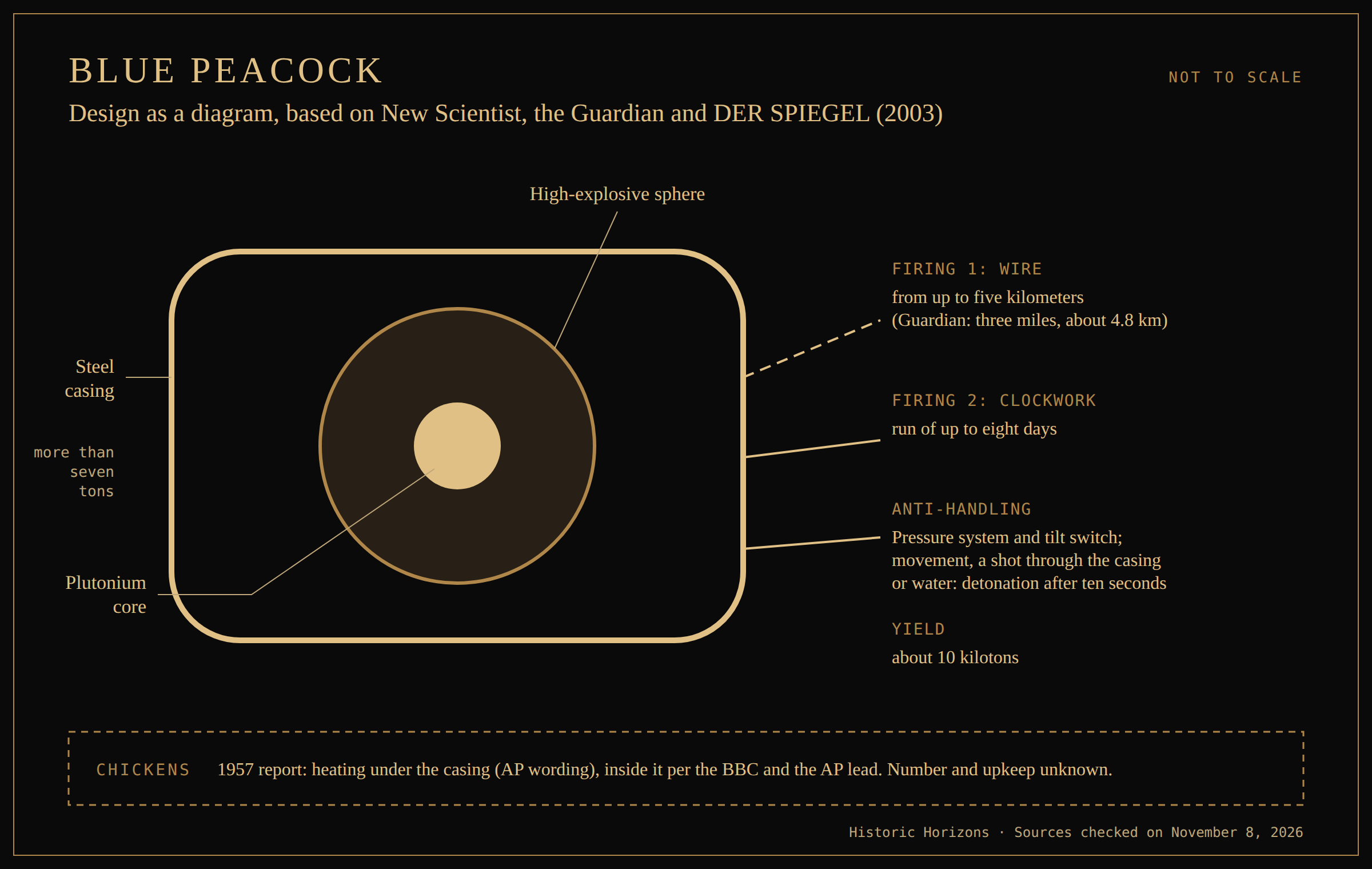
Blue Peacock as a diagram, not to scale. Only the labeled elements are documented, based on New Scientist, the Guardian and DER SPIEGEL (2003). My own graphic.
The steel casing was so large that it had to be tested outdoors, in a flooded gravel pit near Sevenoaks in Kent. And for anyone who asked questions, the Army had a story ready, according to the Guardian: the first line was that an insulated container was being tested. If a nuclear link was suspected, the casing was to house “an atomic power unit for troops in the field.” The English Wikipedia attaches the same cover story to the 1957 order.
Why chickens? The cold problem
The reports from 2003 already describe a problem with cold weather: the mines might fail in winter if their temperature dropped too far. The National Archives catalog lists a “climatic trial report” on Blue Peacock, dated October 1957, under reference ES 12/525. The file has not been digitized, so its contents cannot be read online. AP quoted an article in the atomic weapons establishment’s own magazine that described the problem this way: “The nuclear warhead had to be kept within a specific temperature range, but environmental trials suggested it might not have survived the rigors of a mid-European winter.”
In July 2003, New Scientist and the Guardian described the fix as fiberglass pillows to be wrapped around the mines. Neither report mentioned chickens. According to AP, the magazine article did not mention them either.
The chicken reports of April 2004
Chickens first appeared in press reports on April 1, 2004. AP gave the fullest account. According to the agency, the National Archives had released a secret Ministry of Defence report from 1957. The report lists ways to extend the mine’s armed life. One suggestion was “incorporating some form of heating independent of power supplies under the weapon hull in the emplacement. Chickens, with a heat output of the order of 1,000 BTU per bird per day are a possibility.” BTU means British thermal unit, an old measure of heat energy. 1,000 BTU is about 1.06 megajoules. Over a day, that works out to roughly 12 watts of continuous output per chicken.
The accounts differ on where the birds were meant to go. In its third paragraph, AP summed up the proposal as scientists contemplating putting chickens inside the casing of the mine. The BBC also wrote of birds inside the casing. They were to be given seed and stopped from pecking at the wiring, so that the bomb would still work after a week underground. The wording AP quoted, on the other hand, speaks of heating under the weapon hull in the emplacement. The BBC does not say where its additional details came from. It refers explicitly to The Times only for the quotes from Hennessy and a member of the National Archives staff.
People also disagreed in 2004 about how serious the idea was. The BBC said in its first sentence that the plans had been “seriously considered” during the Cold War. Tom O’Leary, head of education and interpretation at the National Archives, told AP that the idea received only a brief mention in a long document: “It’s purely a suggestion in an official document that that is a possibility that was proposed.” He said there was no indication that anyone tested whether it would work. Andy Oppenheimer, co-editor of the specialist publication Jane’s World Armies, still struggled to believe the chicken story when AP asked him: “I have a feeling that it’s an April Fool.” In his view, wrapping the device in fiberglass would have been better.
No source gives a planned number of birds, explains how they would have been fed for a week or says how they would have received air in a buried emplacement. Air would have been an even greater problem inside the casing. DER SPIEGEL described a pressure system in 2003 that protected the mine against tampering, and such a casing must be airtight.
Why was Blue Peacock canceled?
In July 1957, the Army Council decided to order ten mines and station them with the British Army of the Rhine. According to the Guardian, the design was almost finished by October. Then the reservations set in: the weapon was too large and too heavy, and its radioactive fallout was considered unacceptable. Keeping a nuclear weapon ready in an allied country in advance was seen as politically flawed. And in peacetime, the mine could not be stored where it would have been needed in war.
The Ministry of Defence’s Weapons Policy Committee decided in February 1958 to end work on Blue Peacock. Citing the historian David Hawkings, DER SPIEGEL gave another reason in 2003: smaller, lighter warheads were already under development by then.
The sources give slightly different sequences. DER SPIEGEL wrote in 2003 that Army headquarters canceled the July 1957 order only three months later, in the autumn of 1957. Atomwaffen A-Z and the German Wikipedia give the same account. The Guardian places the reservations in October 1957 and the decision in February 1958. Both accounts could be right if the order was first put on hold and the project formally ended later. The sources do not say whether that happened.
Who told what, and when?
The publication sequence is straightforward. Two dates are still uncertain: when the files were declassified and when Hawkings’ article was published.
It begins with an article in Discovery, the in-house journal of the Atomic Weapons Establishment at Aldermaston. Hawkings had worked there. The publication date is not clear. In its list of sources, Atomwaffen A-Z gives the title “Blue Peacock, the British Army’s forgotten weapon” with the date October 14, 2002, and the German Wikipedia links to a copy of the article under the same date. In July 2003, New Scientist referred to the “latest edition,” and in April 2004 AP referred to an article in the establishment’s magazine “in January.” The German Wikipedia gives 2002 as the year the project became known. I could not read the article itself: the linked copy is no longer available, and the later issues of the journal that are online contain nothing on Blue Peacock. Whether AP’s article “in January” was Hawkings’ piece, the report does not say. But it quotes a sentence from it containing the phrase that the Guardian and New Scientist attribute to Hawkings: “The whole operational scenario appeared somewhat theatrical.”
New Scientist published its report on July 16, 2003. The Guardian followed a day later, and DER SPIEGEL reported on its website on July 21. Each named the mine, its yield, the firing methods, the 1957 order and the 1958 cancellation. None mentioned chickens. All three also identified the basis for Hawkings’ account. New Scientist referred to “declassified army documents from the 1950s,” the Guardian to documents “released by the National Archives at Kew,” and DER SPIEGEL to government documents “that were secret for decades and have now been declassified.” They establish that the documents had been released before July 2003, but none gives the exact date.
Reports by The Times, the BBC and AP brought in the chickens on April 1, 2004. The occasion was the National Archives exhibition “The Secret State” at Kew, which AP says ran from April 2 to October 30, 2004. According to the BBC, the secret plan was being revealed on April 1. The National Archives said the choice of date was a coincidence. Robert Smith, its head of press and publicity, told AP: “It’s a genuine story.”
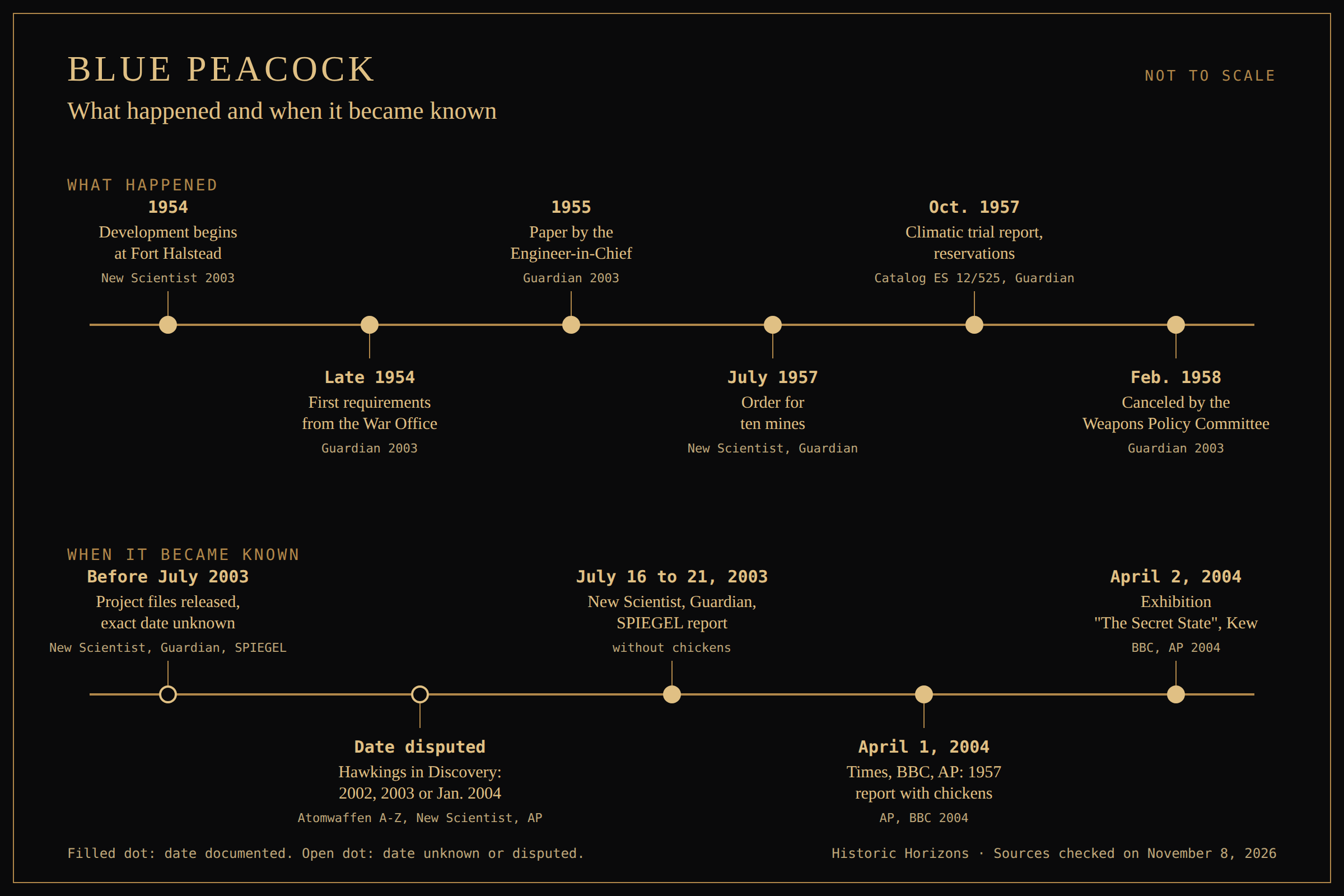
What happened and when it became known. Project dates from New Scientist, the Guardian and DER SPIEGEL (2003) and the National Archives catalog; publications from New Scientist, the Guardian, DER SPIEGEL, the BBC, AP and Atomwaffen A-Z. My own graphic.
The familiar April 1 claim therefore combines two events: the project had been known since July 2003, while the report containing the chicken suggestion was released and displayed by the National Archives according to AP. Saying the project was revealed that day puts its first press coverage nine months too late. Saying the chicken document was released then agrees with AP.
What the sources support
The story has been retold often, including in German by DER SPIEGEL, Wikipedia and Atomwaffen A-Z. The table compares its most common claims with what the evidence supports. Where my knowledge comes only through another source, I say so.
| Claim | Where it appears | What the evidence supports |
|---|---|---|
| The National Archives revealed Blue Peacock on April 1, 2004 | SPIEGEL Geschichte, Atomwaffen A-Z | The project had been in the press since July 2003, including in DER SPIEGEL itself. |
| The Blue Peacock file was declassified on April 1, 2004 | English Wikipedia | Not tenable for the project: the 2003 reports speak of files that had already been released. For the chicken report, see the next row. |
| The 1957 chicken document was released on April 1, 2004 | German Wikipedia | Consistent with AP. AP does not give an exact release date either. |
| A 1957 memo proves the chicken idea | SPIEGEL Geschichte | Documented, but as one sentence in a long report. AP quotes the wording; I have not seen the document itself. |
| Chickens were used instead of a heater | Atomwaffen A-Z | The report calls them “a possibility.” According to the National Archives, there is no indication they were ever tested. |
| The chicken plans were seriously considered | BBC, first sentence | O’Leary told AP it was merely a suggestion. |
| The project became known in 2002 | German Wikipedia | Atomwaffen A-Z and the Wikipedia footnote date Hawkings’ article to October 2002; in July 2003 New Scientist calls it the latest edition. |
| The crater would have been more than 180 meters deep, or 200 meters across | Guardian; SPIEGEL and Atomwaffen A-Z | Depth and width are different measurements, but the figures are close: 600 feet is about 183 meters. In 2003, DER SPIEGEL, citing Hawkings and a manual, gave a width of 200 meters for a detonation 10 meters below ground. |
| The mine was developed at Aldermaston | SPIEGEL Geschichte | New Scientist and DER SPIEGEL in 2003 name Fort Halstead. Aldermaston appears in 2004 as the origin of the chicken report. |
Most of these differences can be explained without assuming anyone intended to mislead. A story gathers details as it is retold: a project and a document acquire one date, and a suggestion turns into something that was done.
For the basic facts about the mine, New Scientist, the Guardian, DER SPIEGEL and Atomwaffen A-Z all go back to the same origin: Hawkings and his article. New Scientist names the article as its basis, the Guardian does the same and also refers to New Scientist, DER SPIEGEL cites Hawkings, and Atomwaffen A-Z takes over large parts of the SPIEGEL text almost word for word. Four texts, one source. The only independent piece is the National Archives catalog that lists the files. For the chickens, the evidence is thinner than for the basic facts. The Times, the BBC and AP all reported on the same occasion, the National Archives exhibition. I have not seen The Times; the BBC quoted it, and the only source for the wording of the proposal is AP, which also spoke to the National Archives itself.
What remains open
I have not read the original chicken report or requested it from the National Archives. None of the reports supplies its current reference. The 2004 accounts offer only clues to its origin. Hennessy pointed to the Aldermaston archives, the BBC identified nuclear physicists at Aldermaston as its authors, and AP called it a Ministry of Defence report.
The National Archives online catalog has three Blue Peacock files. None has been digitized:
| Reference | Title in the catalog | Date | Held at |
|---|---|---|---|
| AVIA 65/2036 | BLUE PEACOCK: atomic land mine | 1955 to 1959 | Kew |
| WO 321/32 | Nuclear warhead development: BLUE PEACOCK; design and development | 1954 to 1959 | according to the catalog, with the creating department or its successor, not at Kew |
| ES 12/525 | Armament Research and Development Establishment. BLUE PEACOCK: climatic trial report | October 1957 | Kew |
Searching the online catalog for “chickens” produces no result connected to Blue Peacock. That proves nothing because the catalog descriptions are short. It does not establish whether the October 1957 climatic trial report contains the chicken suggestion.
The sources also leave open whether the West German government in Bonn knew of the plans.
I could not find a photo of the mine that I was free to use. DER SPIEGEL reported in 2003 that one of the two prototypes was probably destroyed during trials. According to the Guardian and AP, the other was held in the historical collection of the Atomic Weapons Establishment at Aldermaston, without its nuclear components.
Sources
- The National Archives, Kew: catalog entries AVIA 65/2036, WO 321/32 and ES 12/525, accessed via the Discovery catalog on November 8, 2026.
- Rob Edwards: British army planned nuclear landmines. New Scientist, July 16, 2003 (https://www.newscientist.com/article/dn3943-british-army-planned-nuclear-landmines/).
- Jamie Wilson: Nuclear mines ‘to stop Soviets’. The Guardian, July 17, 2003 (https://www.theguardian.com/uk/2003/jul/17/world.jamiewilson).
- Markus Becker: Atom-Minen sollten Deutschland verwüsten. DER SPIEGEL, July 21, 2003 (https://www.spiegel.de/wissenschaft/mensch/a-257553.html).
- BBC News: Cold war bomb warmed by chickens. April 1, 2004 (http://news.bbc.co.uk/2/hi/uk_news/3588465.stm).
- The Times, April 1, 2004: not seen, quoted via the BBC and AP.
- Michael McDonough: Brits Say Chicken-Equipped Nuke No Hoax. Associated Press, April 1, 2004, here via SFGATE (https://www.sfgate.com/science/article/Brits-Say-Chicken-Equipped-Nuke-No-Hoax-2772719.php).
- Wikipedia, article “Blue Peacock” in the German and English versions, accessed on November 8, 2026.
- Danny Kringiel: Projekt Blue Peacock. Als England die Hühner-Atombombe erfand. SPIEGEL Geschichte, May 2, 2018 (https://www.spiegel.de/geschichte/projekt-blue-peacock-als-england-die-huehner-atombombe-erfand-a-951093.html).
- Atomwaffen A-Z: glossary entry Blue Peacock (https://www.atomwaffena-z.info/glossar/begriff/blue-peacock).