A plain brown box lies on the packing table. Beside it sit a roll of round stickers bearing your shop logo and a shipping label fresh from the printer. You have handled these three things a hundred times. Since 12.08.2026, each one has raised a new question: does it make you the manufacturer of the packaging?
The short answer
The manufacturer is whoever makes a piece of packaging or has it designed or made under their own name or trademark. Every piece of packaging has exactly one. If all you do is stick a shipping label on a finished, plain standard box, the European Commission takes the view that this does not make you the manufacturer. If your logo is on the packaging, you usually are. There is an exception for micro-enterprises whose supplier is based in the same country. Manufacturer and producer are two different roles. Your registration in the German packaging register hangs on the second one.
Two dates left this year: anyone already registered in Germany must update changed registration data by 12.11.2026. Existing compliance scheme contracts run no later than 31.12.2026.
Since the August deadline, the EU Packaging and Packaging Waste Regulation, or PPWR, Regulation (EU) 2025/40, has applied directly in every member state. Germany’s Packaging Law Implementation Act, or VerpackDG, sets out the national details. A manufacturer must assess the conformity of its packaging, prepare technical documentation and issue an EU declaration of conformity. This matters to anyone who ships without a legal department: an Etsy or Shopify shop, a print-on-demand seller, a modeller reselling kits, a seller of 3D prints or a photographer mailing prints. This is part one of a short PPWR series, as of 01.11.2026.
Manufacturer and producer: two roles that are not the same
In English the regulation keeps the two roles apart with two clearly different words: the manufacturer and the producer. The German version calls them “Erzeuger” and “Hersteller”, two words that mean the same thing in everyday German. That is why plenty of German guides write “Hersteller”, the producer, when they mean the manufacturer, for example when a “Hersteller” is supposed to issue a declaration of conformity.
Under Art. 3(1)(13) PPWR, a manufacturer is anyone who manufactures packaging or a packaged product. For sellers, point (a) adds the crucial case: anyone who has packaging designed or manufactured under their own name or trademark is also its manufacturer. The duties in Art. 15 follow that role. It is assigned once for the entire EU.
Under point (15), a producer is the manufacturer, importer or distributor who first makes packaging available in a member state. Put plainly, they are the first to hand it to someone there. That role carries extended producer responsibility: registration, a compliance scheme contract and volume reports. It is assigned separately in each country. In Germany, this means registration with LUCID, the packaging register of the Zentrale Stelle Verpackungsregister (ZSVR), the German Central Agency Packaging Register, and a contract with a dual system that organises take-back and recycling.
Someone who only passes packaging on is a distributor. Before selling, distributors must also check under Art. 19(2) that the producer is registered and the packaging is labelled. The manufacturer’s name and address must be provided too, and the packaging must bear a type, batch or serial number.
Am I the manufacturer? Nine cases from the kitchen table to print-on-demand
The overview is based on the text of the regulation, the second edition of the European Commission’s FAQ from August 2026 and the ZSVR’s guidance on online retail. Neither the Commission’s nor the ZSVR’s reading is binding. The regulation itself is what counts. Where the two contradict each other, it says so.
| No. | Your case | Who is the manufacturer? | Status |
|---|---|---|---|
| 1 | Box or mailer bag ordered with your logo | you | clear |
| 2 | Print-on-demand, the provider uses its unchanged standard packaging | as a rule, the provider’s packaging maker | clear, get the provider to confirm |
| 3 | Print-on-demand, the provider has size, material or cut made to its own specifications | the provider | clear |
| 4 | Print-on-demand with your logo on the packaging | you | clear |
| 5 | Plain standard box, you only stick on the shipping label | according to the Commission, the box maker | disputed once you add tape and filling material |
| 6 | Plain box with your logo sticker, or your logo on the shipping label | probably you | open, my assessment |
| 7 | Used box, cut down into a new piece of packaging | you | clear |
| 8 | Used box, reused unchanged | unresolved | open |
| 9 | Micro-enterprise, logo box from a supplier in the same country | the supplier | exception clear, scope disputed |
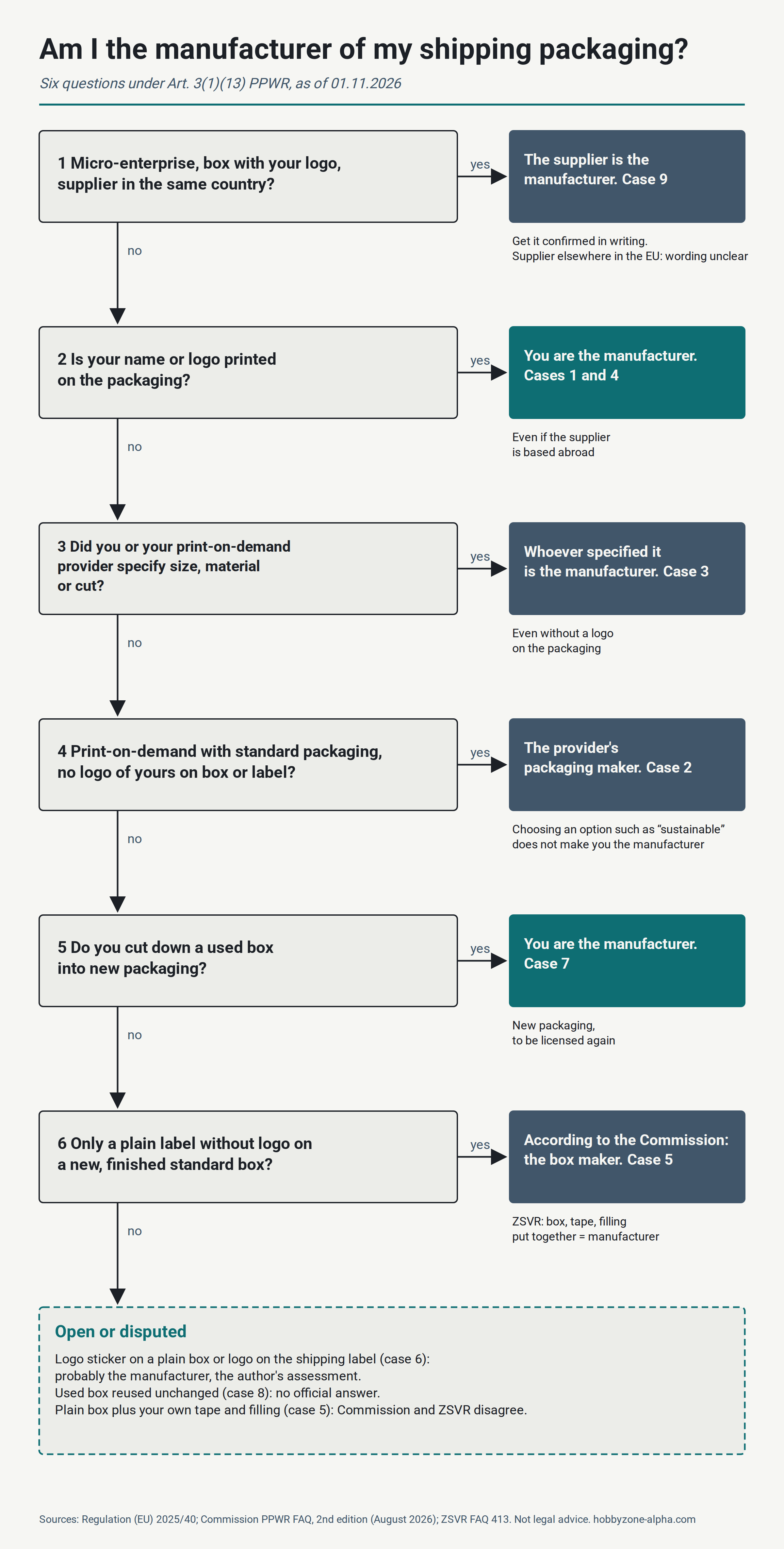
Six questions lead to the cases in the table. Open and disputed cases sit in the dashed box at the end, the scope of the micro-enterprise exception under question 1.
Case 1: box with your logo. If you have packaging made with your name, logo or trademark, point (a) makes you the manufacturer. The ZSVR is clear on this: whether your supplier is based in Germany or abroad makes no difference. Nor does it change anything if the supplier’s name also appears on the box. Under Art. 16, your supplier has to give you all the information and documents you need for the declaration of conformity. Signing it is up to you.
Case 2: print-on-demand with standard packaging. The service provider prints, packs and ships in standard boxes or bags. Neither you nor the provider automatically becomes the manufacturer in this case. The manufacturer is the packaging maker in the provider’s supply chain. A seller running two such shops asked the German online retailers’ association Händlerbund whether selecting “sustainable packaging, no plastic” from the provider’s options changed his role. The editors said that choosing an existing option does not make him the manufacturer. That agrees with the Commission’s reading, provided your name and trademark stay off the packaging.
Case 3: the provider specifies the packaging. A print-on-demand provider that orders boxes made to its own specifications is the manufacturer, even without a brand name on them. For unprinted transport packaging, the Commission expressly asks who orders it and determines its design.
Case 4: print-on-demand with your logo. Mailer bags or boxes bearing your logo make you the manufacturer, even if the provider produces and ships them. The Commission says the trademark owner remains the manufacturer even when it merely selects a standardised option and does not alter the design.
Case 5: plain box, label only. During the summer, the German law firm IT-Recht Kanzlei and the trade magazine logistik-heute were among those reporting that the ZSVR treated a shipping label alone as enough to make the seller the manufacturer. The ZSVR has made no official statement saying that. The Commission’s August FAQ says a box is already in its final form when supplied flat and awaiting folding. For plain standard goods, its maker is the manufacturer. A shipping label is not branding.
Shipping package assembled from box, tape and filling
The issue does not end there. The ZSVR says the person who combines a box, tape and filling material into a shipping package is its manufacturer, because that person creates the complete packaging. The Commission reads the situation differently: combining finished items such as a box, tape and wrap does not necessarily create a new piece of packaging. One shipment may contain packaging made by several manufacturers. Most small shops work right in the gap between those readings.
The safest choice is a box with its own self-adhesive strip, with nothing added by you. The Commission would treat the box maker as manufacturer. The ZSVR does not expressly address the manufacturer role for this case. The producer is the first person to hand on the finished box in Germany: usually the box maker under the Commission’s reading, while the ZSVR also names an importer or wholesaler. Buy these boxes in Germany and both roles lie earlier in the chain.
Pitfall: adding things later. Add extra tape to such a box or use your own filling material and Art. 21 may apply. A person who alters packaging already placed on the market in a way that may affect conformity becomes its manufacturer. The ZSVR looks at whether the alteration can affect recyclability.
Logo stickers, used boxes and the micro-enterprise exception
Case 6: logo sticker or logo on the label. I have not found an answer from the Commission or the ZSVR. At work, when I sort out which role belongs to a supplier and which to a seller, I start with one question: whose name appears on the packaging? Your logo sticker carries yours. The Commission sets the shipping label aside because its purpose is shipping. A logo sticker promotes the brand. That is what point (a) and Art. 21 address: a distributor placing packaging on the market under its own trademark is treated as the manufacturer.
The comments beneath the Händlerbund article raise a similar case: a print-on-demand provider uses standard boxes but puts the seller’s logo on the shipping label. For either case, I would treat myself as the manufacturer unless an authority said otherwise. This is my assessment, not established law.
Case 7: used box, cut down. If you shorten and refold a used box to produce a package that fits, you make new packaging. Point (13) includes anyone who “manufactures” packaging. Answering a reader who described a similar case, the Händlerbund editors said the packaging must be licensed again.
Case 8: used box, unchanged. You take a box from incoming goods, remove its old label, add a new one and put goods inside. Neither the Commission nor the ZSVR has addressed this case. Under the Commission’s reading, that box already has a manufacturer. Under the ZSVR’s, you become its manufacturer when you combine the box, tape and filling. If second-hand boxes are a regular part of your shipping, ask your dual system to clarify the position.
Case 9: micro-enterprise. Point (b) removes a micro-enterprise from the manufacturer role when its supplier is based in the same member state. The supplier becomes the manufacturer. Both the Commission and the ZSVR also regard that supplier as the producer. There is, however, a catch to the exception.
Micro-enterprise, not small business: supplier in the same country or in the EU?
Recommendation 2003/361/EC, in the version applicable on 11.02.2025, defines a micro-enterprise as a business with fewer than ten employees and annual turnover or a balance sheet total no higher than 2 million euros. Figures for partner and linked enterprises count too. This differs from a German “Kleinunternehmer” under section 19 of the VAT Act. That VAT provision does nothing for you here.
Three provisions describe the exception in different terms. Art. 3(1)(13)(b) says the supplier must be based in the same member state. Art. 15(12), which transfers manufacturer duties to the supplier, and Art. 21, second subparagraph, concerning importers and distributors, require only a supplier in the Union. The Commission and the ZSVR both follow the narrower wording. The text does not clearly resolve whether a Polish box supplier assumes the Art. 15 duties for a German micro-enterprise.
My advice is to use a packaging supplier based in Germany if you intend to rely on the exception. Ask for written confirmation that the supplier accepts the manufacturer role. Micro-enterprises, incidentally, have no general exemption from producer responsibility. The Commission provides lighter reporting duties only for producers placing less than ten tonnes of packaging on the market per year and country.
What follows if you are the manufacturer?
Manufacturers may place packaging on the market only if it meets the requirements of Art. 5 to 12. Those requirements cover substances, recyclability and labelling. First, the manufacturer must complete the conformity assessment under Art. 38, prepare technical documentation under Annex VII and issue the EU declaration of conformity under Art. 39. Art. 15(6) also requires the manufacturer’s name, registered trade name or registered trademark and postal address on the packaging or accessible through a QR code. Documents accompanying the packaging suffice only if that is not possible.
The documentation and the declaration have to be kept for five years for single-use packaging and ten years for reusable packaging, counted from placing on the market. If an authority asks for them, they must be supplied within ten days under Art. 15(10).
What a wrong call costs. The VerpackDG treats breaches of the manufacturer duties in Art. 15 as administrative offences. A missing conformity assessment, missing documents or missing information on the packaging are among them. Section 66(2) and (3) VerpackDG allows a fine of up to 10,000 euros. Producer breaches carry higher limits: up to 100,000 euros for not registering and up to 200,000 euros for not joining a compliance scheme. A failure to report changed registration details can also draw a fine. A distributor cannot pass on packaging without this information.
Paperwork for a standard shipping box need not become a mountain. Ask the supplier for the Art. 16 documents now. Check that the name and address appear on the packaging or can be reached by QR code, then arrange to keep the records for five years, or ten for reusable packaging. Part two of this series shows what a declaration of conformity for shipping packaging looks like.
Producer in each country: LUCID, scheme contract, platforms
The producer role is familiar to most German sellers. Under the old Packaging Act, shipping packaging usually ending up with private consumers already needed registration with a compliance scheme. The ZSVR now describes scheme participation as required “without exception”, including for packaging sent to business customers.
Ship directly from Germany to consumers in Austria or France and you become the producer of that shipping packaging in the destination country. Separate registration and scheme participation follow. Buy plain boxes straight from a box maker in another EU country and fill them yourself, and the Commission’s FAQ says you are generally the producer in Germany too. EPR Across the Border: What Hobby Sellers Need to Watch Internationally in 2026 covers the rules in individual countries.
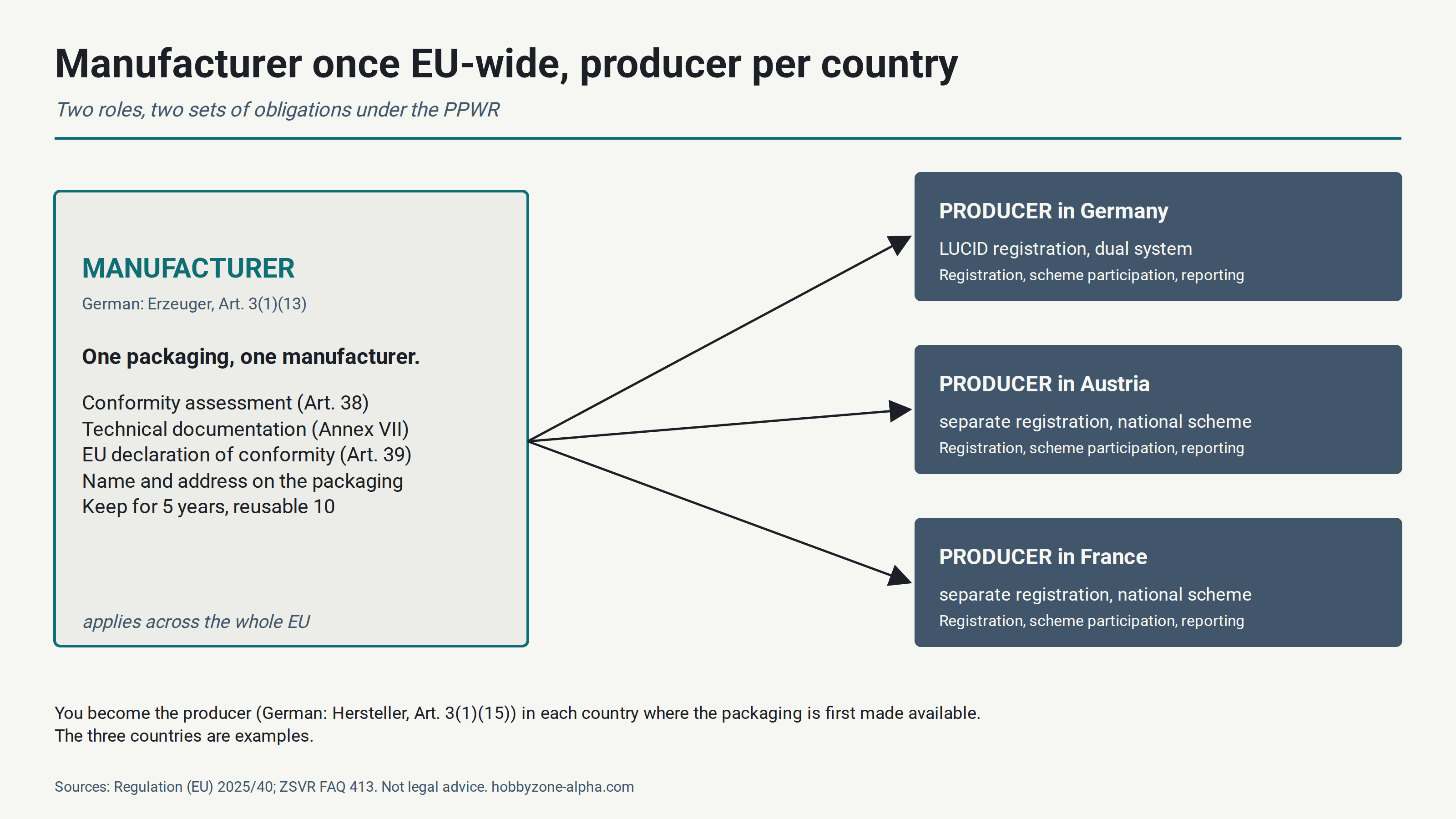
One piece of packaging, one manufacturer, one declaration of conformity. The producer role, by contrast, arises in every country where the packaging is first made available.
Pitfall: ending your registration too early. The Commission’s FAQ says the box maker is usually already the producer when it sells plain standard boxes to a seller in the same country. Even so, keep your LUCID registration and scheme contract. The ZSVR decides producer duties in Germany and still considers a seller responsible when that seller combines a box, tape and filling.
Pitfall: the old scheme contract runs out. Under section 68(1) VerpackDG, scheme participations agreed under the old Packaging Act before 12.08.2026 continue no longer than 31.12.2026, unless the contract provides otherwise. Section 68(2) keeps an existing LUCID registration valid. Any changed registration data must nevertheless be updated by 12.11.2026.
Pitfall: the platform asks. According to the ZSVR’s guidance, online platforms such as Etsy, eBay or Amazon must obtain confirmation of the LUCID registration and a self-certification on producer responsibility before you can use their services. The same applies to fulfilment service providers unless they are themselves the manufacturer of the shipping packaging. How packaging, electrical and battery law fit together in Germany is explained in Extended Producer Responsibility: Deadlines and Pitfalls 2026.
Five questions for your provider or packaging supplier
The ZSVR expressly says you must resolve the manufacturer question on your own responsibility. Its own remit covers producer duties. Where the answer is uncertain, the Commission calls for an assessment of the individual case. An email asking these five questions is the quickest route to clarity:
- Which of us is the manufacturer of this packaging under Art. 3(1)(13) PPWR, and can you confirm that in writing?
- Do you specify the size, material or cut of the packaging, or do you use unchanged standard goods?
- Is there an EU declaration of conformity for this packaging, and can I get a copy from you or the documents under Art. 16?
- If my logo is on the packaging or the label: who then takes care of the declaration of conformity and the technical documentation?
- In which countries are you registered as producer for this packaging, and for which do I have to take care of it myself?
Keep the answers. If an authority asks, the written clarification of roles is the first thing you can show.
What is still open about the manufacturer role
Nearly three months after the deadline, four questions have no clear answer. The Commission and the ZSVR disagree about the plain box you prepare for shipment with tape and filling. Neither addresses a logo sticker on plain packaging or a logo printed on the shipping label. Neither addresses an unchanged used box put back into service. Then there is the micro-enterprise exception, described differently in three parts of the regulation.
Until the Commission or the ZSVR follows up, one rule helps: whoever makes packaging, has it made to their own specifications or puts their name or trademark on it is the manufacturer, in the case of the logo sticker by my assessment. The exception is the micro-enterprise that gets its logo box from a supplier in the same country. A plain shipping label alone makes nobody the manufacturer; putting box, tape and filling together does, in the ZSVR’s view.
Legal position as of 01.11.2026, not legal advice. The Commission’s FAQ and the ZSVR’s guidance offer interpretations. Regulation (EU) 2025/40 itself governs.