Between 2014 and 2018 I went back to Düsseldorf again and again with my camera. Sometimes for an evening, sometimes for half a day. I never had a particular reason. It was only when I sorted the pictures that I noticed I had looked for the same things each time: edges, reflections, painted walls and that quarter of an hour when the light turns. That is where this look back came from. It is not a travel guide. The photos are eight to twelve years old, and some of what was a building site back then has since become something else. I processed almost all of them with heavy HDR or in black and white. Every now and then I let a single colour stay.
An evening in the Medienhafen, October 2015
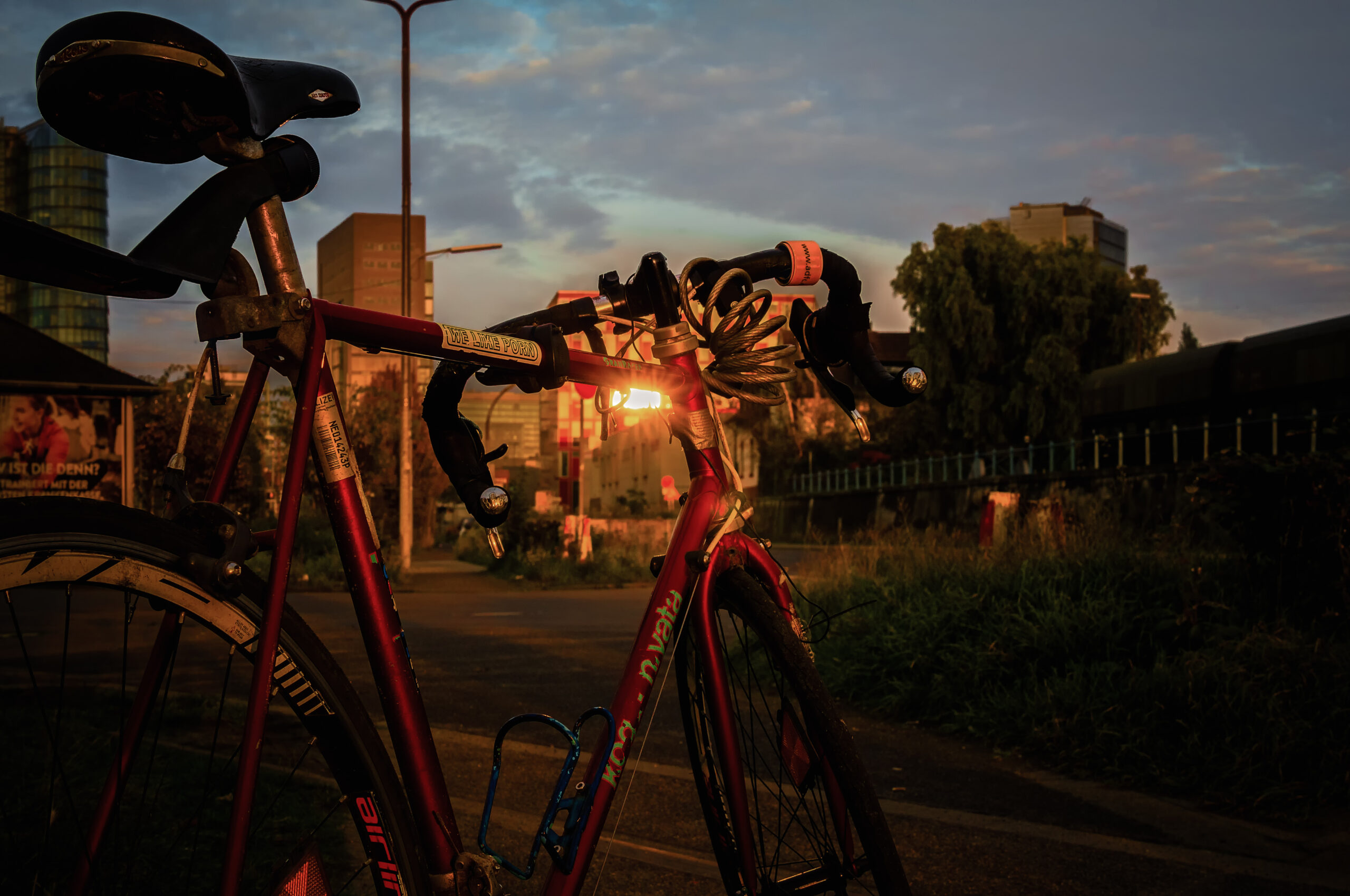
On 28 October 2015 I was down at the harbour shortly before sunset. The sun hung low over the tracks, a freight train with rust-brown wagons stood waiting in the curve, and the light was so orange it almost looked painted. A red road bike was leaning against the railing.
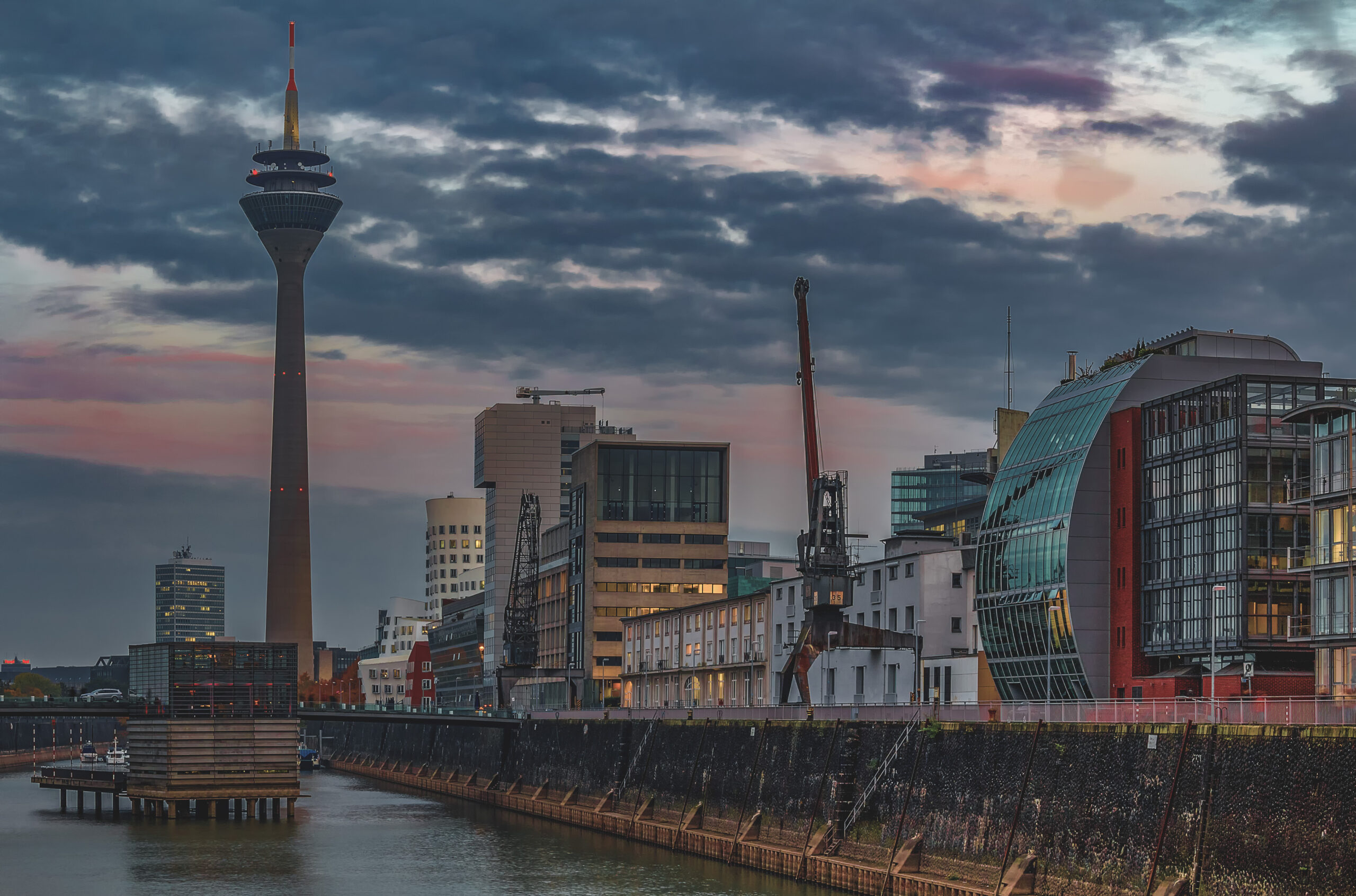
Half an hour later everything had turned blue. The Rheinturm, the city’s TV tower, rose above the harbour basin. To its right stood the old harbour cranes they kept, with the curved glass front of an office building on the far right. A blanket of cloud lay over it all, its last edge pink. By day the Medienhafen is a business district with good architecture. At dusk it all appears again in the water. One window lights up after another, and suddenly every line fits the next.
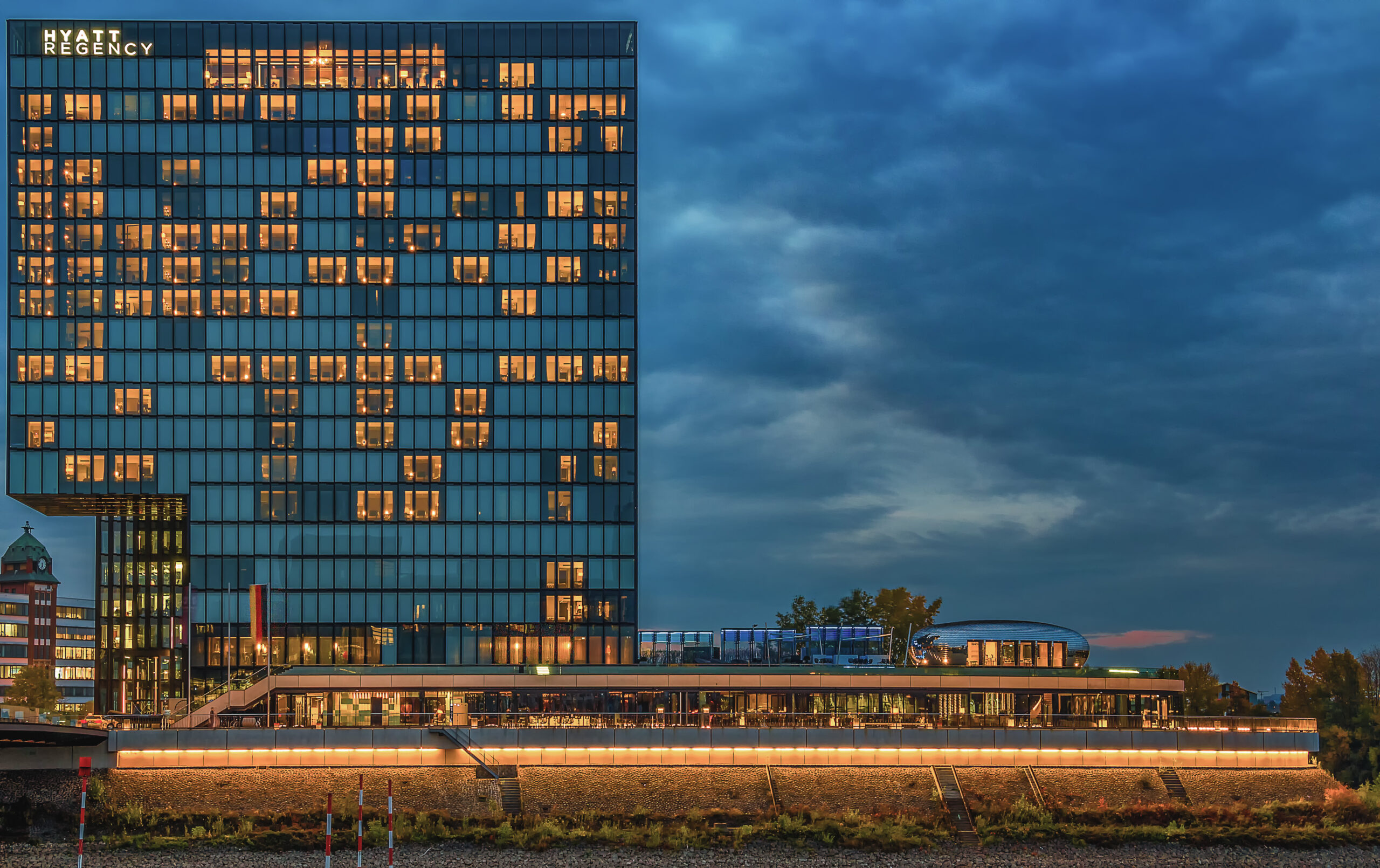
A little further on is the Hyatt, a dark glass tower topped by a cantilevered block. By then every other window was lit. I like buildings like this most when they begin to glow from within.
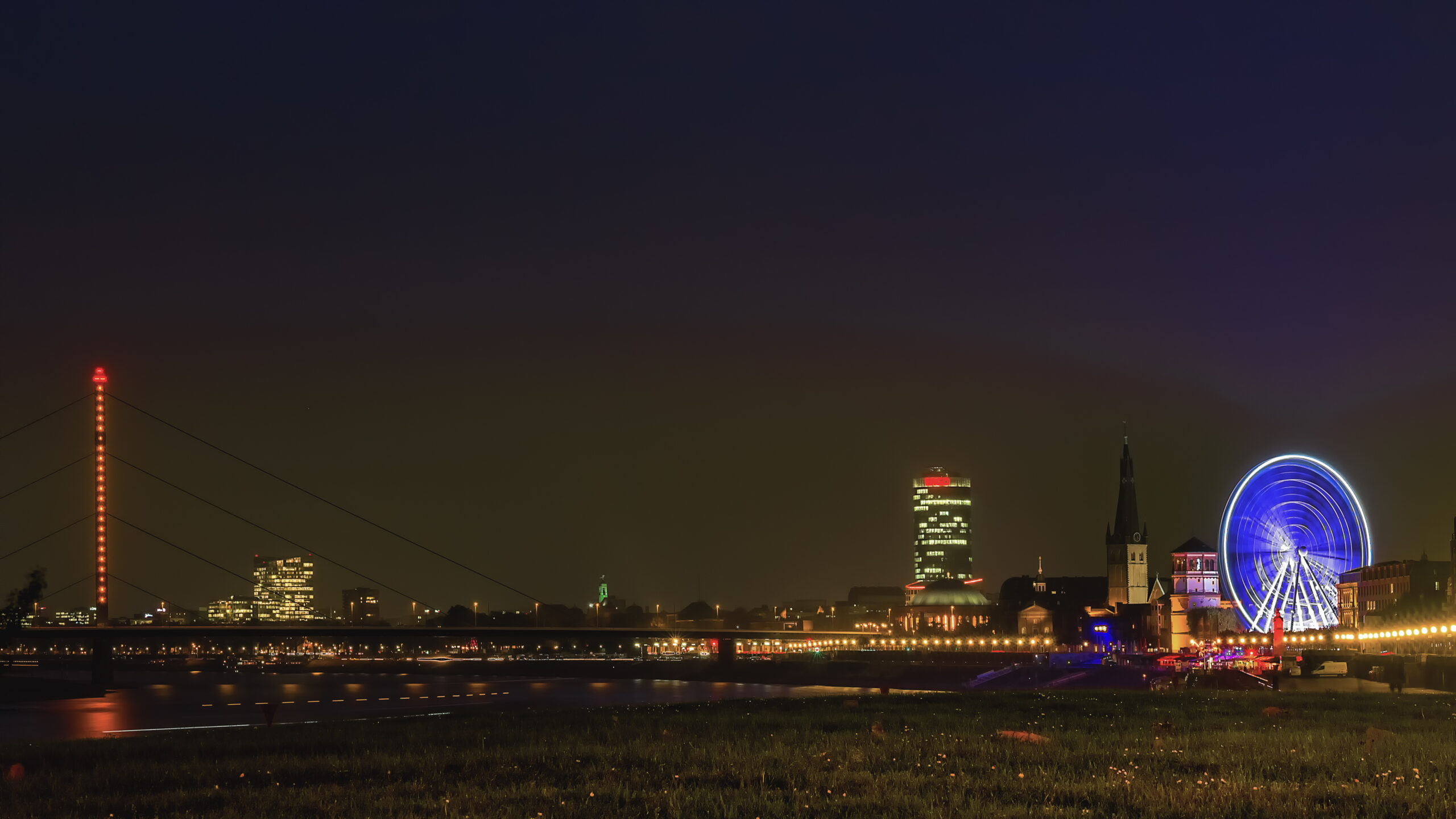
Once it was completely dark, I was standing in the meadows on the left bank of the Rhine, opposite the old town. The promenade on the other side has looked like this since 1995. Between 1990 and 1993 the traffic had been moved into the Rheinufer tunnel. On the left rose the red-lit pylon of a cable-stayed bridge. Its cables ran off at an angle into the dark. Behind it I could see the lights of the old town, a church spire and a Ferris wheel glowing blue.
The Medienhafen by day: the Gehry buildings
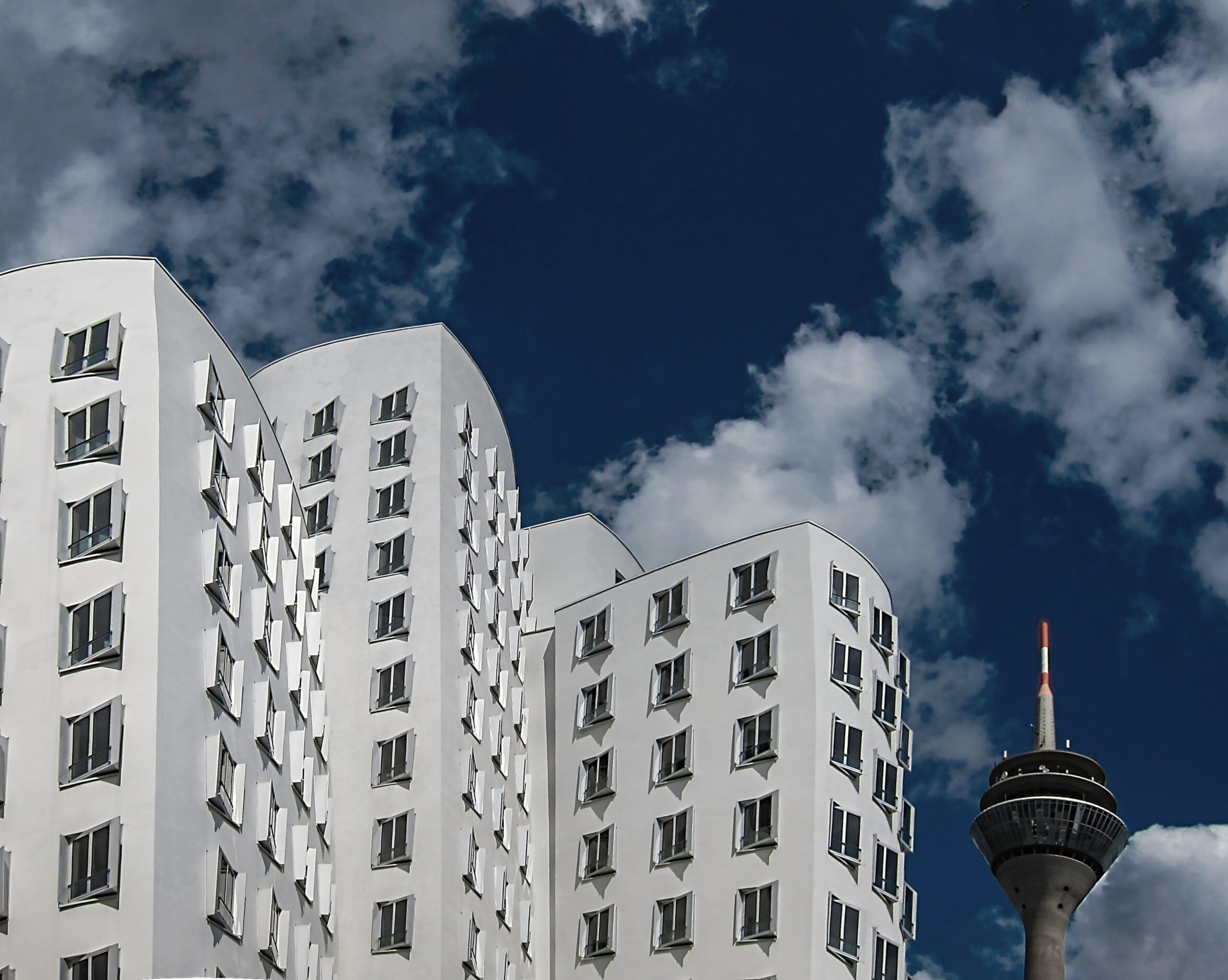
In April 2016 I returned to the harbour. This time I went around midday, taking the Canon 600D and a small PowerShot. I wanted pictures of the Gehry buildings, officially the Neuer Zollhof. Frank O. Gehry designed all three, and they were completed in 1999. One has red brick cladding, the second stainless steel and the third white render. There is hardly a straight wall on any of them. Incidentally, Zaha Hadid won the competition for the site in 1990. Her design was never built.
The sky that day was deep blue, with fast white clouds. It was exactly the sky the white building needs. Its facade reflected the light so strongly that the edges almost seemed within reach. More than an hour went by between my first shot and my last. I spent most of it at the bottom, pointing the camera upwards, with the Rheinturm beside the building on the right of the frame.
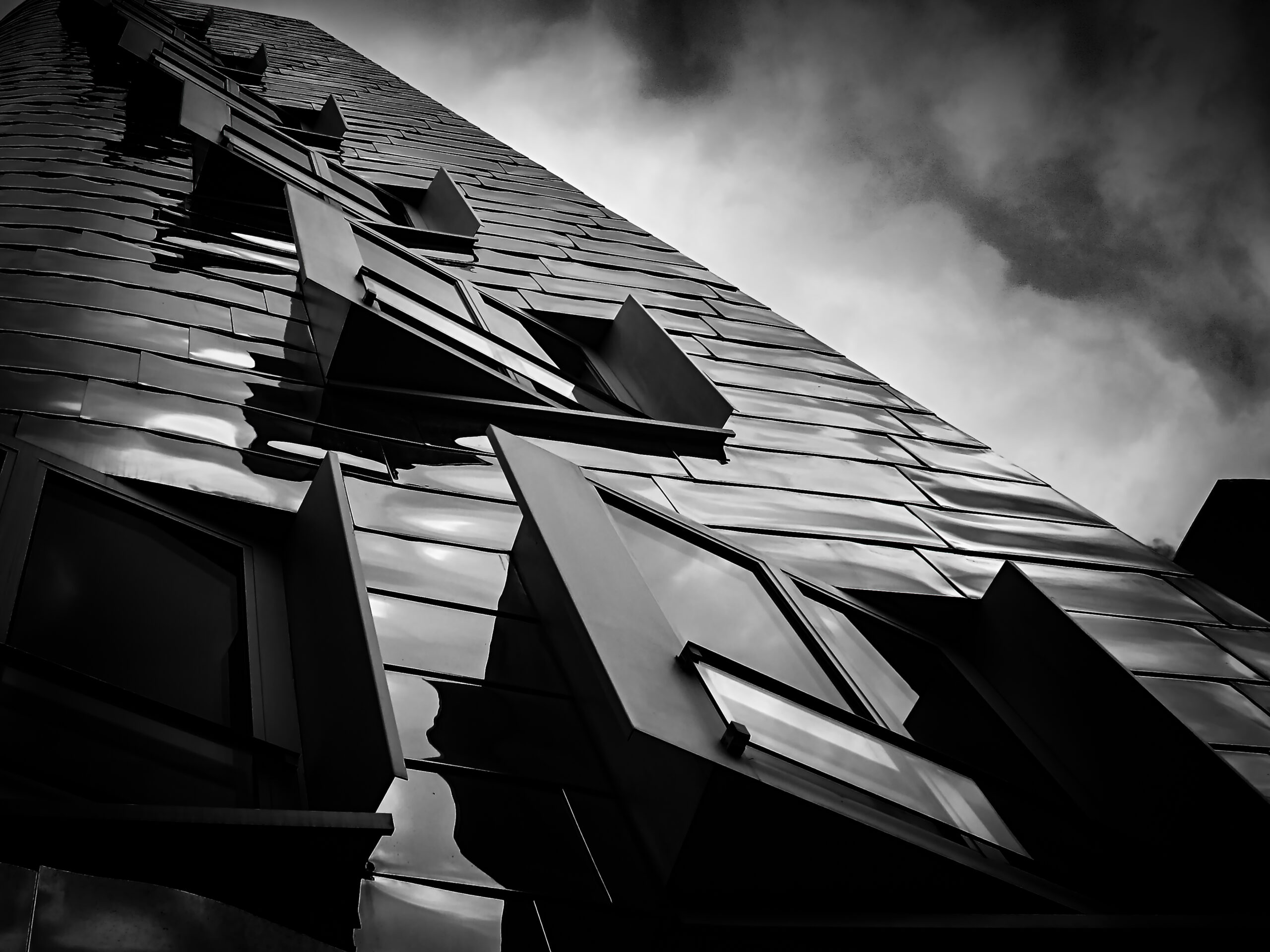
Later I made the stainless steel facade black and white. In colour it looks like a silvery jumble. Without colour it becomes a sculpture. The windows look as though someone pushed them out of the wall. I had already noticed in the architecture album that glass and concrete often work better in black and white.
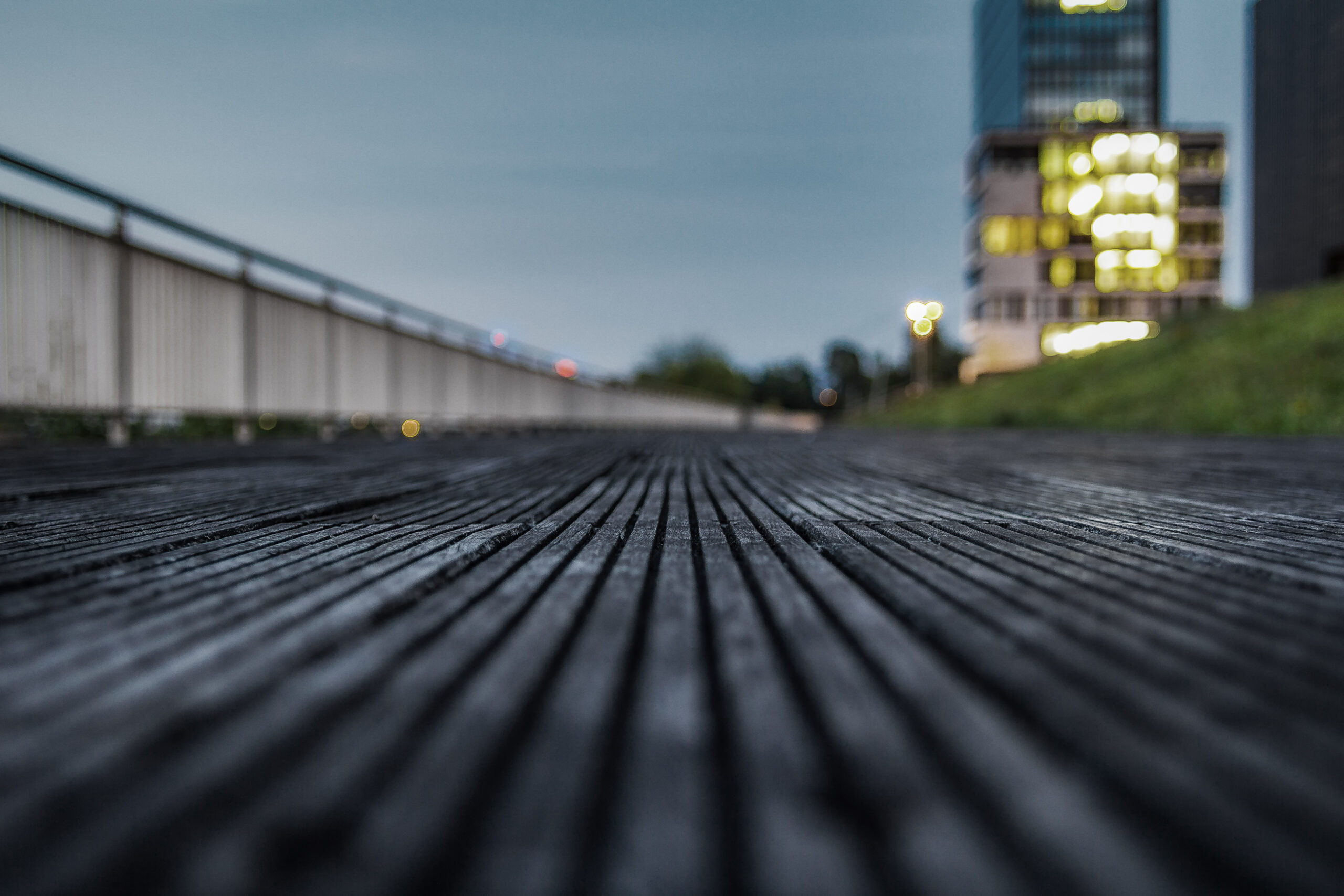
The final harbour picture dates from 6 September 2016, half past seven in the evening. A wooden jetty, the camera almost touching the planks, the boards leading as dark lines into the blur, an office building glowing at the very back. I took no other harbour picture from so low down.
Kö-Bogen and 40° Urban Art on Gründgens-Platz
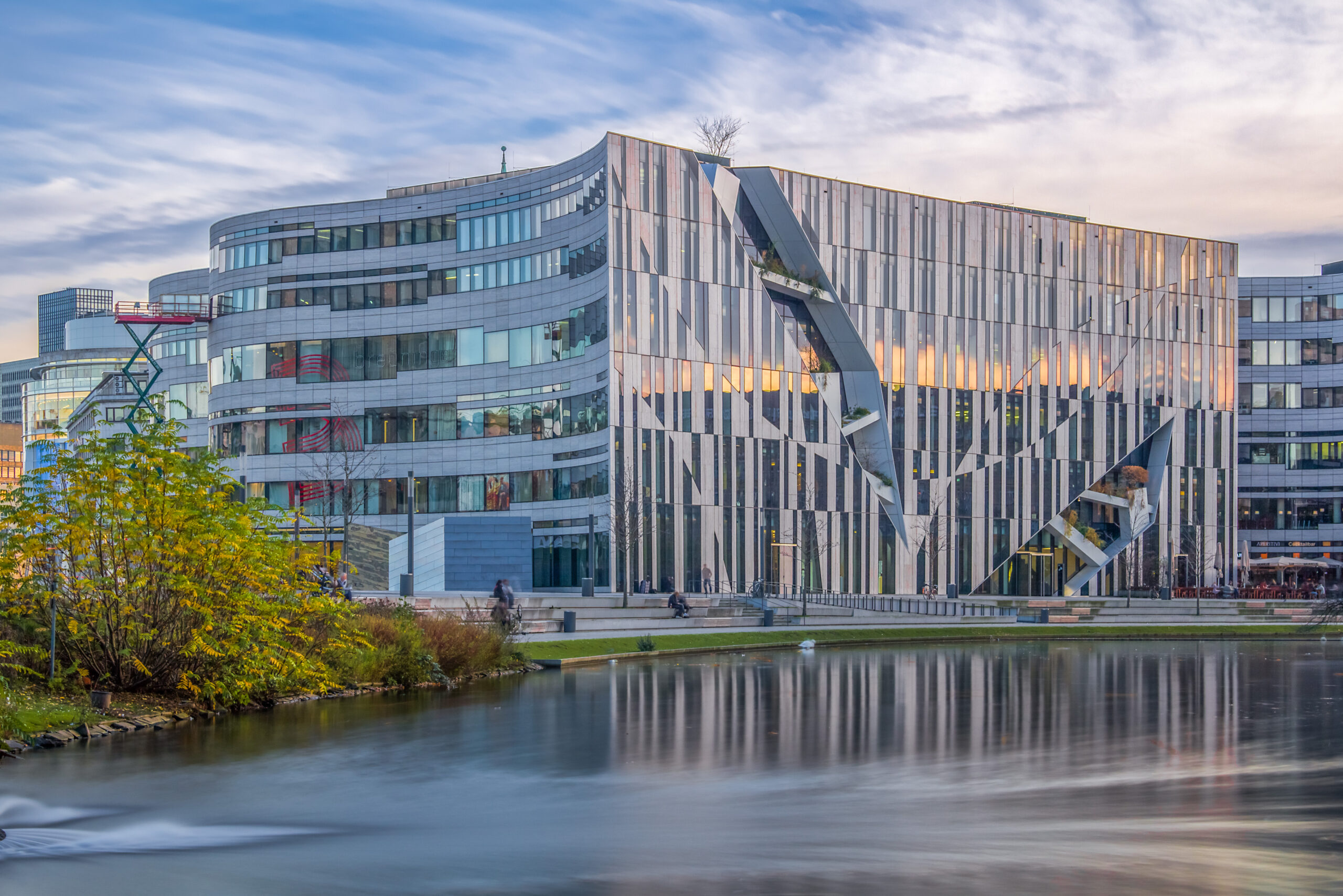
In November 2015 I went into the city centre twice, first to the Hofgarten, the park at the northern end of the Königsallee. Daniel Libeskind’s Kö-Bogen stands there. It was two years old at the time: a pale, curving facade cut by slanted openings with greenery growing in them. The building sits right beside the water. On the evening of 3 November the surface was so smooth that the building seemed to float on it.
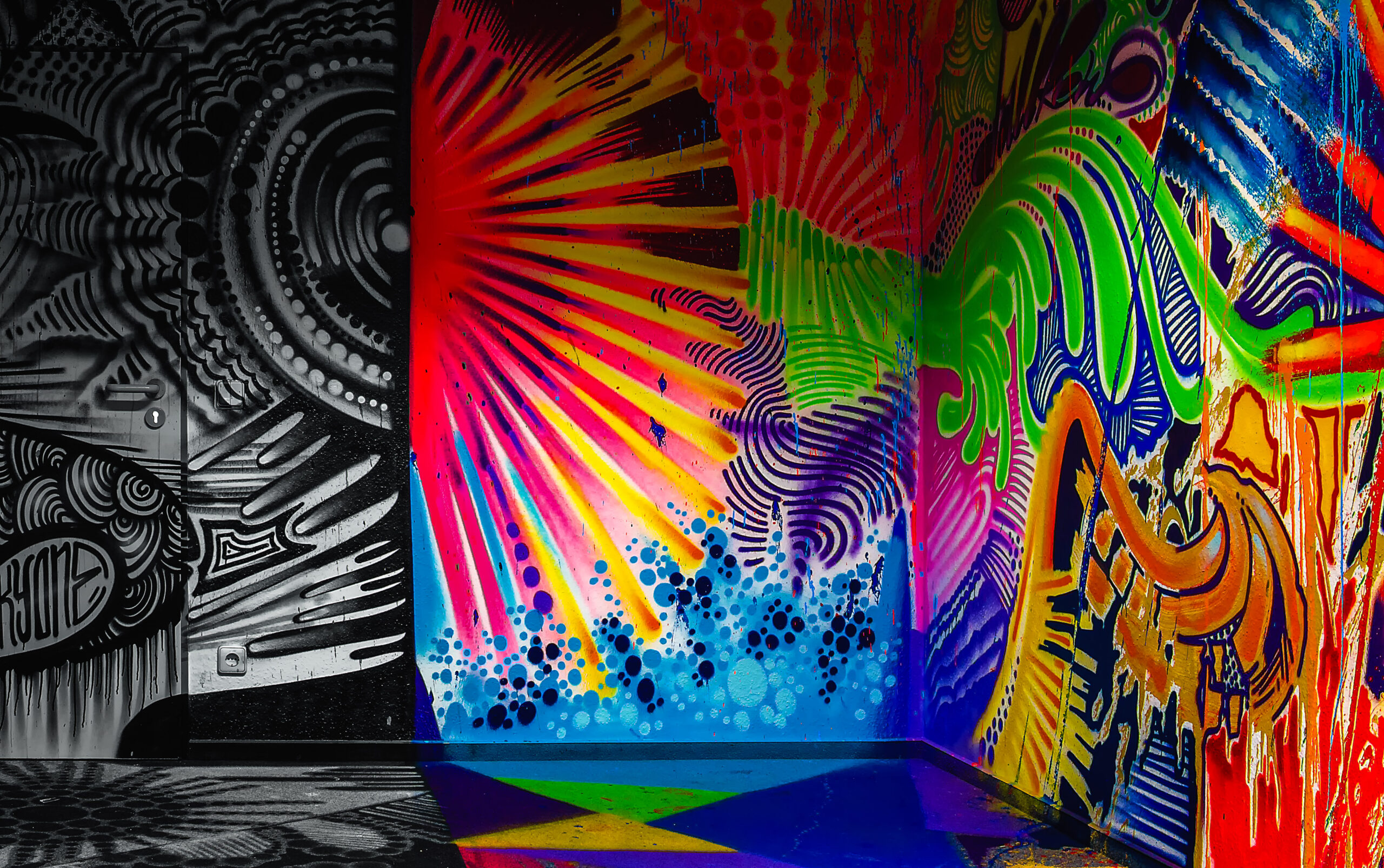
Five days later I was standing a few hundred metres further on, on Gustaf-Gründgens-Platz in front of the Schauspielhaus theatre. At the time the square was a building site full of cranes, fences and barriers. In late summer 2015 the 40° Urban Art festival had brought around a hundred artists there under the motto “Nimm Platz”, take a seat. They painted walls and facades, but also rooms in the office buildings next door. My photos from that day show work from exactly this project. Entire rooms had been designed from floor to ceiling. One was black and white and full of lettering, another showed every colour a spray can has to offer. Today the square also has a second building with almost the same name: Christoph Ingenhoven’s Kö-Bogen II, wrapped in around 30,000 hornbeams.
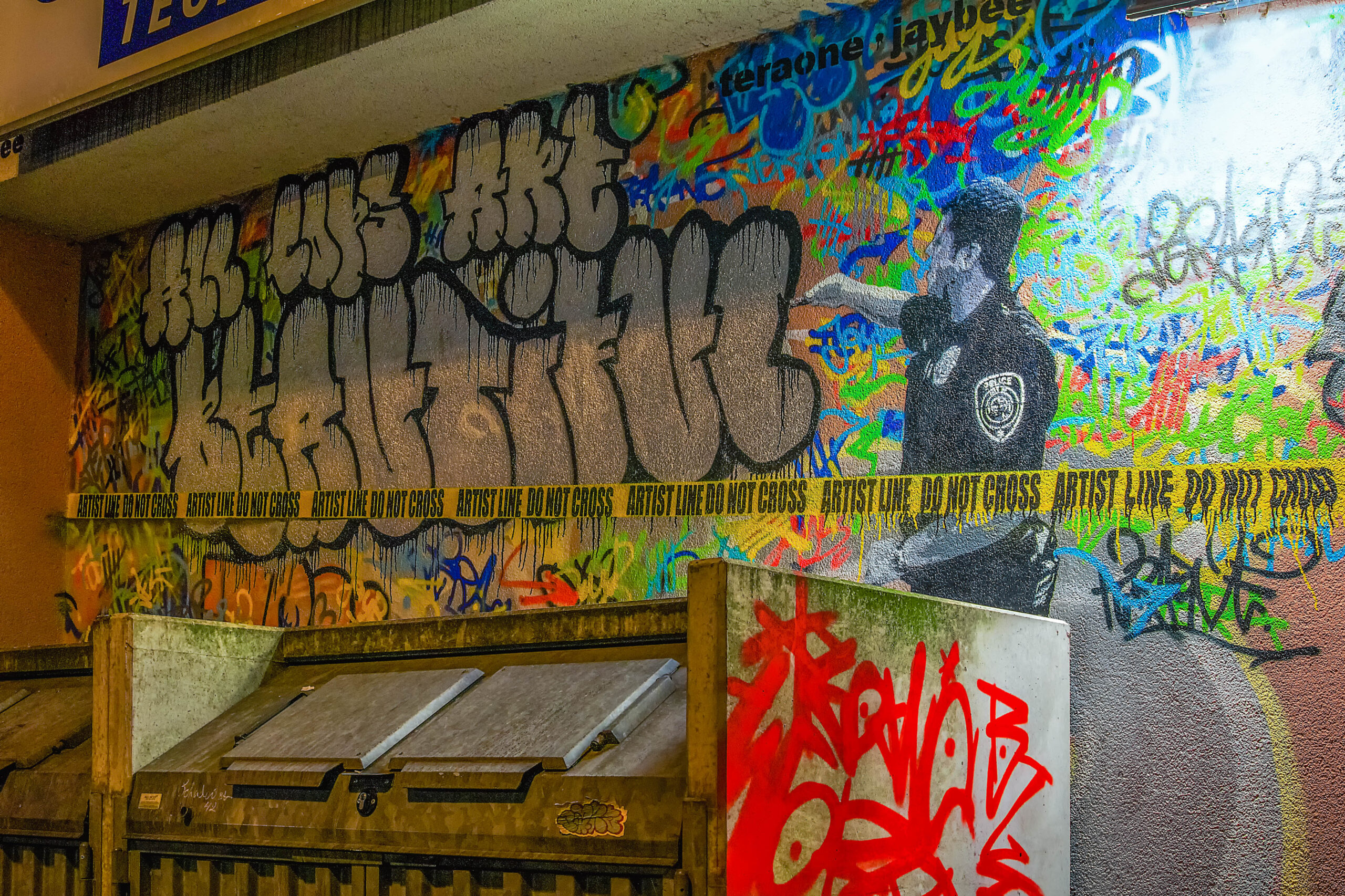
My favourite photo from that visit shows a wall with yellow barrier tape still stuck to it: “Artist Line, do not cross”. Behind the tape are a sprayed police officer and the words “All C…s are beautiful” in fat letters. The lettering makes it impossible to tell whether the second word is cops or caps. Beside the officer, it is probably meant both ways.
Street art: Kiefernstraße and the east
On the afternoon of 28 June 2016 I went to Flingern, east of the city centre. The sky above me was blue with thick clouds. Everyone in Düsseldorf knows Kiefernstraße. It is around 380 metres long, and almost every facade is painted. In the early eighties the houses were meant to be demolished. They were saved in 1981. The street has been a housing project with a character of its own ever since. At the end of August 2026 it marked its 45th anniversary with a street party.
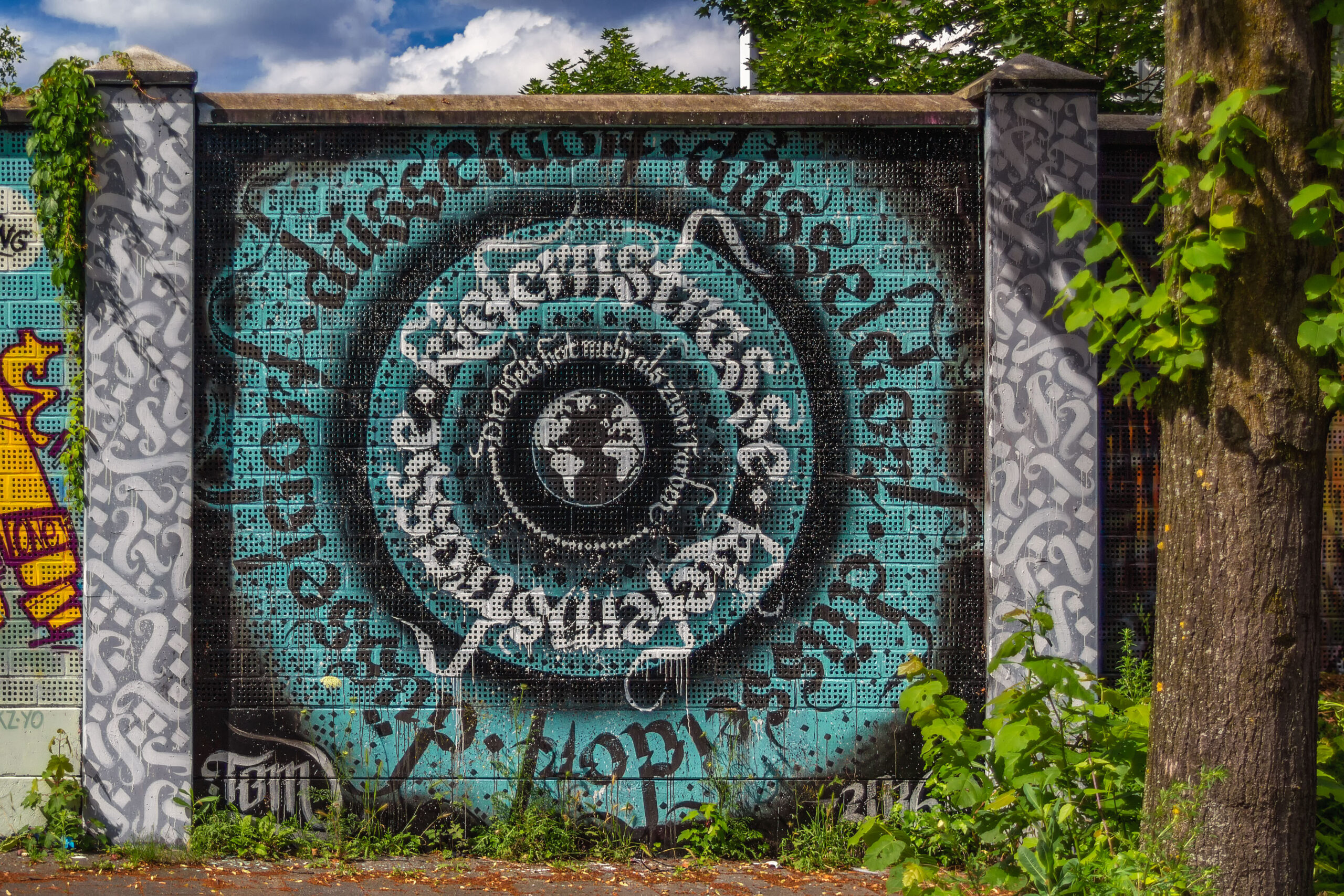
Between two pillars, a wall carries something that looks like the street’s coat of arms: a turquoise circle with a globe in the middle. All around it, “Kiefernstraße Düsseldorf” is written again and again. Ivy grows over the pillars, and a tree stands in the way in front of it.
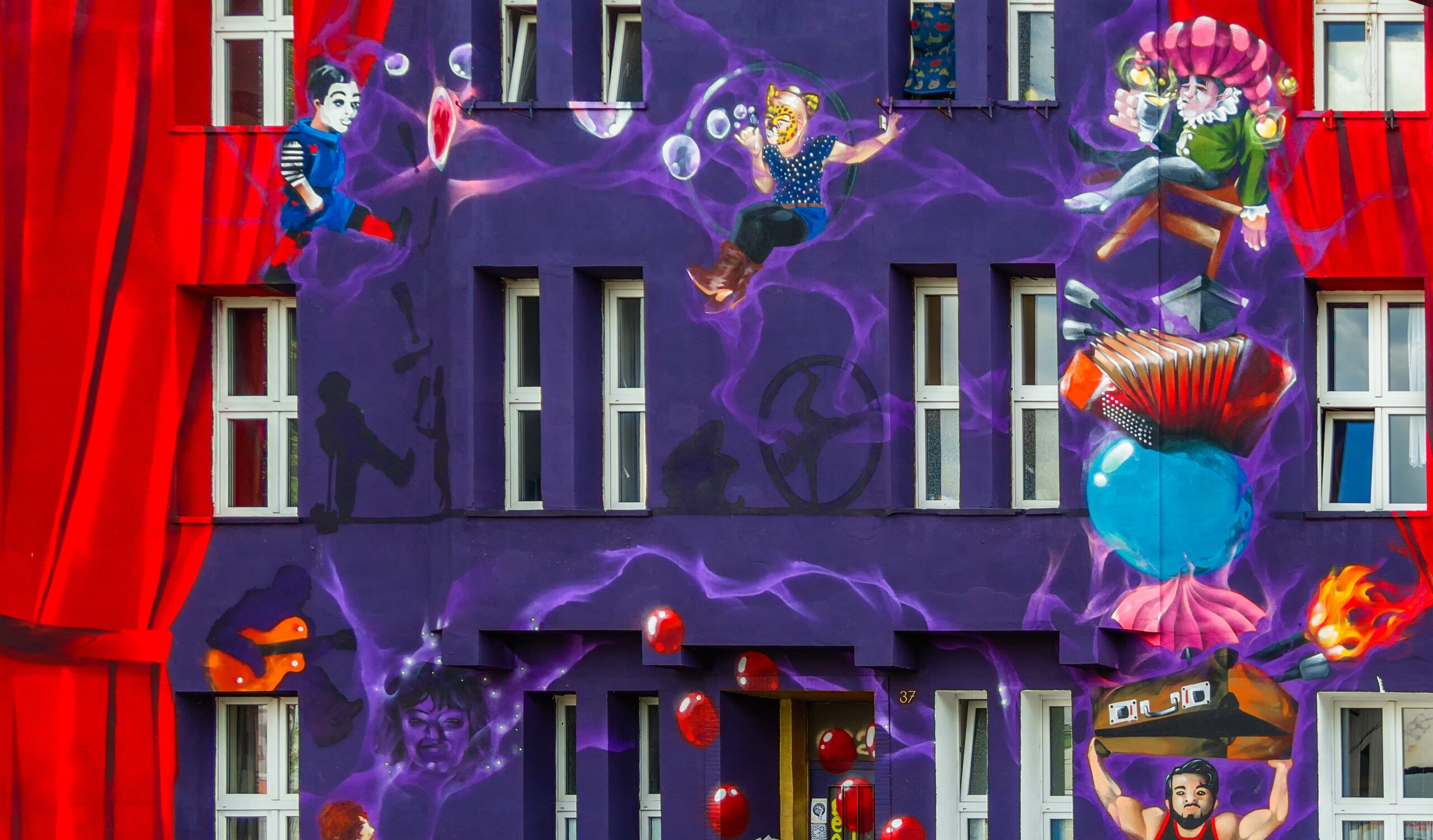
A few metres further on, a whole house is painted purple. Red theatre curtains are painted on the sides, and figures fly through the air between the windows. The windows are real, the curtains are paint. You have to look for a moment to see where the wall ends. In the same corner someone had knitted a sleeve around a tree trunk, in colourful rings right up to the crown. I still wonder how long it lasted.
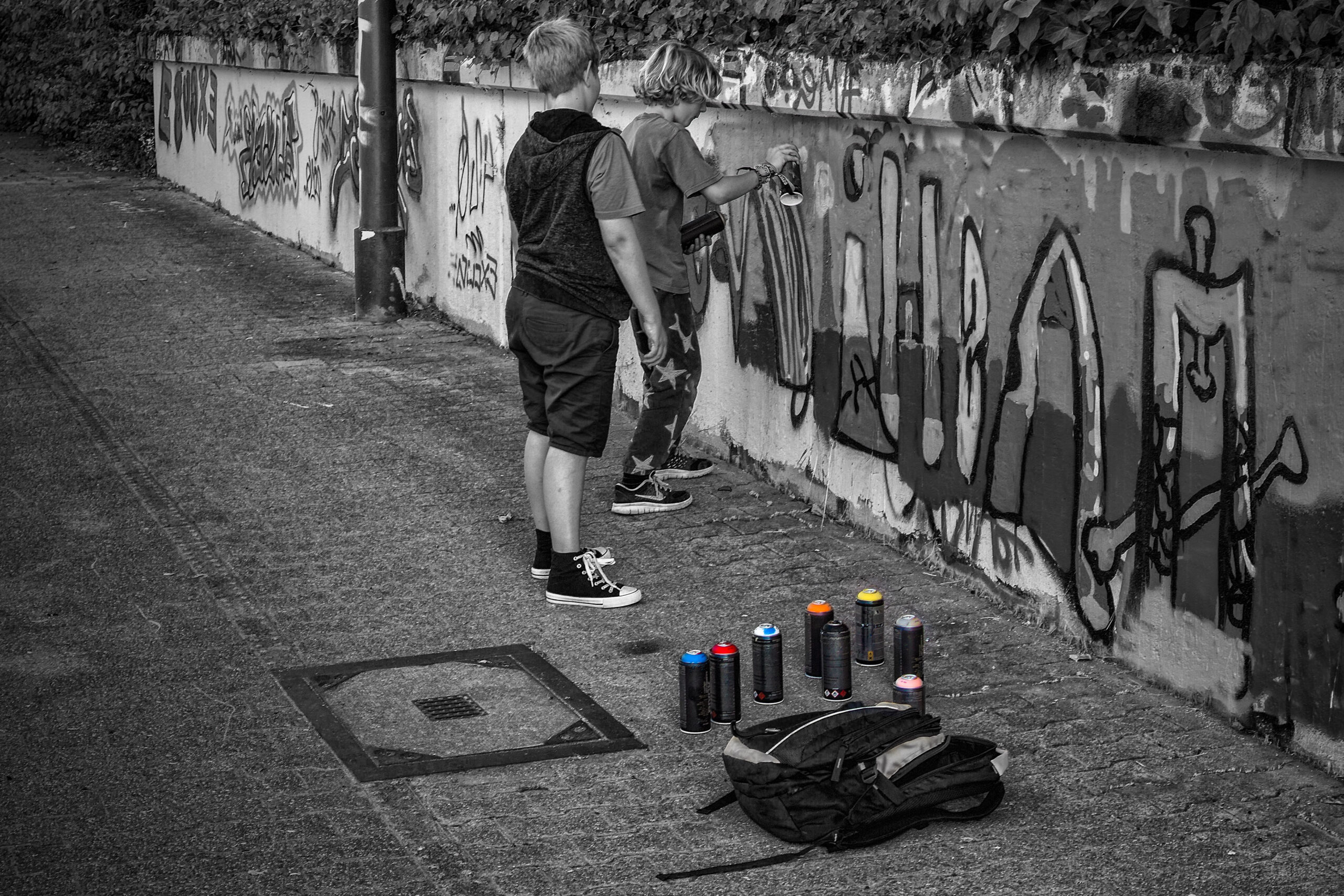
One afternoon in September 2016 I passed a long graffiti wall in the east of Düsseldorf. Someone was spraying there at that moment: a writer in shorts and Chucks, his cans lined up neatly on the paving and his backpack next to them.
The Höfchen in Südpark and other rambles
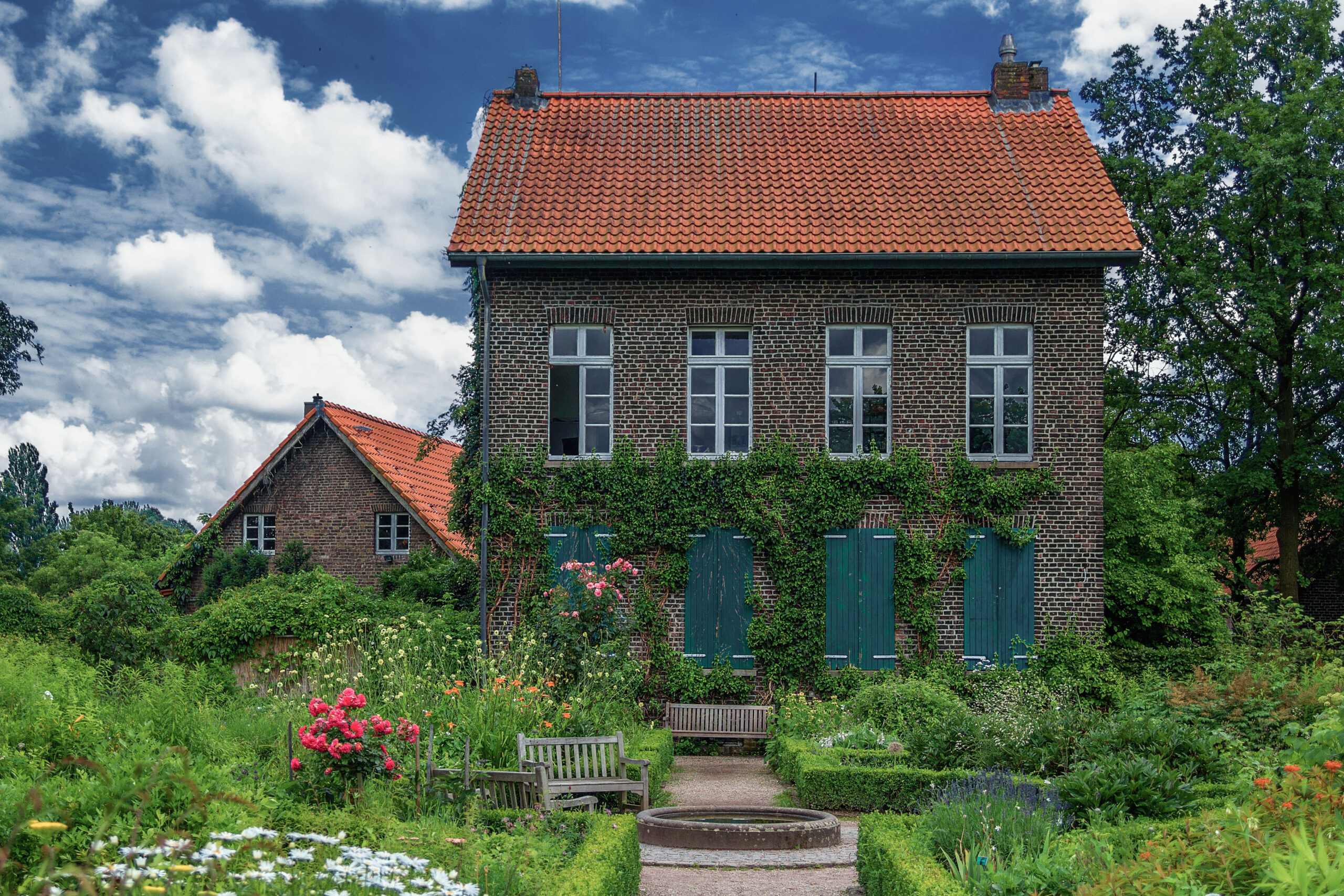
Before reaching Flingern that June day, I went to Südpark. The Höfchen is an old farmstead there, built in 1859 and now a listed monument. It was farmed until the late seventies, restored for the 1987 Federal Garden Show, and has been run since then by the Werkstatt für angepasste Arbeit, a sheltered workshop. Brick, green shutters, ivy reaching the roof, a cottage garden with roses out front, all in the middle of a state capital.
The gallery below includes an escalator that looks like a tunnel in black and white, and a scaffolded house that hard contrast turns into lines. It also contains the oldest picture in the series: colourful posters on a grey wall from November 2014. The rest is there as well. More everyday finds like these are in the Urban Life album.
The Rundgang at the Kunstakademie
My last visit in this series was on 31 January 2018, the first day of the Rundgang at the Kunstakademie, Düsseldorf’s art academy. Once a year the academy opens its studios, and the students show what they have been working on. In 2018 the Rundgang continued until 4 February. I went in the morning. Outside, it was grey and evenly bright.
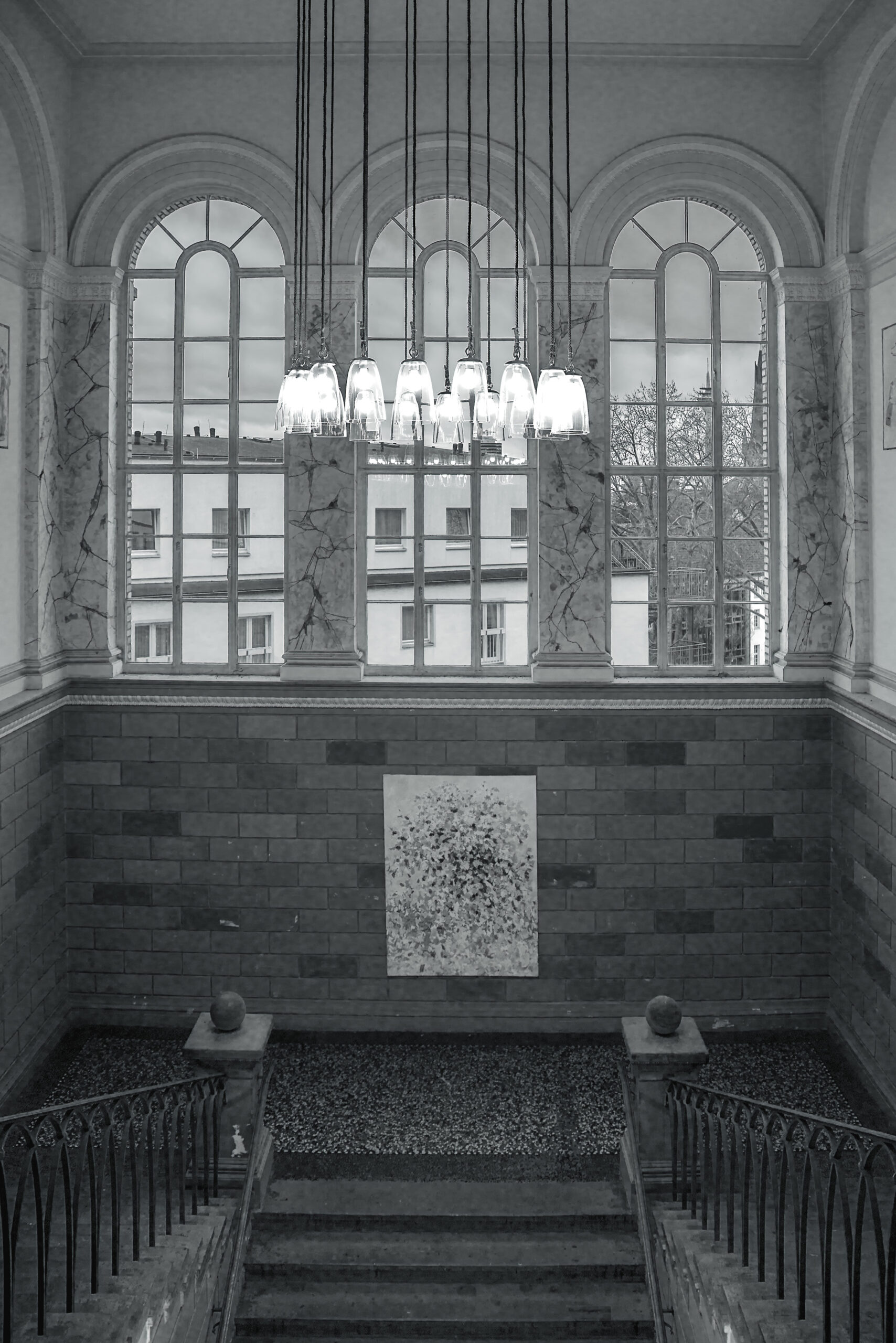
Hermann Riffart built the academy building on Eiskellerstraße between 1875 and 1879 in the style of the Italian Renaissance. Before then, a fire had destroyed the academy’s old quarters in the palace. Inside, the stairwells are where you feel its age most. White-tiled walls, wrought-iron railings, tall arched windows and a chandelier that doesn’t go at all with the fluorescent tubes in the studios.
The rooms themselves are places to work. White walls, radiators beneath the windows, neon light overhead, with paintings, drawings and installations in between. Chinese characters covered one room’s wall all the way to the floor; in another, small oil paintings hung close together. I photographed the works together with the rooms around them. I don’t know who made them, so they appear only in the gallery.
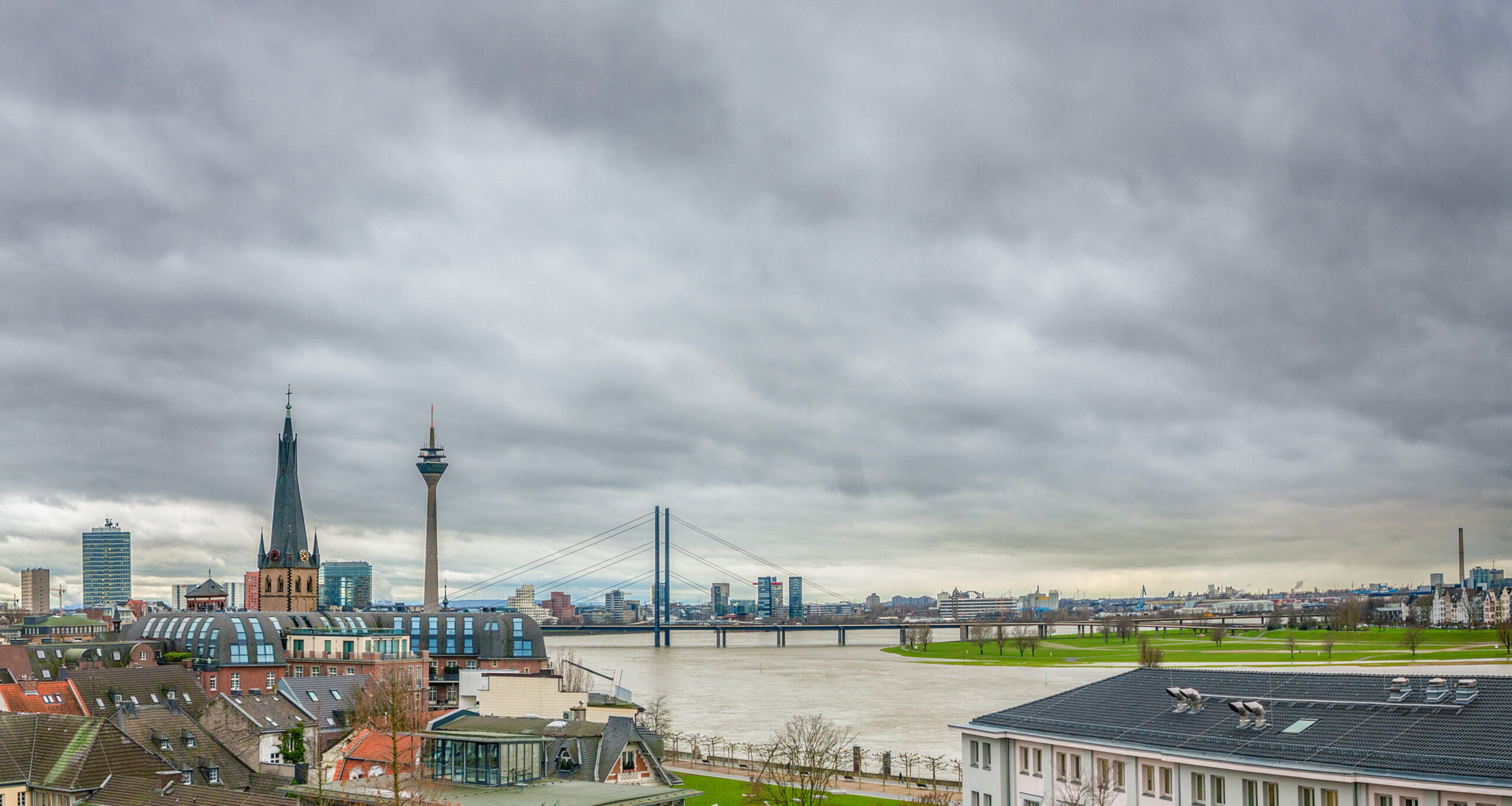
From high up in the building you can look south across the rooftops of the old town. The spire of St. Lambertus stands in front, with the Rheinturm behind it. To the right are the river and the Rheinknie bridge. The sky was grey from edge to edge that day. When I processed the picture, I pulled out every cloud I could find.
What remains
I used a Canon EOS 600D for most of these pictures. A few came from the PowerShot S95 and the iPhone 5s I had at the time. The Sony A99 II came along only for the Rundgang in 2018. My camera changed, then. My eye hardly did.
What became of the painted offices on Gründgens-Platz and of the wall in the east remains an open question. Either way, the light at the harbour, just before it turns, is still there. Nobody can tear that down.


Sources
- Neuer Zollhof and the 1990 competition: baukunst-nrw.de
- Kö-Bogen: Studio Libeskind, libeskind.com
- Kö-Bogen II: baunetz.de, visitduesseldorf.de
- Rheinufer tunnel and Rhine promenade: duesseldorf.de, Wikipedia
- Kiefernstraße and the 2026 street party: kiefern.org, mortimer-reisemagazin.de
- Höfchen in Südpark: Werkstatt für angepasste Arbeit, wfaa.de
- 40° Urban Art 2015 “Nimm Platz”: artjanz.wordpress.com (22 August 2015), 40grad-urbanart.de
- Rundgang 2018 and the Kunstakademie building: art-in-duesseldorf.de, Wikipedia (Kunstakademie Düsseldorf, building)