The Enterprise glides into spacedock. There are no big engines and no dramatic music. A few short bursts fire somewhere along the hull, the ship turns on its own axis and stops. Two seconds of screen time, and Picard is already talking to someone again.
Those bursts come from the reaction control thrusters, RCS for short. They are the least conspicuous system on board, and I can’t think of a single episode where they save the day. Yet they are the only drive on the Enterprise based on a real-world model. Space Shuttle, Apollo and the ISS all use the same principle to steer.
Two things caught me by surprise when I looked into it. The writers copied from NASA, down to the vocabulary. And the number that seems most absurd in the book turns out to make more sense than any of the others.
What reaction control thrusters actually do
There is nothing in space to push against. No air for a rudder and no road for a wheel. Anyone who wants to move a spacecraft must throw mass away in the opposite direction. That is Newton’s third law in its most stubborn form: every force produces an equal and opposite force.
A thruster does just that. It blows gas out for a fraction of a second, moving the craft a tiny step the other way. Put several of them far apart on the outer hull and you can rotate the vehicle about all three axes: pitch, yaw, roll. Fire two at opposite points in the same direction and their torques cancel out, making the whole ship slide sideways. That is exactly what docking calls for.
There is a second way to rotate, incidentally, without throwing anything out. I will get to it later. It is why the ISS avoids using its thrusters.
The Enterprise’s impulse drive also works by reaction, but with a very different machine behind it and for a different job: impulse takes the ship from A to B, the RCS points it. How it does that is a story of its own.
The Enterprise’s thrusters according to the Technical Manual
The canon for this comes from the Star Trek: The Next Generation Technical Manual by Rick Sternbach and Michael Okuda, published by Pocket Books in 1991. Both men worked as technical advisors on the show. The book is therefore the production bible, not a fan invention. Section 7.3, pages 85 and 86, covers the thrusters.
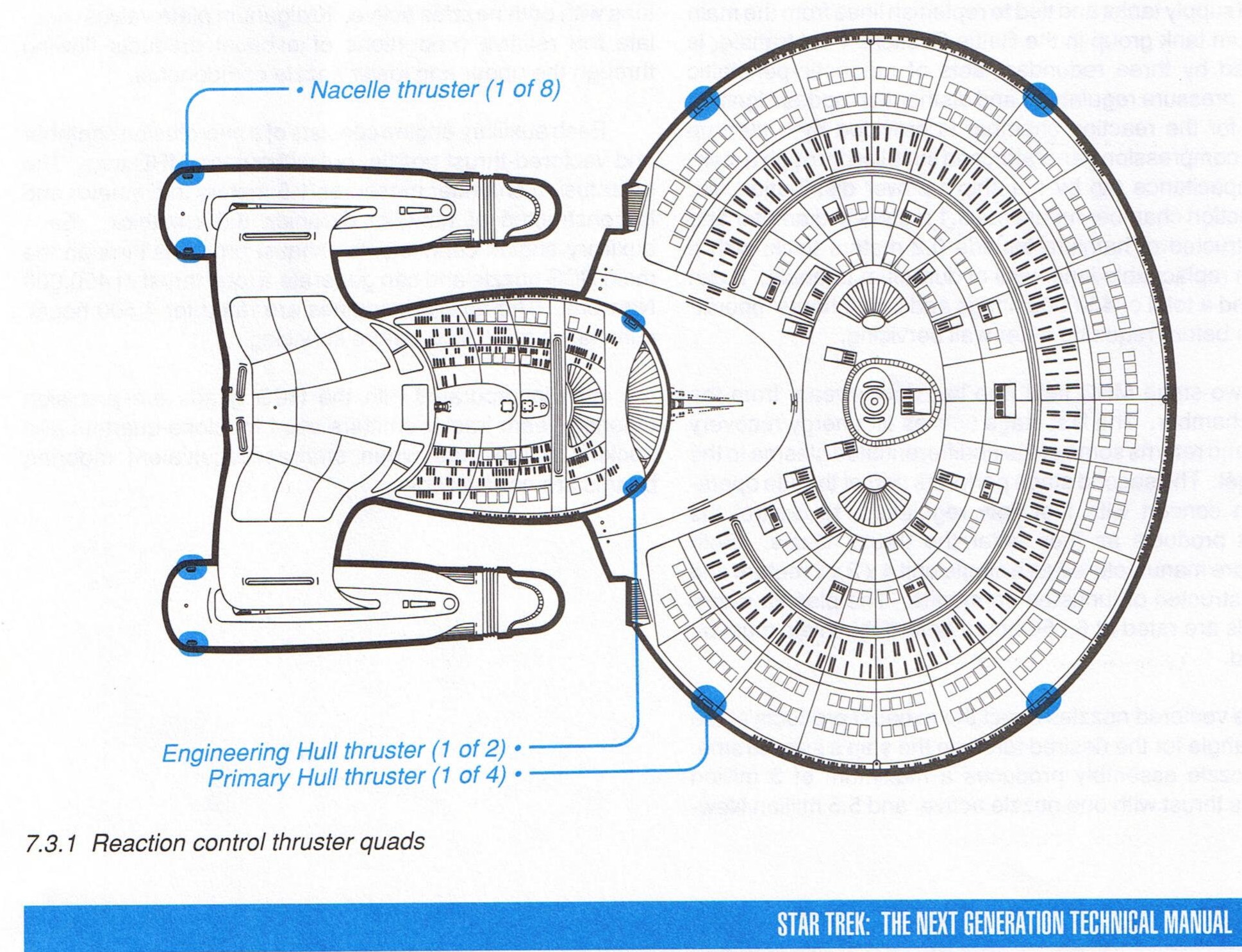
In its connected configuration the Enterprise-D carries six main and six auxiliary engines, responsible for station-keeping, three-axis stabilisation in drift mode and spacedock manoeuvring. They sit in groups on the outer hull that the book calls quads. The accompanying drawing marks fourteen such groups: four on the saucer, the big flat disc at the front, two on the engineering hull below it and eight on the two warp nacelles.
A main engine has three parts. At the front is a gas-fusion reaction chamber that burns deuterium, which is heavy hydrogen. Behind it sits a magnetohydrodynamic energy field trap, MHD trap for short. It taps energy from the hot exhaust as it passes through. At the end are two exhaust nozzles, an upper and a lower one, both of which can be vectored. The burnt deuterium is what gets thrown out. It serves as both fuel and reaction mass.
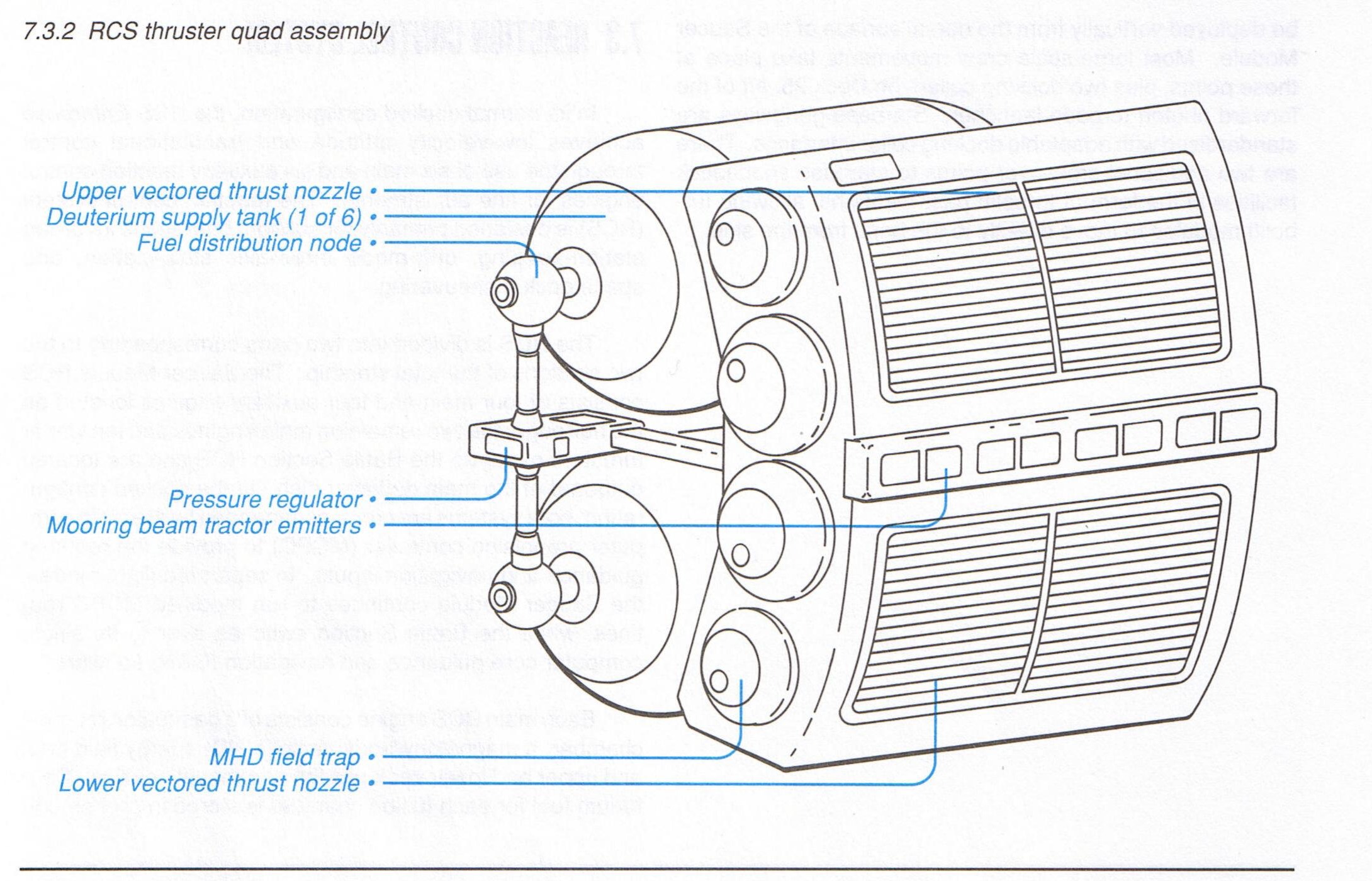
The chamber is 3.1 metres across and is made from hafnium carbide, a real material with one of the highest melting points known. The book even specifies the service intervals: 400,000 firings or 5,500 operating hours, after which the inner wall comes out.
The MHD trap works in two stages. The first captures some of the outflowing plasma and returns the energy to the ship’s power net. The second throttles the exhaust stream before it gets to the nozzle.
Then there are the thrust figures: 3 million newtons per active nozzle, 5.5 million with both together. The smaller auxiliary engines manage 450,000 newtons. They use a microfusion chamber instead of the fusion chamber and have no MHD trap.
Then I started counting, and that’s where I got stuck. The opening sentence says there are six main and six auxiliary engines. One paragraph later the count is four plus four on the saucer and two plus ten on the engineering hull. The main engines add up: four and two make six. The auxiliary engines give me fourteen rather than six, while the nacelles, which carry eight quads in the drawing, get no mention in the running text.
Perhaps the opening sentence counts only the engines needed while the ship is connected, with the rest waiting for saucer separation. The book does not say. I have gone over the passage several times and I still do not know how many thrusters this ship actually has.
How real spacecraft hold their attitude
Real thrusters use chemistry rather than fusion. It is a kind of chemistry that has flown practically unchanged since the sixties: hypergolic propellants.
Hypergolic means the fuel and oxidiser, the substance that supplies the oxygen, ignite by themselves when they touch. There is no spark and no warm-up. There is a second choice, too: both liquids are kept under helium pressure. The gas pushes them into the combustion chamber, so no pump is needed. Open two valves and it burns. A system with no moving parts except the valves is a blessing in space, because nothing can break that isn’t there.
Space Shuttle: 44 thrusters and eight hundredths of a second
The orbiter had three RCS modules: one in the nose section and one in each of the two rear pods. Together they held 38 primary thrusters at 870 pounds of thrust each, around 3,870 newtons. There were also six smaller vernier thrusters at 24 pounds, around 106 newtons, for the really fine corrections.
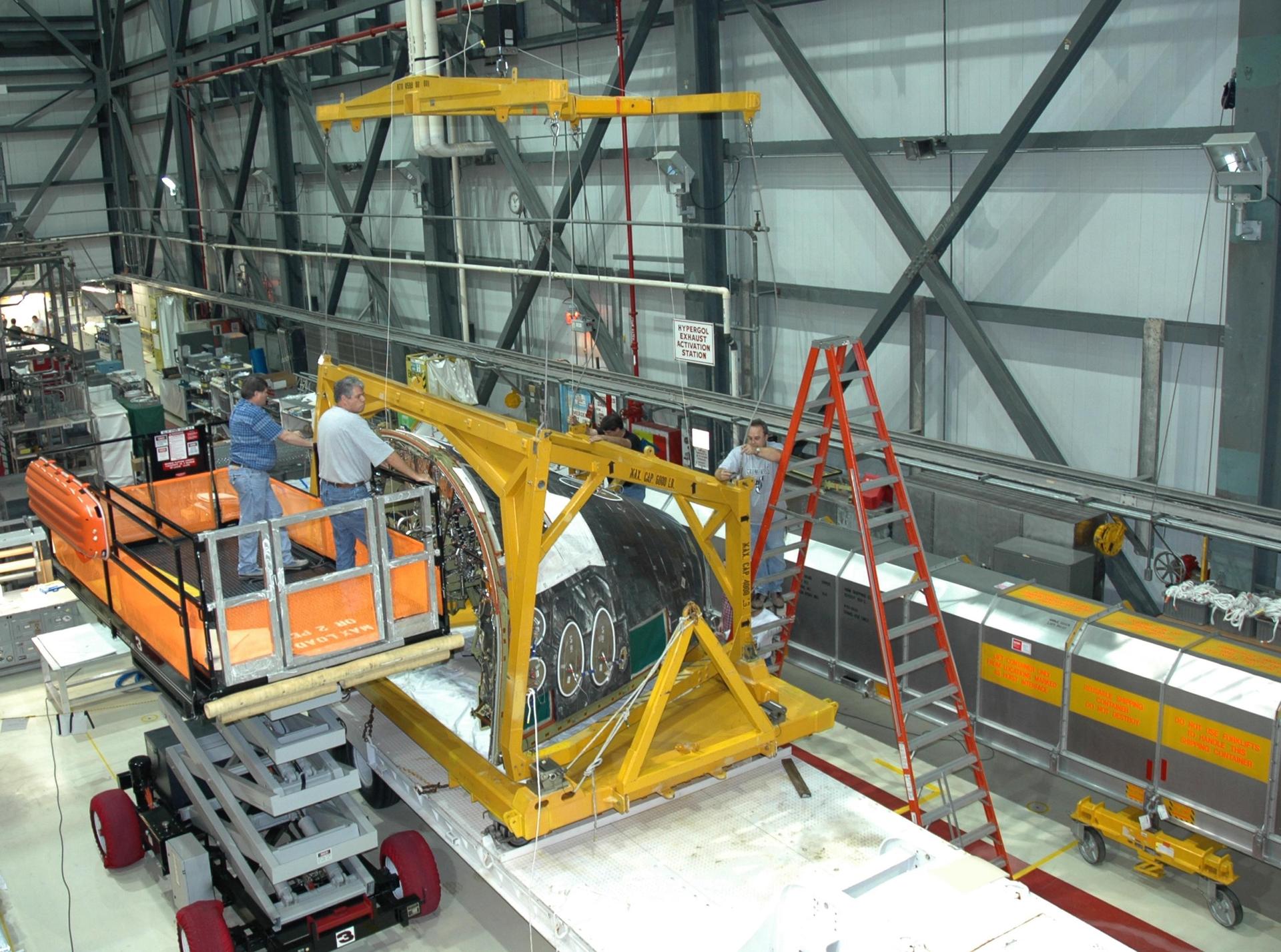
Both kinds used monomethylhydrazine (MMH) as fuel and nitrogen tetroxide (N2O4) as oxidiser. A primary thruster’s shortest possible burn lasted 0.08 seconds, its longest 150 seconds. Each primary was rated for 100 missions, 20,000 firings and 12,800 seconds of cumulative burn time. That gives an entire thruster life three and a half hours of fire, divided among 20,000 bursts averaging two thirds of a second. The small vernier thrusters can take considerably more: 330,000 firings and 125,000 seconds. The smaller the thruster, the more often it gets to fire. That is the rule in spaceflight.
Apollo: 4 quads and a second system for the way home
On the Apollo service module, 16 thrusters were arranged in four groups of four, spaced 90 degrees around the hull. NASA called each group of four a quad. The Technical Manual uses that same word. At that point, the resemblance becomes a loan.
Each of those thrusters was a Marquardt R-4D, 30 centimetres long and 15 across, producing 100 pounds of thrust, around 445 newtons. Here too, monomethylhydrazine and nitrogen tetroxide came from tanks under helium pressure. Later versions of the same design still fly aboard satellites today.
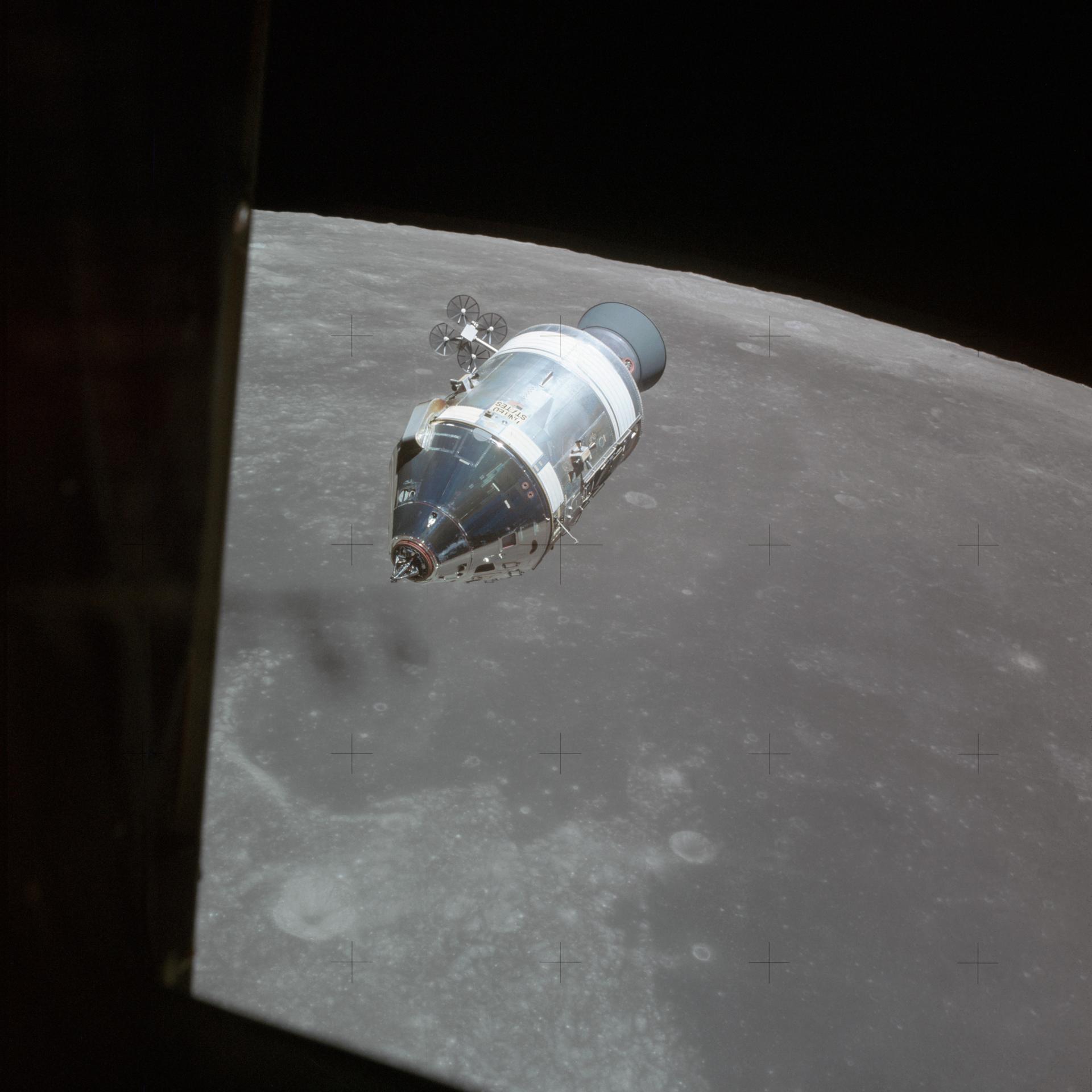
What often gets overlooked: the command module had its own entirely separate system with twelve smaller thrusters at 93 pounds each, around 414 newtons. It was only needed once the service module had long been jettisoned. The capsule fell heat shield first on its own thanks to its offset centre of mass, but those twelve thrusters held the roll attitude and damped the oscillation, and where exactly in the Pacific it came down depended on them. In spaceflight, redundancy is rarely a luxury.
ISS: 32 thrusters and a set of gyroscopes
The International Space Station controls its attitude through the Russian service module Zvezda. NASA lists 32 thrusters on that module for attitude control, plus two large ones for orbital manoeuvring. Each small thruster delivers 130 newtons. Each of the two big ones delivers 3,070 newtons and can be gimballed through five degrees.
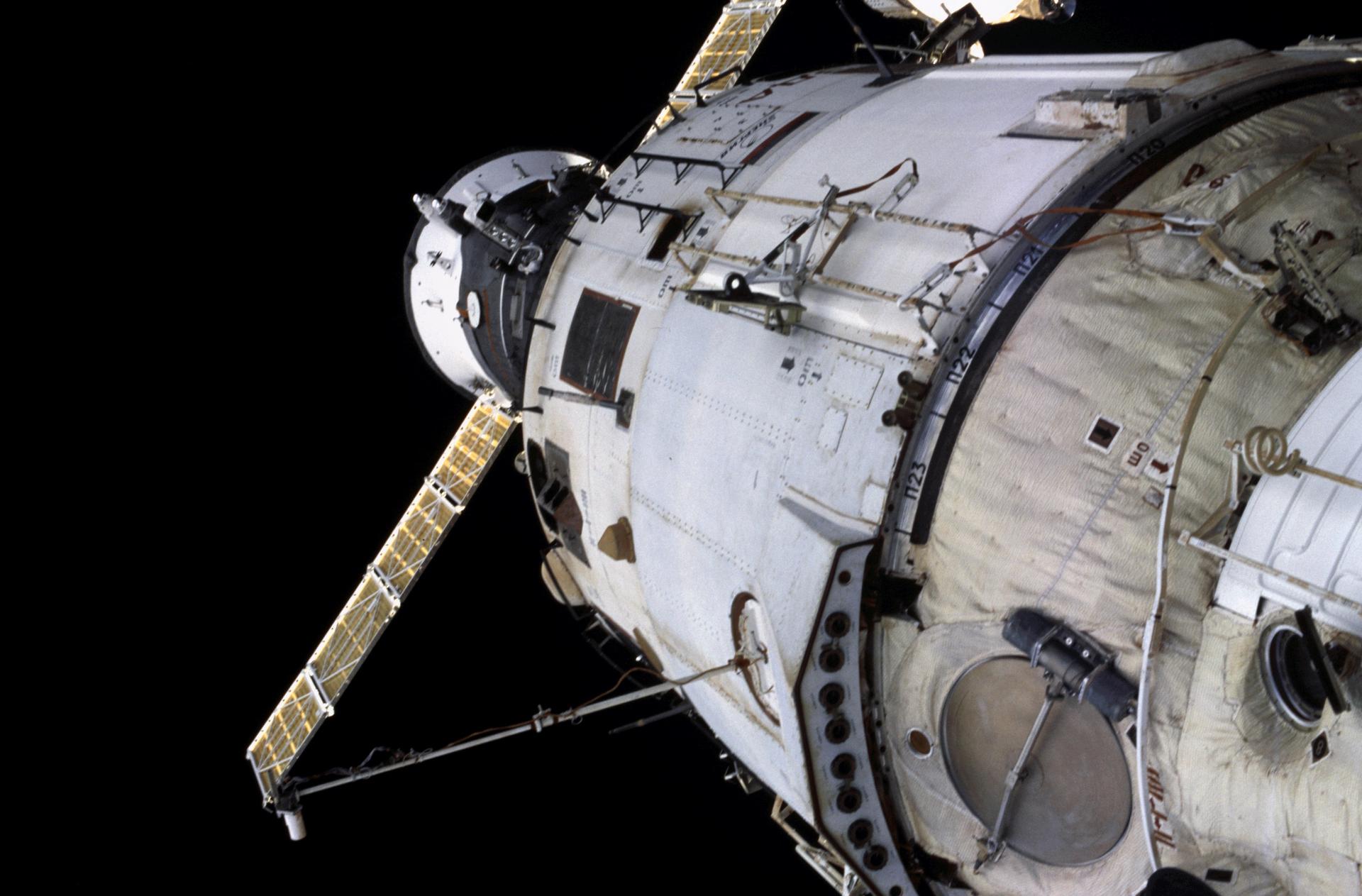
Zvezda alone, out of these three systems, uses unsymmetrical dimethylhydrazine (UDMH) instead of MMH. It is the Soviet house blend. The oxidiser is again nitrogen tetroxide, while nitrogen replaces helium as the pressurant. Four tanks hold 860 kilograms in total.
Here is the second way of turning that I promised earlier. The real trick aboard the ISS is to use its thrusters as rarely as possible. Four control moment gyroscopes on the American part of the station handle fine pointing. They are mounted on the Z1 truss. The Russians call devices like these gyrodines. Their rotors spin at a constant 6,600 revolutions per minute. The gimbal turns, not the rotor, and the rotor’s resistance to being tilted puts torque on the station. They use electricity in place of propellant, and the solar panels supply it for free. The thrusters hold the station to one degree of accuracy per axis; the gyroscopes hold it to half a degree.
The gyroscopes can absorb angular momentum, though they can never shed it. Sooner or later they become saturated, and the Russian module then fires them empty again. Here the two halves of the station work for each other.
Star Trek against real spaceflight: the comparison
Four systems doing one job. Here are the key figures side by side:
| System | Count | Thrust per thruster | Propellant | Energy source |
|---|---|---|---|---|
| Space Shuttle | 38 primary, 6 vernier | 3,870 N and 106 N | MMH and N2O4 | chemical, hypergolic |
| Apollo service module | 16 in 4 quads | 445 N | MMH and N2O4 | chemical, hypergolic |
| ISS | 32 on Zvezda, plus 4 gyroscopes on Z1 | 130 N | UDMH and N2O4 | chemical, hypergolic |
| Enterprise-D | 6 main, plus 14 auxiliary | 3,000,000 N per active nozzle | deuterium | nuclear fusion |
The basic concept holds up. Small thrusters sit far apart on the outer hull, grouped in fours. They handle fine manoeuvring at low speed and are separate from the main drive. In fairness, there is barely an alternative in vacuum. Every designer arrives at this sooner or later. So the loan lies in the vocabulary, not the principle. Anyone writing quads has had a NASA handbook open.
The MHD trap is not a fantasy word either. Magnetohydrodynamic generators really exist, and they were the subject of intense research in the sixties. Send hot, ionised gas through a magnetic field and the charge carriers are deflected sideways, where electrodes pick them up. You get electricity from flowing plasma without a single moving part. The Soviet U-25 facility even fed power into the Moscow grid from 1971. Still, the technology never got beyond experimental plants. Nobody has found electrodes that last long at those temperatures. It is exactly the kind of technology a writing team likes: real enough to sound credible, still unsolved enough for the 24th century.
The number that looks too big
The figure is 3 million newtons per nozzle. That is 775 times the thrust of a Shuttle primary thruster and 23,000 times that of an ISS thruster. For comparison, one of the Space Shuttle’s three main engines in the tail, whose hydrogen flame is barely visible in launch footage, produced a good two million newtons in vacuum. A single manoeuvring thruster on the Enterprise therefore beats it.
Keep calculating, though, and the number starts shrinking. According to the same book, the Enterprise-D has a mass of just under five million tonnes. Applied to that mass, three million newtons produce an acceleration of 0.0006 metres per second squared. After ten minutes of continuous fire, the ship covers about 100 metres. The orbiter, with 3,870 newtons acting on roughly 100 tonnes, accelerates about sixty-five times harder. Relative to its own mass, the Enterprise is considerably less powerful than a Space Shuttle. And 100 metres in ten minutes is precisely the speed at which a ship that size crawls into a dock. The huge number isn’t showing off. It’s to scale.
What Star Trek leaves out: the tank
Real thrusters use up propellant that does not grow back. That supply puts a hard limit on any mission. The ISS keeps its 860 kilograms only because a Progress freighter delivers fresh propellant at regular intervals. It also saves every burst the gyroscopes can take over. The Technical Manual, for what it is worth, does not hide the tank. It even puts a figure on it and lets the MHD trap recover some of the energy. These are two answers to the same problem: the station goes without, the starship recycles.
Only the show never asks. Nobody aboard the Enterprise wants to know how much deuterium is left. That is not sloppy engineering, it is a dramatic decision: a fuel gauge creates tension, but it creates it again every week, and sooner or later it becomes tiresome.
Things get interesting right at that seam between book and show. The Dortmund physicist Metin Tolan approached the calculation from the other end and made a whole book of it. He takes a thrust figure from the canon, measures the acceleration the ship actually achieves on screen, then works backwards using force equals mass times acceleration. His result is 158 kilograms. That does not contradict my calculation. It exposes a contradiction between two sources. The book is internally consistent: its thrust and mass fit together, producing a ship that inches into dock in slow motion. Every week the show demonstrates something else, an Enterprise that leaps off the mark.
What stays
For anyone who would rather hold the Voyager than watch her: my build report on the Revell kit in 1/670 scale is here on the blog. And if it should be real space rather than built space: the blood moon over the Bergisches Land sits in the Historic Horizons section.
What I like about section 7.3 is that it is so unspectacular. Sternbach and Okuda could have made up anything for the thrusters: graviton pulses, inertial field projectors, whatever they liked. Instead they opened a NASA handbook, borrowed its vocabulary and sorted their own numbers until thrust and mass fit. Two paragraphs later, the thruster count no longer adds up. That sits on the same double page. A very human document: meticulous where the two of them cared, sloppy where they stopped caring.
At the next docking manoeuvre, I will watch those little bursts along the hull. It is the one moment where Star Trek doesn’t need an excuse. Impulse and warp drive make things harder, which is exactly why I am taking those on next.
Sources
- Rick Sternbach and Michael Okuda: Star Trek: The Next Generation Technical Manual. Pocket Books, New York 1991, section 7.3, pages 85 and 86.
- NASA Kennedy Space Center, Shuttle Technology Reference: Reaction Control System.
- NASA: Zvezda Service Module. Boeing/NASA Space Station User’s Guide, service module chapter.
- Smithsonian National Air and Space Museum: Rocket Motor, Liquid Fuel, Apollo Service Module Reaction Control System.
- Metin Tolan: Die Star-Trek-Physik. Warum die Enterprise nur 158 Kilo wiegt (The Physics of Star Trek: Why the Enterprise Weighs Only 158 Kilos). Piper, Munich. No English edition.