Lost and Forgotten · No. 001
“Music is the strongest form of magic.”
Marilyn Manson
October 14, 2017, 4:40 PM / UTC+2 – Bad Wildungen, Germany
The dust lay so thick on the hall floor that his shoes left prints the way they would in snow.
Lukas stopped and looked back. Two tracks, straight down the hall to the front door he had not pulled all the way shut. Nothing else. No sweeping, no other soles, nothing to say that anyone had walked here in the past few weeks.
That should have reassured him. It did not.
He went on. The air tasted of wet paper, sweet on the palate, the way books smell when they have soaked through and are coming apart from the inside. Under it cold plaster and something metallic he could not place. With every step the floorboards gave under the carpet runner, not much, but enough that he shifted his weight onto the balls of his feet without thinking about it.
In the stairwell the light came in at an angle through a window of glass block, milky and without direction. The rail was thin steel rod, bent into uneven curves, no two alike. Above the first turn the wallpaper hung in a strip almost down to the steps, red flowers on a ground that had once been pale.
Eighty euros a month. He had read the figure twice before he understood that the ad was serious. A room in the apartment above the shop, two streets over, kitchen and bath shared.
He had nothing else. The apartment in Cologne was gone, the piano too, sold to a man from Leverkusen who came to collect it while Lukas stood in the stairwell pretending he had a call to make. After that, two months without a single note. Not because he had not wanted to.
Upstairs it smelled different. Drier, dustier, and the sweet paper smell fell back.
The door at the end of the corridor stood open.
He saw the room before he entered it: ocher stripes on the walls, a salmon-colored curtain with a valance hanging in front of a narrow window, throwing the light into the room as if through tinted glass. To the right a double door with muntins and panes, behind it a room whose ceiling lay open. Beams, pipes, a piece of sky where something had come down.
And in the middle, lid open on the prop, the grand.
Lukas heard himself breathe in.
He went over, slowly, because the floor between him and the instrument was covered in paper. Sheet music. It lay in single leaves and in layers, some with the written side up, some baked together by water. He picked one up. Handwriting, not a printing plate. The lines drawn with a ruler, the noteheads cleanly set, in one place a measure struck through and written out again below it.
On the fallboard stood Grotrian-Steinweg in Fraktur, the old German blackletter, and beside it, smaller, the name of a dealer in Kassel. The finish was matte and rubbed through at the edges. Above the top octave someone had scratched something with a sharp object that was no longer writing.
He did not wipe it off. He laid his index finger on a key, into the dust, and pressed it down.
The note came.
It came full and deep and without the rattle he had expected, and it stood in the room as if someone had set it there. Lukas felt it in the soles of his feet through the floor, then in his ribs. The hair on his forearms stood up.
Thirty years. No tuner, no heating, frost down into the strings in winter.
The instrument was in tune.
He drew his hand back and waited for the note to die away, and for a moment, when it was almost gone, there was something else underneath it. Not a second note. More the place where a second note would have been.
Then it was quiet, and the quiet had a direction, the way a room has a direction when someone is standing in it.
He came back the next day, and the day after that.
The room above the shop had a table, a mattress and a window onto the yard. He could stand it there until late morning. Then he took the bag with the notepad and walked the two streets over. At first he still told himself he only wanted to check whether the door was open. At some point he let that go.
The grand was holding its tuning. That was the second impossibility, and it was harder to push aside than the first, because he could check it every day. He struck an octave, listened and found nothing. No beats, no sag in the bass.
On the third day he lifted the lid all the way and looked inside. The pinblock is the first thing to give up in a cold house: the wood works over the winters, the pins sit looser, and at some point none of them holds what you force on it. He turned one with his thumb. It sat as if someone had tightened it yesterday.
Next to it, stamped into the cast-iron plate, was a number. He copied it down and looked it up that same evening in the room above the shop, and what came of it was a year of manufacture, and it lay far ahead of everything else in that house.
On the fourth day he wrote down the first sixteen measures.
It came easily. It came so easily that in between he laid his hands in his lap and waited to see whether it would stop. Outside it grew dark early, the curtain hung still in the room, and the pencil kept going as if someone were guiding it.
On the fifth day the sheets lay differently.
He would not have noticed if he had not picked one up the evening before and put it on the stool to look at more closely next time. The sheet was on the floor now, in the same place it had been before, with the same corner under the right front leg.
The dust on it was untouched.
He stood there a long time. Then he looked at his own prints, which ran from the doorframe to the stool and nowhere else, and at the fact that around the grand there was an area with no dust on it at all. Not wiped. Simply no dust, the way it is in a place where someone is always standing.
That evening he stayed until it got dark. He played the sixteen measures he had, and after that nothing came, the way nothing had come since the fourth day. Then he left the old sheets where they lay, pulled the front door shut behind him and walked off down the street.
He was almost at the corner when something started up behind him on the first floor. Quiet, muffled through two walls and a closed window, but an instrument, not wind. He knew the sequence. They were his own sixteen measures, and they broke off in the same place where he had broken off earlier.
Then they started again and went on.
On the eleventh day he stayed the night.
He brought a blanket, a thermos and the flashlight from the car he had not sold yet. Around ten he sat on the stool with his back to the grand and watched the last of the light go out of the salmon-colored curtain. The room did not go dark, it went gray, and then the gray went grainy.
A little after eleven thirty the house stopped creaking.
He noticed it because it had been creaking the whole time before, beams, plaster, a drip somewhere. Not anymore. He heard his own blood in his ears and the sheet of paper he was turning between his fingers, and nothing else.
The cold did not come through the door. It came out of the floor, up through the soles and the calves, and when it reached the backs of his knees, he turned around.
The keys were moving.
Not all of them, not at random. One, then two, cleanly struck and held, with a weight behind them that belongs to fingers. The note stood in the room, and the key came back up as slowly as it comes back when someone releases it, and not the way it springs.
Lukas stood up and knocked the stool over.
The bang echoed, and in the same moment the light was different. It came from the right, where there was no window, and it was blue. Not the blue of moonlight on snow. A cold, grainy glow with no source that still cast shadows, and the shadows ran the wrong way.
She was standing at the head of the grand.
He saw the hair first. It was black and came down past her hips in heavy waves, and single strands glowed from inside, as if a thread of light lay in each one. The dress was white and close at the upper body, a high lace collar up under the chin, closed with a round brooch with a blue stone set in the middle. From the shoulder, lace fell in layers to the floor, and where it touched the floor no dust rose.
Her skin was blue-gray, and it glowed.
Then he saw the eyes.
They had no pupils. They had no iris. They were entirely white and sat in sockets ringed with dark, as if the flesh around them had sunk in, and they stood open without blinking, and they looked past him.
That was the worst of it. Not that she was looking at him. That she was not.
Lukas wanted to say something and found that his jaw would not open. Not clenched, not bitten shut. The order arrived and was not carried out, the way it happens in a dream, and he heard the sound he made instead, a pull of air through the nose, and he heard that it was the sound of an animal.
He backed away, spine first, and stepped on the sheet music, and the paper tore under his sole with a sound that was far too loud.
Her head turned toward it.
Too fast. The head was already there while the movement was still running, like footage with frames missing. And then it did it again, in the other direction, and again, four times back and forth in less than a second, the hair following a beat late every time.
It stopped. She stood still.
His bladder clenched. He had not known that really happens.
The smell came only now. It did not come from her, it came from the whole room at once, cold and mineral, the way a cellar smells with water standing in it, and under it something sweet that he knew from the library and that had no business here.
She was closer.
He had not seen her move. A meter and a half had passed between two blinks, and her feet stood under the hem, and he had had the hem in view the whole time, and the hem had not moved.
From that distance he saw that the lace at the collar did not lie on her but in her. The fabric had no shadows. The light went through where it should have rested, and at one spot below the collarbone he saw through the dress and through her the pattern of the wallpaper, ocher and striped, and it was not distorted.
She raised a hand.
He saw that the fingers looked too long because they were too thin, and that the fingertips did not go flat toward anything but spread, and something in him that had nothing to do with thinking read that as reaching.
His jaw opened. The scream did not come.
He ran.
On the stairs he lost his footing.
He grabbed for the steel rod, and the steel rod gave, because thirty years of damp had worked at the anchoring, and then came the wall, then the edge of the fourth step under his ribcage. The air went out of him. He lay across the stairwell with his face on the carpet runner, smelling wet dust and tasting blood, because he had bitten his tongue on impact.
Above him it was silent.
Not quiet. Silent in the way it had been silent in the room when the house had stopped creaking, and the silence came down the stairs, step by step, the way cold moves through a room.
He got onto his knees and then onto his feet and made the rest without the rail, his shoulder against the wall. On the ground floor he ran into the doorframe, half turned, tore the front door open and was outside in the wet air, and he ran off down the street and did not turn around.
He ran four streets. At the end he had to hang onto a fence and retch, and nothing came, because there had been nothing in him since noon.
Behind him, on the first floor, the light in the windows went on and off again, blue, twice, like two breaths.
And then the grand played on.
For four days he did not go.
He slept with the light on. He shopped at the store under the apartment and talked to the woman at the register about the weather, just to hear a voice that belonged to a body. Twice he packed his bag to drive to Cologne, and both times it occurred to him that there was nothing there to drive to.
On the second day he had the explanation ready.
Carbon monoxide. A leaking flue, a blocked chimney, a house where nobody had maintained anything for thirty years. It was all online, and it fit every single item: cold that comes from below. Colored light phenomena. Figures at the edge of the field of vision. Panic without cause. He read it through twice and put the phone down and breathed easily for the first time in two days.
The explanation held until he went back.
The measures stayed.
They ran in the morning while he brushed his teeth, they ran in the evening when he closed his eyes, and they went on at the place where he had broken off in the night. On the third day he sat down and wrote them out, and what came out of the pencil was better than anything he had managed in Cologne in two years.
On the fifth day he went back, in daylight, and took the flashlight.
He told himself he wanted to understand the house. He looked into the rooms he had not looked into before, and what he found did not make it better.
On the ground floor, to the left of the entrance, shelves stood to the ceiling, and the lower rows had swollen and grown together. A green wing chair stood in front of them, angled so that someone sitting in it would have looked out the window. The smell of wet paper came from here.
At the end of the same corridor was a door with a pane of frosted glass.
Behind it the carpet stopped and tile began, and the temperature dropped so noticeably that he felt it on the backs of his hands. A window facing north, barred from outside. In the middle of the room stood a chair.
Not an examination table. A chair, with two supports for the legs, angled outward, and beneath it, in a bracket, an enameled basin. Above the chair hung a lamp with four shades on an articulated arm, and the arm had been run down low, as if someone had pulled it over a body and not pushed it back up.
Lukas laid his hand on the seat. The vinyl did not give a millimeter. It was hard and cold and smelled, when he leaned closer, of old rubber.
There were files on the floor. Not a few. The whole room lay full of them, index cards, forms, prescriptions, and among them photographs with people from a time when you held still to be photographed. Some lay writing side up. A name at the top, a date below it, further down lines in a hand that no one read anymore. He did not pick any of them up. He noted that he did not want to, and was relieved about it.
At the door he lifted his foot. A card had stuck under his sole, where the paper had been damp. He peeled it off, and because you read what you are holding, he read it.
It was older than most of what was in that room. Thicker paper, yellower, the writing narrow and slanted to the right. At the top a first name and a last name, of which the waterline had left only the first letter. Below that a date, and he read it twice. 1913. It did not go with the lamp above the chair or with anything else down here.
Anna, it said.
He laid the card on the seat of the chair, written side down, and wiped his hand on his trousers. Only out in the corridor did it occur to him where he had put it.
One floor up stood the grand. Until a moment ago, no one in this house had had a name.
He went up and past the hall where the shutters stood open, and on up under the roof.
The bedroom was there. He took two steps in and stopped, because the floor gave, and then he saw that it was not carpet. It was feathers. They lay everywhere, ankle deep in the corners, and they rose with every step and hung in the air. Above the bed hung a canopy of fabric where someone had left a heart and two letters with a spray can. The mattresses were slit open. Not burst. Cut, in straight lines, by someone who had taken his time.
He went back down to the first floor, into the ocher room, and there the sheet music no longer lay the way he had left it.
It lay in a row.
Seven sheets, from the window to the stool, evenly spaced, all with the written side up. The dust between them was untouched. There was no drag mark, no print, nothing to show how they had got there.
Something in him read that at once, and it read it wrong.
He saw a line running toward him. He saw seven steps someone had taken, and the last of them under his seat. He heard himself breathing, far too fast, and then he stepped into the row and shoved the sheets apart with his foot, one after another, until there was no order left.
“I’m not doing this,” he said into the empty room. “I’m not going along with it.”
The light turned blue.
It came from the right again, without a source, and this time he did not wait. He took the stool by the leg and lifted it over his shoulder with both hands.
She stood two meters in front of him.
He swung.
He did it with everything he had, with the full turn from the hips, and the stool went through her upper body and carried Lukas with it, because there was nothing there to stop it. The force spun him around his own axis. The stool struck the grand, the wood splintered at the edge, and inside the instrument a chord sounded that no one had played, deep and long.
Where the blow had gone through, something pulled apart in her like smoke over water and ran back together.
She had not moved.
Lukas stood with his back to the window, holding the stool in front of him like an object that had suddenly become nothing, and in that second he understood something that took the floor out from under him: there was nothing he could do. Not strike. Not run, he had tried that, and she had been there again the next time. There was no door that fit between him and this.
He heard himself breathing and could not stop.
From that close he saw that the lace at the collar had a floral pattern, that a second brooch sat lower on the bodice and carried the same blue stone, and that the dress was not transparent. It was there. It had folds where shadow gathered. What was transparent was her.
Again she was not looking at him. She was looking at the floor, at the scattered sheets.
And then something tipped in her face.
The brows drew together, the corners of the mouth fell, and the lower lip pulled inward, very briefly, the way it does with someone who has given a gift and watches it being dropped. Then a jolt ran from the shoulders into the hands, and the fingers stood spread in the air, the way they had when he had taken it for reaching. After that they hung down again, as if she had not noticed it herself. It lasted less than a second, both together. The first movement in her did not look wrong. The second one did again.
The stool grew heavy in Lukas’s hands.
She went down on her knees.
Not toward him. Beside the sheets, with her back to him, and began to gather them. She did not touch them. She held her hand above them, and the sheet came up, and she laid it back in its place in the row, one after another, in the same order as before.
At the fourth sheet Lukas saw what was on it.
It was his handwriting.
It was his sixteen measures, the ones he had written on the fourth day and then put in his bag, and below them stood eighteen more in a hand that was narrower and set the noteheads at a steeper slant, and the place where his pencil had broken off was exactly where the other hand had started.
It went on where he had stopped. Not beside it, not below it. On.
He set the stool down.
She paused, her head half turned, and waited to see whether he would reach for it again.
He let go of it.
She laid the seventh sheet in its place, straightened the edge with two fingers without touching it, and stood up.
Then she raised her hand, slowly this time, so slowly that he could see her doing it, and laid her fingertips against his cheek.
He felt no skin. He felt cold, but it was not the cold of the room, it was something with a direction, and it ran from the cheek over the jaw and down his throat. His pulse beat against it in his neck.
She left the hand there for three breaths.
And then she looked at him. For the first time not past him but into his eyes, with white eyes that had no pupil, and he had not the faintest idea how that was supposed to work, and knew all the same that she was doing it.
He left when it got light. Down at the front door he noticed that his hands were shaking, and he stopped and waited for it to stop. It stopped. Then he thought about the stool he had swung up, and it started again. He knew he would come back that evening, and set off before he could finish the thought.
That was how the nights began.
He came in the evening when it got dark and left when it got light. He brought candles, because the flashlight flattened everything, and a folding stool, because he did not want to use hers anymore. She was already there, every time, and every time he knew it because the house stopped creaking.
She did not speak.
He tried it in the second night, with a question he started three times before it came out. She stood at the window, her head tilted slightly, and waited until he was finished. Then she looked at him and did nothing further, and he understood that it was not a matter of will. There was nothing there for her to do it with.
So they put paper between them.
He wrote a measure, pushed the sheet across the music desk, and she looked at it. If it was right, her chin came down, a nod that was barely one. If it was not right, she stayed still, and he struck it out and wrote it again, and at some point he understood the silence too: it was not a verdict, it was the invitation to try once more.
Her corrections came without a pencil. She held her hand above the sheet, and the note was there, narrow and slanted, with heads that tipped to the right.
In the third night he contradicted her for the first time.
She had rewritten three measures he had thought were good, and what came of it went in a direction he did not want to hear. He struck it out. He wrote his own version underneath, pushed the sheet over and looked at her the way you look at someone you want an answer from.
She read it. Then she raised her hand, and the note did not disappear, it moved. She took his measure, left the first half standing and turned the second around, and what came of that was neither what he had written nor what she had written.
It was better.
He read it twice and felt something he had last felt in Cologne, in a room with other people, when somebody had shown him how it was done. He wanted to object and found nothing to object to.
He nodded. She took her hand off the sheet.
After that he wrote differently. He left places open where he would have closed them before, and waited to see whether she reached in. Sometimes she did. Sometimes not, and then he knew he was meant to finish it alone.
In the fourth night she played in front of him for the first time.
She did not sit down. She stood at the head of the instrument, her hands above the keys, and the keys went down without her fingers reaching them. What came of it was nothing Lukas knew, and it was nothing he could have played either. It started low, in the left hand alone, a figure of five notes that repeated and on the third time set one of them differently. Then the right hand came in. It ran in a key that refused to settle, and every time he thought it had arrived, it went one step further, and then another.
He sat on the folding stool with his hands between his knees and noticed at some point that he was crying, without his face having moved. It simply ran.
When she stopped, she looked at him, and this time the corner of her mouth went up. Only the one, only for a moment.
He played it back.
The first forty measures cost him three nights, and the place where it caught was always the same: a jump in the left hand, across an octave, in the middle of a phrase that left no air for it.
The first time he played over it and went on. He got four measures further, then her hand stood above the keys, and the sound broke off as if someone had shut a window.
He looked up. She was looking at his left hand.
So, from the top.
The third time his shoulders came up and he struck harder than he needed to. He thought about how he had once been someone nobody had to tell that to anymore. He played the passage deliberately clean and the rest sloppily, to see what would happen.
She let him run to the end. Then she raised her hand and made him start from the top again.
The fourth time she laid her hand over his, without weight, and led it along the stretch she meant. The jump had not got smaller. She only took it earlier, half a beat before the place where he had been taking it, and then the hand lay where it had to lie, and the phrase had air.
He copied it. It worked.
It took him a moment to notice that he was laughing, and another to notice that it was the first time since Cologne.
The house changed with it. He could not have said when it had started. In the eighth night a shutter stood open that he had never seen opened, and the moonlight lay as a rectangle on the floor, in the middle of a room that had been closed for thirty years. When he stepped out onto the street in the morning, the daylight blinded him so badly that he had to stop and shut his eyes.
In the tenth the stairwell no longer smelled of wet paper but of cold stone and faintly of beeswax. That same morning the coffee in the room above the shop tasted of nothing, and he drank it anyway.
The strip of wallpaper above the first turn still hung there. Nothing changed about it. He looked at it every time all the same.
Down in the town they noticed around the same time.
First two women with a dog stood at the corner and looked up. Then there were more. They came in the evening, stopped on the sidewalk and moved on after a while, and nobody rang the bell, and nobody called the police.
The woman from the shop put his change down and left her hand on it. She was in her late fifties and wore her glasses on a chain. The nails on both hands were cut so short that the pads stood out above them.
“My grandmother had lessons there,” she said. “During the First World War. She was nine.”
Lukas waited.
“Twice a week, up to the first floor. She never said with whom.” The woman took her hand off the money. “After that she never played again. We had a piano standing in the hall when I was small, and she walked around it every time.”
“Did she say why?”
“No.” She looked past him toward the door. “She said it’s a beautiful house.”
She asked nothing. She only set it down, the way she had set down the change, and then the next customer came, and Lukas left.
Outside he stopped and looked down the street to where the people stood in the evenings. There were always some there now. They looked up, and they went away again, and not one of them had ever come up the stairs.
An old man spoke to him and asked whether that was him, up there.
“Partly,” Lukas said.
The man nodded as if that were a normal answer, and walked on.
Some claimed later that they had heard voices in the melodies. Lukas heard no voices. He heard that the music went on every evening at a place where it had been the evening before, and that it was nearing an end, and he heard that there was an end that everything had been running toward since the first note he had struck in the dust.
What he did not hear was the stairs.
From the tenth night on, the way back took him three times as long as it had on the first evening. He stopped on the landing with one hand on the steel rod and told himself it was the sleep. He slept during the day, four or five hours, and woke as if he had not been lying down.
The room above the shop was worst in the morning. It smelled of the yard and of cold grease from the kitchen below, the window in the shared bathroom faced north, and the light in there was such that everyone looked like they had come off a night shift. He told himself that every time he looked in the mirror while shaving.
That morning he told himself twice.
The face in it was thirty-two and looked older. The cheeks lay narrower than in Cologne, the temples sunken, and over the jaw stood four days of beard that came through gray in places, which he had not known before. His hair hung in his forehead, dark and too long, nobody had cut it since Cologne. The eyes sat deeper. The lower lip had split in one place and bled when he opened his mouth too wide.
He drank two glasses of water from the tap, one after the other, and was still thirsty afterward. Then he leaned in closer, and the mirror really was bad, that was true, but it was not that bad.
Getting dressed, the belt went one hole further than usual. It was the brown one he had bought himself in Cologne for a performance, and the leather carried a crease at the old hole that would not press out. He pulled it tight, looked at it and let the shirt fall over it. He had never carried much on his ribs. But the shirt had not hung on his shoulders like that in Cologne, with the collar that now had room.
Then he took the bag and the sheets and left.
His hands he saw the whole time. Four hours at a stretch they lay in front of him on the keys, in candlelight, closer to his eyes than anything else in his life. A few nights later he noticed that the tendons on the backs of his hands stood out more clearly than before and that the veins lay over them like an old man’s. He pinched the skin up over a knuckle. It took too long to settle back flat.
He turned the left hand over and looked at it.
Then he turned it back, because in the next system there was a passage he did not have securely yet.
Anna grew more distinct.
He had called her that since the card under his sole. Whether the name belonged to her he had never checked.
He saw things about her that had not been there before. In the twelfth night she cast a shadow.
In the thirteenth night he meant to let it go.
He had decided it in the afternoon, in the room above the shop, with the belt in his hand. At nine he sat on the mattress and listened to the woman downstairs pulling down the shutters. At half past ten the house was quiet, and in the quiet it started up in his head again, the eighteen measures in the narrow hand, and they broke off where they always broke off. He lay down and got up again. He turned the light off and on again.
At a quarter past midnight he put his shoes on.
The two streets were wet. Nobody stood in front of the house. The first floor was dark, and he stopped at the fence and waited for it to grow light, blue, the way it always grew light. It did not grow light. He stood there until the wet came through his shoes, then he went in and up the stairs, and the door at the top stood open as it did every evening, and the room was empty.
He sat down at the grand and played the beginning, because he did not know what else to do. In the middle of the second system he noticed he was playing too fast. He stopped and laid his hands in his lap.
She did not come.
He stayed until four.
In the fourteenth night she was there before he had lit the candle.
He heard her first. A drag of fabric on floorboards, behind him, level with the window, and he turned around and laughed, because for the first time a sound from her had not frightened him. She had her head tilted, and the hem lay on the floor where in the nights before it had stood a hand’s breadth above it.
He said nothing about the evening before. She did not ask, she could not, and she did not look at him that way either. She went to the music desk and held her hand above it. Below the eighteen measures the paper was empty.
In the fifteenth night he wanted to leave earlier.
He had not slept all day, and at some point around two he stood up and said that he would come back tomorrow. He said it into the room, the way he said everything into the room, and then he gathered the sheets and turned toward the door.
The door was shut.
He had left it standing open, the way he did every time, because the lock stuck and he did not want to be locked out. Now it was shut, and when he pressed the handle down, it did not move.
Behind him the house stopped creaking.
He did not turn around right away. He stood with his hand on the handle and felt the cold come out of the floor, up through the soles and the calves, and his body knew faster than he did what that meant.
When he turned around, she was standing at the head of the grand, where she had stood in the first night, and the light in the room was blue.
She was looking past him.
“I’m coming back,” he said, and his voice came out too high.
She laid a hand on the keys without looking, and what came was the passage from the middle, the one that had cost him three nights. She played four measures and stopped.
Then she waited.
He stood at the door a while longer. Then he went back, sat down and laid his hands on the keys, and at four, when he stood up for the second time, the door was open and the light in the room was the way it had been all night.
On the stairs he stopped twice. He told himself she had not understood him.
In the sixteenth night she sat down on the stool.
She sat. The padding gave under her the way it gives under a person, and she laid her hands on the keys and pressed them down with her fingers, and Lukas stood behind her and saw that her hair had fallen forward over one shoulder and left the nape of her neck free, the high collar and the fine dark hair above it, and thought of nothing.
In the second measure a note sat wrong.
Not by much. A half step, in a place where she had been right a hundred times. She did not stop. She played over it, and Lukas heard that she had heard it, because her hand lay a shade too carefully afterward.
He said nothing. He thought it was the fingers, the adjustment. Then the next entry came, and he went on listening.
She turned her head without stopping, and looked at him.
He laid his hand on her shoulder.
It was the first touch that came from him. He felt the fabric. He really felt it, the rough pattern of the lace under his fingertips, and beneath it something that gave, and the cold, which by now was less than in the nights before.
She stopped playing. She tilted her head far enough that her cheek touched the back of his hand, and stayed like that.
The night after that they did not work.
He had brought the sheets and the pencil and laid it all out, and then he sat there and did not do it. She stood at the window where she always stood, and at some point she turned around and looked at him, and he shrugged.
She came over and sat down beside him on the floor.
So they sat. Backs against the wall under the window, the candle on the music desk, and outside the rain came and went. She looked straight ahead at the doorframe opposite, and he looked at her from the side, for as long as you do not look at a person, because it would be rude, and she allowed it.
Her profile had a line from the forehead over the nose to the chin that he could have memorized, if it had come to that. The collar went up under the chin. At the ear, where the hair fell back, there was nothing, no stud, no hole, and he thought that she came from a time when daughters did not have their ears pierced.
He noticed that he had started talking.
He talked about Cologne and about the man from Leverkusen who had picked up his piano and asked twice whether the price still stood.
Then he came to the exam.
“There were twenty-three people in the hall,” he said. “I counted them while I was waiting. You don’t do that, but I counted them.” He looked at his hands. “In the third minute came the place where I got stuck. Not difficult. I had played it a thousand times.”
He stopped and started again.
“I didn’t break off. That’s the stupid part. I kept playing, eleven minutes, and everyone in that hall knew where it had happened, and I kept playing as if nothing had.” He pulled up one shoulder. “After that I didn’t do it anymore. Not in front of people.”
She did not interrupt him, which was easy, and she did not look at him with pity, which was harder and meant more to him.
When he had finished, she raised her hand and laid it against his cheek.
It was the same movement as on the evening he had swung the stool at her, and it was not the same thing. The cold was gone. What was left was pressure, light and dry, a palm against his cheekbone and a thumb that went across it twice, slowly, the way you do with someone who is crying and will not admit it.
He was not crying. He held still and closed his eyes and breathed through his nose.
When he opened them again, her face was closer, and she was looking at him out of white eyes that had no direction and reached him all the same, and somewhere behind his ribs something contracted that had nothing to do with fear anymore.
She left her hand there until the candle on the music desk collapsed into itself.
Outside a car went past, and the headlights traveled across the ceiling, and Lukas heard his own heart and thought that it was beating too loudly for so quiet a moment.
It was not too loud. It was too slow, so slow that he waited between two beats, and when he got up in the morning it made up for everything at once, and on the stairs he had to sit down twice.
After the eighteenth night the town began to look at him. On one of those evenings he noticed that he had been playing in front of people for weeks. Until then it had not occurred to him.
The woman in the shop twice added something he had not ordered, rolls one time, a bar of chocolate the next, and pushed it across the counter without ringing it up. The landlord came up, knocked, looked at him in the doorway and asked whether everything was all right with the heating. It was November, the heating had been running for a week, and they both knew it.
“All good,” Lukas said.
The man looked past him into the room, at the mattress and the table and the sheets lying everywhere, and left again.
In the house he did not notice it. In the house he was never tired.
That was the strange part, and he actually thought about it a few times, between two sentences, when he was looking at a sheet. As soon as he had the stairs behind him, the dragging in his legs stopped. The fingers that were stiff in the morning ran. He could play four hours at a stretch, five, and noticed it only because the rectangle of moonlight had traveled across the floor.
Outside then, on the street, it came back. Doubled.
In the twentieth night the music stood just short of its end. There were not many measures left, and he knew which ones they were, he could already hear them, they only had to get onto the paper and into his hands.
That evening Anna was not waiting at the window.
She stood in the middle of the room when he came in, and she stood facing him, and Lukas stopped in the doorway, because something about the way she held herself was not as it usually was.
She raised a hand and pointed at him. Then she turned the hand over and pointed at the door he had just come through.
He did not understand it.
She did it again, more slowly. At him. At the door. And then a third thing he had never seen in her before: she shook her head. After that she pointed at the sheets on the floor and then at herself. Her hand went a little further, in his direction, and stopped halfway. Then the hand sank, and she shook her head again.
“We’re almost finished,” he said.
She stopped shaking her head and simply stood there.
He went past her to the grand, and as he sat down he looked up into her face, and in that face was something he knew from his mother, from a hospital corridor, a very long time ago. He saw it and placed it and pushed it away, all in the same second, the way you do when you do not want the end of something.
Then he laid his hands on the keys.
It was seventy-two measures to the end.
At measure twenty sweat ran into his collar, although the room was cold. At measure forty the paper in front of him went out of focus, and he played on from memory, because he knew it from memory. At measure fifty he heard his own breathing beside the instrument, short and flat and much too fast for what his hands were doing.
He looked up once.
Anna was complete. She stood in the candlelight and cast a shadow that matched the candle, and her skin was no longer blue-gray but had a tone you would not have noticed on a person, and her eyes were still white, but in the white eyes there was water now.
She held both hands in front of her mouth.
At measure sixty his left hand no longer went where he sent it. He corrected, missed, corrected again. The rest he played with a mistake in every second measure, and it was all the same to him, and somewhere underneath it all lay a thought, small and far away, that they were the same mistakes he had made as a child.
He hit the last chord.
He held it until the pedal no longer carried it, and after that it was quiet, and in the quiet the room tipped away to the left, and Lukas slid off the stool and hit his shoulder and then his head, and the sheets under him gave like leaves.
The wind came from inside.
It went through the room without a window being open, tore the salmon-colored curtain horizontally into the room, knocked over the candles and slammed the doors throughout the house, one after another, from top to bottom, until down in the hall something crashed twice and then nothing came.
They were standing in front of the house within minutes.
They were used to the music, and so they came when it stopped: the woman from the shop in her bathrobe, the old man from the street, the landlord, and behind them eight more holding up phones. The front door stood open as it had for weeks. They went up the stairs in a cluster and stopped in the doorway of the ocher room.
Lukas lay on the floor among the sheets, his face turned to the side.
A woman stood next to him.
She wore a white dress that none of them could place, and she was barefoot, and her eyes were wet. She had one hand half outstretched toward the man on the floor, and she did not pull it back when the people came in.
“Who are you?” the landlord said. “What did you do to him?”
She opened her mouth.
Nothing came.
She tried again, and you could see that she was trying, you could see the throat working and the jaw, and no sound came, and in that face there was now something that everyone in the room understood without being able to name it.
Two of them bent down to Lukas.
They took him under the arms and by the knees, and one said he was breathing, and they carried him out. The woman in the white dress did not go along. She stood where she had stood and watched the group until they were downstairs. The last one turned around once more in the doorway, and after that nobody saw her again.
Then she was alone.
She had what she had needed. The house was full of it, she could feel it in her hands, in her feet, in the weight she suddenly had and had not had for over a hundred years. She could smell the dust. She could feel the cold on her skin and knew for the first time again that it was unpleasant.
And there was nothing there.
No relief. No triumph. Only a room in which there had just been music and in which there was none anymore.
She went to the grand and laid her fingers on the keys.
She knew every measure. For over a hundred years she had waited for it, and now it stood finished on the paper at her feet, and she had everything you need to play it: hands, weight, time.
She struck.
What came was wrong. Not slightly off. It was a chord in which no note belonged to any other, hard and flat and without a floor, and she heard it and struck it again, harder, and it did not get better.
She lifted her hands and looked at them.
They were hands. They had weight and color and a thumb that moved when she wanted it to, and they were not his. The measure she had just smashed was the one he had sat over for three nights.
In the stairwell she heard the steps of the people carrying him down.
Then she screamed.
It came out of a throat that had not said anything in over a hundred years, and it was not a word. The first note tore something open in her. She felt it at the back of her throat, a burning as if from water that was too hot, and she went on screaming. The note broke off at the top and came back in lower, and in the taste she had not had for so long there was blood.
She did not stop.
Down on the street people put their hands to their ears and backed away, and in the window frames on the ground floor a trembling went through the glass.
The candles had been lying where the wind had knocked them.
One of them had rolled between the sheets of music and stayed there while the people came in and carried Lukas down, and at some point the wax had burned down far enough that the wick lay on the paper.
The first sheet went up while she was screaming.
Paper lay everywhere. It had lain thirty years in a dry room, and it burned the way such paper burns, in jumps from layer to layer, and the scraps rose black and were carried upward. Then the fire took the curtain, then the finish, and then it reached the strings.
She was still screaming. The note had grown thinner, it tipped away at the edges and came back as a hiss, and at some point the fire was louder than she was.
She stood in the fire and did not step aside. The heat arrived, and she felt it, and that was the part she wanted to keep: that she felt it. For over a hundred years nothing had reached her. Now something reached her, and it hurt, and she let it.
From the street, the last thing to be seen of her before the smoke took the windows was a figure at the burning grand, head lowered, hands still on the keys.
Then the roof came down through three floors.
The fire brigade needed nine minutes, and after that nine hours.
The nine hours had a sound. It came at irregular intervals, and at first nobody on the street knew what it was: a stroke, bright and short, and behind it a resonance that pulled upward and broke off. Then nothing for a long time. Then again.
It was the strings. A grand carries eighteen tons of tension, and the fire took the steel’s power to hold it, over the whole night. Each one snapped with a stroke, and each gave off its last note as it went.
Anyone still standing there at four could not tell afterward what he had heard that night and what he had added himself. They remembered the fire and the cracking of the beams and somewhere in between something that had sounded like a person, and none of them could have said when it had stopped.
They held the neighboring house, that was all there was to hold. Around four in the morning the cellar stood under foam, and what was left of the upper floors was the outline.
In the morning people stood on the other side of the street. It smelled of wet burning, that smell that settles into clothes and stays for three days, and out of what had once been the first floor single plumes rose and dissolved above the roofs.
In what had once been the grand lay the cast-iron plate. It was the only thing that had stayed whole, black and rectangular, with the holes where the pins had sat, and it lay crooked because the floor beneath it had burned away.
Ash lay on the sidewalk.
It lay thick and flaky and without pattern, out to the curb, and the woman from the shop walked through it to pull up her shutters, and behind her two tracks stayed standing, straight across the sidewalk to the door.
Lukas lay in the district hospital, two towns over. Undernourished, dehydrated, circulation bottomed out. On the third day he woke up. On the fifth he could sit. He did not say much, and when he did say something, he asked for the address, and at some point they stopped answering him.
On the sixth day he laid his fingers on the edge of the bed and went through the passage he had sat over for three nights. The left hand came as far as the jump and stayed lying there. He waited for it to go on, and it did not go on, and after a while he took it down and pushed it under the blanket.
The next day he tried again. The hand came to the same place and stayed lying there, and he took it down before anyone came in.
It was the jump she had taught him.
Of the woman in the white dress nobody found a trace. No identity card, no missing person report, no remains. Eleven people had seen her, and no two described her the same way, and because the statements diverged so widely, the file said in the end that there had probably been nobody there.
The lot belongs to a community of heirs. They have not agreed on the demolition to this day.
What remained of the music remained in the town.
Not as a recording. Nobody ever taped it, and on the phone videos from that night there is nothing but fire and above it a tone the microphones did not get cleanly. It stayed in the people who had stood on the sidewalk in the evenings, and it came out when they were not paying attention: as humming while they put things away, as a sequence of notes somebody tapped out on the kitchen table with two fingers, without knowing where he had it from.
There are two hands in it. None of them hears that, and it does not change the fact that it is so.
Some of them wake at night and do not know from what.
The woman from the shop has started playing the piano again. She has had a used instrument put in the hall, in the place where her grandmother had one, and she sits down at it in the evening when the shop is closed. She says she cannot really play. And that her hands go slower every time beforehand.
And sometimes, on very quiet evenings, when no car comes and the air is damp enough to carry sound, people claim they can still hear it. Far away, muffled, as if it were coming through two walls and a closed window.
It always breaks off in the same place.
Then it starts again and goes on.
THE END
Author’s Note
This story is fiction. It is set in the autumn of 2017, and its first version appeared in March 2025.
The building that served as the model for the setting is real and burned down on the night of May 16, 2026. The cause of the fire had not been established when this version appeared. The story is older than the event and has nothing to do with it.
The Place
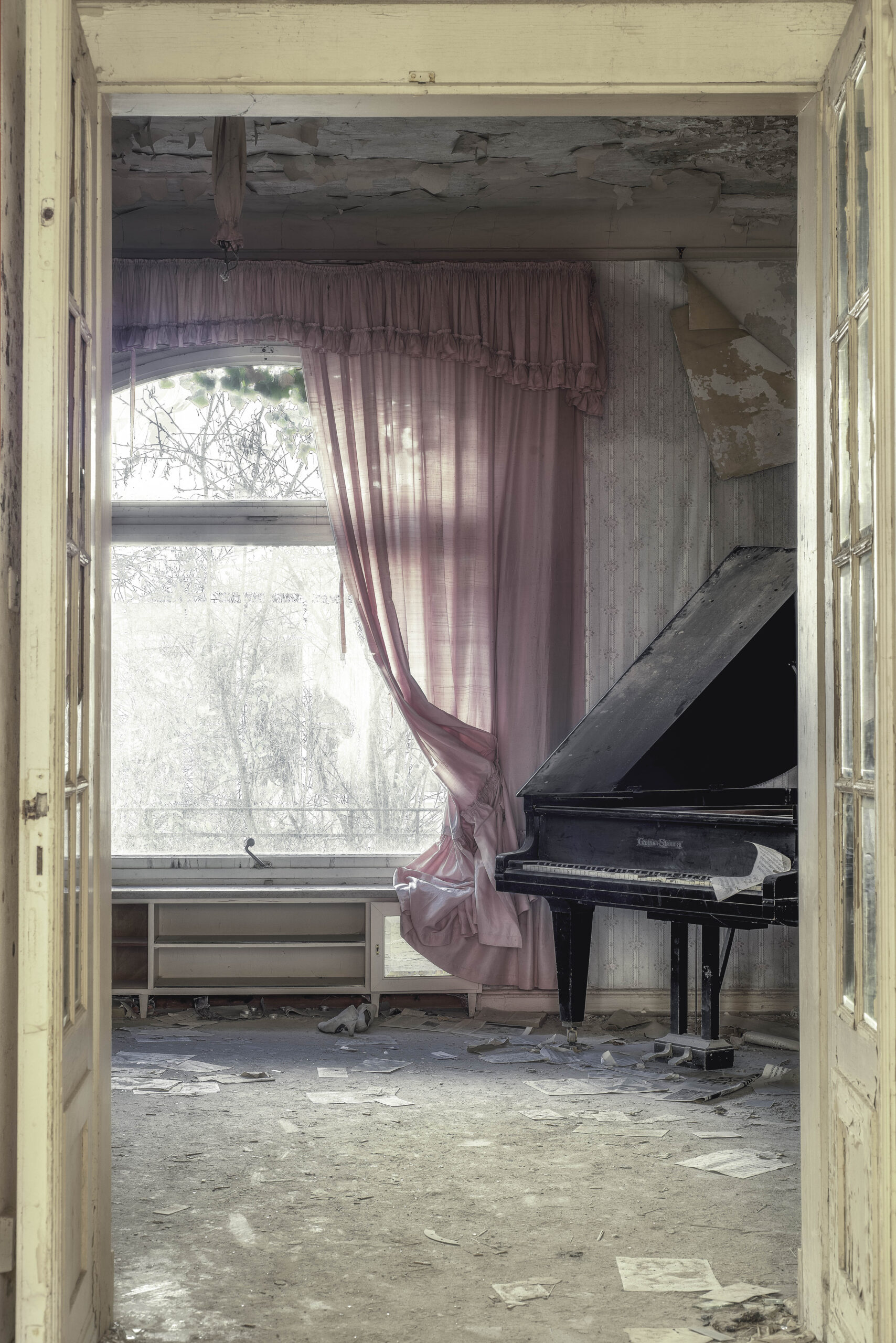
The grand piano was real. I photographed it in February 2019, a good year after the autumn this story is set in. In the story it is long gone by then. That is how far the invention goes.
The house itself, its history and the rest of the rooms I documented separately: The Urologist’s Villa Anna L.