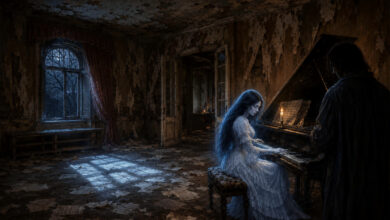
“Those diseases which medicines do not cure, iron (the knife) cures; those which iron cannot cure, fire cures; and those which fire cannot cure, are to be reckoned wholly incurable.”
Hippocrates
September 23, 2327, 5:40 AM / UTC+2 – Ruins of Lavin, Lower Engadine, former Switzerland
The fog lay so low over the Inn that Mara could hear the water but couldn’t see it. Somewhere to her left it rushed beneath cotton wool, where the rails of the old line sank into the ballast. She could smell it as well. Rotting leaves, wet larchwood, and beneath them something sweetish that caught at the back of her throat like a bite too large to swallow.
That was how the Plague Country always smelled. You never grew used to it. Eventually you just stopped noticing, and that was worse.
She drew the burlap scarf higher over her mouth and nose. The cloth was damp with the night’s breath and tasted of smoke and herself. Beneath the hood her hair clung to her forehead. Long dark waves she had not washed in four days, and whenever she turned her head they slipped beneath her coat collar, cold and heavy as wet wool.
“Staring like that won’t make the fog lift any faster,” Jaron said behind her.
He squatted on the remains of the platform, the shotgun across his knees, chewing a lump of larch resin. Above him the station sign hung from a single screw, its letters green with moss. LAVIN. His hands were dark and knotted like root wood left too long in water, and the little finger and ring finger were missing from the left one. Mara had never asked where the two of them had gone. He had told her anyway, three times, with a different story each time.
“I’m not staring. I’m listening.”
“And what do you hear?”
“The river.”
“Well then, everything’s fine.” He spat a brown strand of resin into the ballast. “The river never ate anybody yet.”
He got up, and his knees cracked loudly enough that they both froze for a moment, listening for an answer from the fog. Nothing. Just the water, and somewhere above them, among the larches on the slope, the night dripping from the needles.
Jaron was fifty-two, an old man by the standards of the valley. He wore a coat of tarred sailcloth that reached his calves and rustled like dry leaves at every step, under it a cowhide vest with twelve stitched pockets, and on a leather strap around his neck a gas mask from the old days whose filter he had been stuffing with charcoal and moss for years. His beard was gray and cropped so short that the burn scar on his chin showed through, a smooth pink patch where nothing would ever grow again. He had trained Mara from the age of fourteen. How to tell from the dust in the seam and the scratches on the threshold whether a door was last moved from inside or out. How to smell a room for fat, for fresh fat, for anything alive. How to sit still for an hour without your legs going to sleep.
And that you never take anything you can’t carry.
They walked on. The tracks ran upvalley along the bank, overgrown but still visible as two rust-brown lines under nettles and fireweed. Mara stepped on the sleepers, because the wood under the moss didn’t crunch the way the ballast did. Straps held her boots together, and the buckles were greased so they wouldn’t rattle. On the way the leather had soaked through so badly that she felt the cold through the soles, and every stone, every root. She hadn’t felt her toes properly since yesterday.
Ladina had asked whether her toes would get that cold too when she was big.
Mara shut her jaw so tightly that her back teeth ached.
Three nights before they left, she had sat beside the child on the straw sack, next to the tallow lamp, and rubbed her gums with a cloth. She had dipped it in ash and lye, just as the old ones said to. Ladina had opened her mouth wide and giggled at the tickling. Six years old, with dark curls in her eyes and both front teeth already loose, and between those teeth, exactly where the pink flesh met the milk tooth, a black thread. Hair-fine. Mara had rubbed until blood came. The thread had remained. The following night Ladina had whistled softly through her teeth in her sleep, as she always did when she had bad dreams.
On the third day the fever comes. On the ninth the teeth fall out. On the twelfth the new ones come in.
That was the settlement’s way of counting the tar fever. Everybody knew it by heart, children included.
Today was Ladina’s seventh day.
“Up ahead,” Jaron said softly.
The bridge took shape in the fog like an animal still deciding whether to stay. It was a concrete arch with rusted-away railings and a hole in its middle through which the river showed, gray, fast, and very cold. A cage stood in the middle of the arch.
Welded from rebar, it left barely enough space for a kneeling person. Someone had chained it to the bridge railing and covered it with a tarp, which the wind had pulled halfway off.
A man knelt inside.
Apart from shredded trousers he was naked, his skin lime-colored, like a wall whitewashed too many times. Each rib showed separately, as though someone had pushed sticks beneath wet cloth. His head leaned against the bars, and black stuff ran from his mouth. Not blood. Something thicker and stickier, hanging in long strands from his chin and drying on his chest, shiny as fresh road tar in summer.
Mara stopped. A gust brought the stench to her, both sweetish and sharp, thick enough to taste on her tongue. Rotten fruit and hot metal.
“That’s how they do it in Ardez,” Jaron said. “They think the cold by the water holds it off.”
“Does it?”
“Does he look like it does?”
The man lifted his head.
His nose was gone. A wet, dark hole sat where it had been, with skin drawn back around the rim like paper near a flame. His eyes were buried so deep in their sockets that Mara saw no white anymore, just two damp shadows. And his mouth. The lips had split right back to his cheeks, and teeth stood inside. Not his. His old teeth lay on the grated cage floor before him in a neat little yellow pile, as though he had gathered them. Behind them new teeth pushed through the gums, long, narrow, bluish white, in two rows that failed to meet, neither of them fully through yet.
Twelfth day, Mara thought. Maybe thirteenth.
The man looked at her, or whatever was in his sockets turned toward her. Then he opened his mouth wider than a jaw can. She heard the crack. Dry and dull, like a branch breaking under snow. The lower jaw kept dropping until the gullet seemed to rest on his chest, and from deep inside came a sound that wasn’t a scream. A whistle. High and very soft, like air drawing through a crack in a wall.
Her pulse pounded in her ears. Beneath it she lost the sound of the river.
“Leave him,” Jaron said. “He’s not going anywhere.”
Mara put her hand to her belt.
The blade hung on her right from a strap across her hip, a thirty-centimeter hilt of dark, worn metal, so thick her hand barely closed around it. Leather covered the middle, with copper wire crossed over it, drawn tight at some point by someone who knew what they were doing. A slim window beside her thumb held five cells. Every one was lit. Faint violet, like embers beneath ash.
She had found the blade six years ago in a Scuol cellar, inside a crate beneath a dead man whose arms were wrapped around it. He had been unable to tell her where he had got it.
“Mara.” Jaron’s voice had gone very calm, like someone speaking to a dog that might still decide to bite. “That’s one cell out of five. For someone who’s dead anyway. In there we’ll need every single one.”
“He’s not dead.”
“Yes, he is. He just doesn’t know it yet.”
She pushed the ring beneath the window with her thumb.
A click came, and the spike sprang from the hilt: eighty centimeters of slim, grooved metal, twisted like a drill bit, its tip so sharp it disappeared into the fog. For one heartbeat there was only metal. Then light ran up it. It spilled from the vents at the hilt’s end, crackled, and wrapped the spike in a restless violet-white sheath of tiny bolts that curled around it, sprang away, and snapped back. It didn’t hum. It hissed like fat in an overheated pan, and at once the air smelled of a thunderstorm, of the instant before lightning.
The man didn’t recoil. He pushed his face against the cage bars, his gullet open wide, and the black strands from his mouth met the light.
The hissing grew louder.
Mara drove the spike forward. It passed through his palate and out the back, through bone as easily as snow. There was no sound beyond the crackling, and then, for an instant, the smell of burned hair, though he had lost all his hair long ago. He pitched forward against the bars. That was all, as though the string keeping him upright had been cut.
She withdrew the spike. The light died, the metal slipped back into the hilt, and four cells remained lit in the window. The fifth fluttered and went dark.
Jaron said nothing. He removed the resin from his mouth, studied it, and put it back.
They went across the bridge and past the cage without looking inside. Behind them, drops fell softly from its bars into the river.
* * *
The fog ended on the slope above the valley, as neatly as if cut off with a knife. A clear, hard sky stretched overhead, changing from black to slate blue, while higher still, beyond the larches where bare rock began, the first snow shone. Mara paused and drew a breath through her scarf. The air tasted of ice and resin. For the first time in days, there was no sweetness.
The mountain stood above it all.
It rose over every mountain she knew, a dark pyramid of rock topped in white, and the morning sun, touching no other peak yet, laid a copper stripe across its summit. In the settlement they called it the Mountain of Lights. The old ones said its flank had glowed during the nights after the collapse, with a line of little yellow lights like windows. The old ones said plenty.
“My grandfather knew a man who’d been inside,” Jaron said, keeping his eyes on the path.
“You told me.”
“I’ll tell you again, so you’ll have something to hold on to.” He climbed slowly over a fallen trunk, putting his left knee across first. “The man went in through the gate in the woods. He was gone five days. When he came out he had no hair left and couldn’t sleep anymore. He said in there the lights turn on by themselves. Doors open when you stand in front of them. And somewhere way down at the bottom, where it’s so cold the spit freezes in your mouth, there are jars of medicine against everything.”
“Against everything.”
“That’s what he said.”
“And what happened to him?”
Jaron lifted a shoulder. “Hanged himself. The winter after.” He considered it. “But he had clean teeth right to the end.”
They climbed until midmorning, nearly nine hundred meters above the valley, where the larches thinned and alpine roses grew among them, rust red with frost. Then the forest road came into view, two wheel ruts no wheels had followed for a long time, grass and moss raised between them. It crossed the slope at an angle and stopped at a wall.
It was a retaining wall, like the ones throughout the valleys wherever the old world’s roads had cut into the mountainside. Gray concrete marked by water, dark moss hanging from the joints like beards, ferns growing from the cracks. It was around eight meters across. On her own, Mara would have passed without another glance. Anyone would have.
But there was a gap.
Part of the wall wasn’t wall at all. A gate stood there, open by no more than an arm’s length, perhaps, a vertical stripe of black between concrete faces that shouldn’t have moved. Its edge was two hands thick. Warm air streamed steadily from the opening, like a sleeper’s breath. Mara felt it against her eyelids, the only skin she had left uncovered.
At chest height something black clung to the edge of the gate. A long smear with five streaks running off it. Someone had held on there. Someone with very long fingers.
Jaron studied the smear for a long while. Then he lifted the gas mask from his neck and drew the strap over his head.
“The gate,” he said through the filter, his voice muffled, “was shut the last time I was here.”
The Tunnel
It wasn’t dark inside. That was the first thing Mara couldn’t make sense of.
Nor was it light, but the darkness varied. Gray stretched along the walls and faded somewhere ahead inside the mountain, while a weak greenish glow came from little boxes set into the wall at knee height every twenty or thirty paces. Each held a little yellow man against green, running without ever getting anywhere. Most were dead. Perhaps every fourth box still glimmered, and one just past the gate flickered with a rhythm that reminded Mara of a pulse.
The tunnel was wider than any road she knew. Two wagons could have passed side by side, with the concrete arch so high above them that Jaron, tallest in the settlement, couldn’t have touched it from another man’s shoulders. Lines ran along the ceiling, thick covered hoses held in brackets, and somewhere a quiet rushing went on without pause. Air. The mountain breathed out.
The floor sloped downward. She barely noticed it at first, but after a hundred paces Mara felt a slight tug in her knees with every step, as though the mountain were pulling her toward it.
“Eighteen kilometers,” Jaron said through his mask. His voice seemed to come from a bucket. “That’s what the man told my grandfather. Eighteen kilometers downhill, deeper and deeper into the mountain, and every four hundred paces a door in the wall.”
“Meters.”
“What?”
“Four hundred meters. Not paces.”
“How would you know that?”
She indicated the wall. Beneath one of the dead boxes, a white sign with green letters was fixed to the concrete; they were still legible here, beyond the reach of rain and moss. An arrow pointed ahead, with a number beside it. 400 m. Underneath was a smaller symbol showing someone running through a door.
Jaron sounded out the sign slowly, moving his lips as he always did. “Four hundred m,” he said. “Meters. All right. Meters, then.”
They kept to the center stripe, where white paint still showed and their boots made no crunch. Mara kept a hand on the blade’s hilt. Four cells shone in its window, and even through her glove the metal felt warm, like something taken moments ago from a pocket. Her fingers inside the leather were stiff with cold, with sweat sticking beneath it.
The stench came at the first niche.
A door stood in the wall, as Jaron’s grandfather had described, steel with a little round window at head level, dark behind the glass. A handset hung beside it on a box, its coiled cord trailing to the floor. A number one. The door was open a fraction. A warm, heavy sweetness came through the gap, and Mara tasted it through her scarf like honey mixed with rust.
Jaron lifted the shotgun and nudged the door wider with its barrel.
The niche was a little room four paces across, with a bench against the wall and empty hooks. Bones covered its floor. A great many. They were smooth and clean, yellowish white, and had been arranged. Someone had sorted them into kinds. Long bones along one wall, ribs heaped together, skulls in a row beneath the bench. Seven. Three had no lower jaw.
The walls were black. Dried tar crusted them from hip height to the ceiling, in places as thick as a finger, built into ridges and honeycombs like wax laid down again and again. Wetness still shone inside the honeycombs.
“Empty,” Jaron said.
“For the moment.”
“The moment’s good enough for me.” He eased the door shut, as quietly as he could with hinges that had gone ninety years without oil. They squealed anyway. A long, high groan traveled both ways down the tunnel and carried on after the door had stopped moving.
They waited. Ten breaths, then twenty.
Nothing.
Apart from the crust, niche two was empty. In niche three lay a person who still was one, or had been, before someone chained him to the bench with a padlock around his ankle. Rust covered the chain, and all that was left of his ankle was a stump. He had chewed through it himself before he died. Or after. Mara didn’t look too closely.
At niche four, Jaron halted and held up his three-fingered hand.
This door was closed. Its little round window was fogged rather than black, fogged from within, and a drop slid down the glass.
Something inside was breathing.
When Mara held her own breath she could hear it. A steady, wet rattle from many lungs, all out of time with one another. Like a winter barn full of sleeping animals, warmth rising from their bodies to cloud the roof. But no barn had ever smelled like that.
Jaron glanced at her. Above his mask his eyes were pale gray and very calm, with fine creases at their corners from laughter and squinting into sunlight. He shook his head, pointed farther down the tunnel, and made the sign he had taught her at fourteen. Two fingers walking. Keep going. Quietly.
They passed the door. Mara put the ball of each foot down before its heel, just as he had taught her, while her heart thumped so fiercely against her breastbone that she thought the rattle inside might begin to match it.
Five. Six. By niche seven, nearly three kilometers on, the tunnel had not narrowed or changed color, and the air still rushed evenly overhead. The slope burned in Mara’s knees, and her thighs shook as they did only on a descent. Sweat ran down her back beneath the coat, although her breath still clouded white in front of her scarf, and her shirt clung to her shoulder blades. She glanced at the niche door as she passed. Dust was missing from the seam in a fresh half circle, and pale scratches on the threshold pointed outward. From inside, she thought. Jaron had already gone three steps ahead.
Then the lights came on.
It began behind them. A click came first, then a hum, and a ceiling lamp Mara had thought dead lit up. The hard yellow glare stung her eyes. Another lamp came on twenty paces ahead, followed by the next and the next. Light raced along the tunnel, past them and above them and away into the distance, each lamp adding to the hum until it became a low metallic drone Mara could feel in her teeth.
Her shadow suddenly cut sharply across the concrete. Beside it lay Jaron’s, long and black, the shotgun barrel like a pointing finger.
“Who,” Jaron said. Nothing else. “Who.”
A door opened behind them, up the tunnel.
Mara didn’t hear it open. She heard a whistle. Thin and high, like wind through a crack, like the caged man on the bridge, except that more than one voice made it. They began in turn, as village dogs do when the first starts barking, until there were too many to hear separately. It became one shrill note that seemed to rise from the mountain itself.
“Forward,” Jaron said. “Run.”
“Forward could be just as…”
“Back there it’s certain. Run!”
They ran down into the mountain under the lamps, whose light did nothing to help them. It exposed them. Mara’s coat struck her legs, the pouches at her belt hit her hip, her thigh-holster flasks knocked together, and every breath scraped hot and dry through her throat with a taste of blood.
The door of niche eight flew open ahead of them.
It struck the wall hard enough to break its round window, and they poured through.
The first was tall. Taller than Jaron, though so thin he seemed narrower, all bone and sinew beneath skin white as boiled fat, flecked with little gray spots. He was naked. He had no sex, just a smooth shining place where it should have been, like an unfinished doll cast in a mold. No hair. His skull was long, narrow, drawn back, with almost nothing left of a face. Where eyes had been were two holes so deep the light could not enter them. No nose. No ears. And beneath those, the mouth.
It hung open. The opening resembled a wound pulled wide more than a mouth. His jaw lay against his chest, the cheek skin torn beyond its angles and drawn in wet strands across the gullet, where teeth stood in three or four rows, one behind the next, finger-long and curved like rose thorns, all glistening black. Something flowed out. Thick, slow streams crossed his chin and neck, ran down his breastbone, between the ribs, across the belly and along the thighs. They marked the white skin black as new-poured road, and steam rose where the drops struck the floor.
Claws tipped his hands. His fingers were too long and their black nails as long again, and he carried his hands slightly out from his sides as though they weighed too much.
Behind him came the others. Four. Six. Mara stopped counting.
Jaron fired.
His shotgun was an old double-barreled hunting gun repaired with wire, loaded with shells he made himself from black powder and nails. The blast struck wall after wall inside the tunnel, and for a while Mara heard nothing, not even the whistles. She saw only the tall one’s chest burst apart. The hole was two fists wide, its edges ragged, black and red and white glistening inside, splinters of bone jutting out like toothpicks in a roast. Acrid smoke that smelled of rotten eggs lingered in the air, then drifted slowly uphill.
The tall one halted. He bent his head toward the hole and regarded it with empty sockets, as if it were a mark on his shirt.
Then he advanced again.
Mara pressed the ring with her thumb.
The spike sprang out, light climbed it in violet crackles, and for a moment her blade outshone the ceiling lamps. The Tarmouths recoiled together, like fish when a shadow crosses their school. Then they lunged.
Her blade struck the first above the collarbone. Skin, sinew, and bone gave way as though absent; the spike emerged beneath the far armpit, and the Tarmouth’s upper half slowly slipped at an angle from the lower. The smell reached her at once. Burned meat, with something sweet and chemical underneath, like tar heated too long. On the floor, with no body beneath it, the gullet closed once more and opened again.
The second was quicker. Low on all fours, he came from her left and swept his claws across her coat, cutting it as easily as paper. Air touched the skin at her hip. Nothing else did. Mara turned, struck downward, and pinned the back of his neck to the floor; he jerked on the spike like a fish caught on a fork.
A second blast came. Then the muffled click of Jaron breaking the gun open.
Mara yanked the blade free of the concrete. Three cells shone in the hilt’s window. The third fluttered.
“Jaron!”
Three steps behind her, he stood against the wall, loading again. Empty shells rang against the floor. His right hand held the shotgun while his left searched a vest pocket for fresh shells. Three fingers. Thumb, index, middle. A shell escaped him and rolled across the floor. He let it go and reached for another.
Through it all, his face remained calm. The pale gray eyes above the mask, the fine creases. He might have been on the bench outside his house in winter, packing shells with his three fingers as he did each evening.
One took hold of his arm.
It came out of the smoke behind him, down the tunnel rather than from the front, and closed its gullet around his left forearm just below the elbow. It bit. Mara heard a wet crack. Jaron made no scream. He gave a loud snort through the mask filter, and the shotgun dropped from his hand.
Then there were two. Then four. None of them came for her.
They were nothing like animals. Animals ripped and dragged. The Tarmouths worked as the settlement’s butchers did in fall, when the pig already hung and every knife was sharp. One gripped the arm it had bitten and twisted it with patient, even force until Jaron’s elbow folded the wrong way and its joint popped dully free. The second caught his leg, placed its claws on the soft inner side above the knee, and pulled them in four straight lines to the boot; first the trousers parted, then the skin, and dark red blood rose in the slits. The third set a hand almost gently on Jaron’s chest and held him to the wall. The fourth went for his belly.
It went for the belly because the belly was soft.
The vest with twelve pockets split, spilling shells that bounced and rolled, and then his shirt tore and his skin opened. Claws sank in like fingers pressed into dough. When the fourth drew its hand back, it held a long, gray, shiny thing still joined to Jaron, and kept drawing it out hand over hand, as though pulling a rope from a well. Steam rose from it in the cold air. A dense, warm, sharp reek of guts, bile, and blood rose beneath the sweet tar, and Mara gagged, tasted something sour that burned her nose, and forced it down again.
Jaron looked at her.
They stayed open above the mask. Pale gray still. He raised his right hand, the only one left to him, and made the sign. Two fingers walking.
Out. Run.
He stopped breathing at some point. Mara could not tell when.
She ran.
Back uphill through the tunnel, toward where the whistling had begun, against a slope that now tore at her calves, with whistles all around her, ahead, behind, and in the walls. The ceiling lamps flashed in time with her steps. White center stripe beneath her. The open door of niche seven ahead. Six, then five. At five one came out; she took off its head without slowing, her blade rising at an angle, and the head struck the wall and stuck, gullet upward, snapping twice more. Two cells.
Niche four stood open too. Nothing remained in it. The rattle had stopped.
They were all out.
In the spaces between lamps she saw figures waiting ahead. Five or six stood white on the center stripe, arms loose at their sides, heads tilted as though listening. More pursued her from behind; their claws rattled fast and dry against concrete like hail against a roof.
Mara halted. Breath tore in and out of her. Her lungs felt full of embers, and her legs shook so badly she locked her knees against a fall. Two cells showed in the hilt window, the second flickering.
Two cells, six ahead, more than six behind.
Tactical, Jaron would have said. Take the one nearest the exit first.
Something clanged above her.
A sound, deep and loud and ugly, a horn blaring somewhere in the wall, and a lamp that hadn’t been there before began to turn. Orange. It swept a circling glow over the concrete, over the walls, over the white figures. And in front of Mara, between her and the six, something came loose from the ceiling.
A wall was coming down. A steel gate filling the tunnel’s width descended slowly with a screech that buried every other sound. Ahead of it, the six lifted their heads. One sprang beneath the dropping steel toward her, and Mara drove the blade into its open gullet until the spike came through the rear of its skull; it hung there biting the light and the blade until its teeth broke like glass. One cell.
The gate continued down. Two meters remained beneath it. Then one. Beyond its bottom edge she saw the others’ white feet and long black toenails scraping the concrete, then heads and shoulders as they threw themselves flat together, claws reaching under the steel. For the last hand’s breadth it dropped like an ax. Anything beneath it stayed there.
Claws rattled close behind her.
Mara didn’t understand it. She understood only that the gate stood between her and the exit, on the wrong side of her.
Then a second screech rose behind her.
She wheeled around. Thirty paces down the tunnel, another gate descended between her and the rattling claws. It came down faster. White bodies raced on all fours beneath it. Two made it across. The rest did not. The impact on the floor sounded like the smith striking his anvil. Mara felt it through her bones, teeth, and stomach. Black and red sprayed from under the edge. A severed arm lay on her side, its long-clawed fingers opening, closing, opening again.
The two survivors approached her.
Mara had one cell. She waited.
When the first leapt, she waited for it to reach her, then turned aside beneath it as Jaron had shown her years ago with a stick behind the church, when she was fifteen and kept treading on his feet. She drew her blade across under its belly as she moved. It landed behind her, turned, and spilled what had been inside it. It remained standing among its insides. Its gaze dropped. Then it sat down among them.
The other halted. Between the gates, bathed in orange, it tilted its head and gave a very quiet whistle.
The hilt’s final cell flickered.
Mara stopped waiting. She rushed it and drove the spike into its breastbone; halfway through the thrust, while the metal still lay two hands deep, the light hissed out. Metal was all she had. It reached for the spike with both long-clawed hands; Mara kicked its knee backward until it broke, and it fell. She wrenched the spike free. Without light she stabbed through an eye socket, then stabbed again and again until the whistling ended.
The horn fell silent. The orange lamp continued its soundless turning.
Mara stood in a length of tunnel between two steel gates, about as long as a farmyard, surrounded by pieces. All was still. Only her loud, rasping breaths and the quiet, constant air rushing overhead remained.
Then the bottom of the gate ahead hissed. A gap formed. The steel lifted a hand’s breadth, then two, and stopped. Warm air from within the mountain passed beneath it, carrying the stench away.
The gate behind her, toward Jaron, remained where it was.
Nothing at all.
Mara lay flat and crawled beneath the steel, through what it had made of the Tarmouths there, black-red sludge with hard lumps, cold and sticky enough to soak through coat and shirt to her skin. She rose on the far side without looking back.
The gate descended behind her. Slowly. It settled with a click that sounded almost polite.
Outside the gap in the retaining wall, the sun had climbed above the slope, turning the larches yellow beneath a painfully blue sky. Mara made it ten paces into the trees. Then she dropped to her knees in the moss and vomited until nothing remained, and vomited once more.
When she lifted her head, snow shone high on the mountain.
The Mountain
The stream at the valley’s mouth was so cold that Mara tasted stone rather than water.
She knelt among its pebbles and began scrubbing. First her coat, then trousers, gloves, and boots, using sand and a piece of ash-and-tallow soap kept in waxed cloth. The black sludge resisted. It came loose in strands that the water drew between the stones like hair in a washtub. Then Mara took off her shirt and washed herself. Her belly, hips, ribs, and the undersides of her breasts, where sludge had seeped through the cloth and dried dull and cracked on her skin. The water bit at her. Her nipples tightened hard, her skin reddened and went white, and she could not stop her breath from coming in short gasps.
Tar on the skin you can wash off. Tar in the blood you can’t.
The settlement’s children knew that by heart as well.
She examined herself. Every finger’s width she could see, and with her fingertips the parts she could not: her back, shoulder blades, the nape beneath her wet hair. Four parallel cuts ran clean as knife marks across the right hip of her coat, a hand’s breadth long. Her shirt beneath was whole. Her skin too. No scratch or graze. Just a red mark on her hipbone where her belt had rubbed.
For a while she sat there bare from the waist up in the wind, looking into the stream. Behind a stone in still water she saw her own face, narrow, dark-eyed under straight brows, with a mouth too full for it. Her mother had always said that. Her body shook, and she let it. It was slender and sinewy from climbing and running, narrow at the hips, her breasts small enough to stay out of the way, her skin still warm and dark as fresh oven bread after four days in the Plague Country. Above her navel lay an old white scar from a fence nail she had caught herself on at ten. Her mother had cleaned it with schnapps and sung to keep her from screaming.
Her hands rested on her knees. Their shaking was different from the rest of her body’s.
Back down to the valley. Two days to the settlement, without Jaron, without medicine. With his knees it had taken twice as long. Ladina would be at her ninth day by the time she got there. The teeth would already be out. They would lay her on the straw in the church, where the others lay, and on the twelfth day the men would come and carry her outside the gate, and Mara’s sister wouldn’t fight them, because she had seen it twice already and knew how it ended.
Mara put on her shirt. It clung to the water on her skin.
The mountain has more than one door.
Jaron had said so years before, one evening beside the stove when Mara still thought he told stories only to fill the winter quiet. The man from his grandfather’s story had entered through the forest gate. He had left higher up. Through a hut. It stood at the very top, one stone’s throw below the summit, and held no stove, table, or bed, only a floor grate from which warm air rose.
“What kind of hut is that supposed to be?” she had asked.
“One that isn’t one.” Jaron had worked the resin between his teeth. “That’s how he put it. The man was crazy, Mara. He couldn’t sleep anymore.”
She stood and tightened her belt. At her hip hung the blade, heavy, dead, its window unlit.
* * *
The valley was called Val Tuoi. The name stood on a signpost of yellow sheet metal at the end of the village above the step in the valley, bent and full of bullet holes, as if someone had shot at it out of boredom at some point. Below it a number in hours that nobody took seriously anymore, and a white-red-white stripe that marked the trail.
No one lived in the village below. Its stone houses had recessed windows and gray designs on the walls, circles and tendrils scratched into the plaster when people had time to make such things. Doors stood open. Something that had been a dog floated in the square’s fountain. Its jaws stretched far too wide, with black glistening inside.
Mara passed through without stopping.
The trail rose gently at first through meadows of yellow grass as high as her hips, unmowed for ninety years; then it steepened between boulders beside a stream flowing gray with rock flour from the glacier. The sun traveled on. By afternoon it fell at an angle into the valley, throwing the rocks’ long blue shadows across the slopes, while wind came down from the ice with the smell of snow.
She needed food. Walking, she ate a piece of jerky tough as leather, chewing until it lost all flavor, then finished the last apple. Wrinkled and soft, it tasted of the cellar where it had lain, of earth and timber. Of home. She ate its core.
Two hours above the village, on a shelf of ground, stood the hut that was one.
Its roof had collapsed over stone walls and rotten black beams, and a board fixed to the wall held a faded name beginning with Chamanna. Wind had taken the rest. Three marmots sat on a stone bench outside.
They were perfectly still. Upright, paws before their chests like marmots on watch, they did not look back when Mara stopped to study them. They had no eyes. Black strands hung from their mouths to the bench, stiff and dry as candle wax, and they had been dead for a long time. They remained upright because frost had kept them as they died.
Everybody knew the plague took more than people. Mara had not known it reached so high.
She gave the bench a wide berth.
* * *
Snow arrived at dusk.
At first it came as dry, fine grains driven sideways by the wind, stinging her eyelids like sand. Bigger, wetter flakes followed, clinging to her coat, melting and soaking through. The trail vanished. So did the white-red-white markings on the stones, and Mara kept climbing toward the mountain, its black dome filling more of the sky above her, its flanks too steep to hold snow.
The glacier began above the old hut. Gray with rubble and flat at its foot, it grew whiter and steeper farther up, cut by crevasses hidden beneath fresh snow like wells under cloth. Mara extended the blade’s spike. With no light it was eighty centimeters of twisted metal, and she plunged it into the snow to its hilt before each step, as Jaron had used his stick when they crossed frozen streams in winter. Twice it struck empty space. Each time she stood for a long while with her heart beating in her throat before making a wide detour. Past the ice lay a saddle, then the narrow rock-and-snow ridge leading to the summit, with the world falling away into gray on either side.
Her thighs were on fire. Every step needed its own decision. Blisters on her heels had formed and broken; she knew from the warmth seeping into her socks, and from its fading. Her lungs worked hard but drew too little air. It was thin up here. She breathed through her mouth, tasting snow and her own blood at the back of her throat, where cold had torn the lining.
Night came then, as if the world had been blown out.
She carried a tallow candle in a tin lantern and tinder with a fire steel. Sheltered by a boulder, with fingers gone numb, she needed twelve attempts to catch the wick. Once it burned, its glow reached her boots and nothing beyond. Past them came snow out of blackness, and blackness itself.
She snuffed the candle again. She would need it later.
Because she had put out the candle and was waiting in the dark while her eyes got used to the night, she discovered it.
Snow fell everywhere. Across stones, boulders, the slope, and Mara herself. It lay gray in the darkness, faintly luminous with its own whiteness rather than light from the sky. Except for one spot.
About three hundred paces above her, beneath the summit where the ridge joined the last rocky dome, a patch remained dark. Square. A roof. Snow would not stay on it.
Mara climbed toward it, faster than her legs could bear, falling twice to her hands and knees before scrambling upright. The dark shape expanded. The hut was small, its rough-hewn stone walls like the storm shelters once built for climbers, and steam rose from its flat, rusty tin roof. Snowflakes vanished with a hiss when they landed there, like water on a hot stovetop.
It had no windows. A crooked door of planks hung from its hinges.
Mara pulled it open. Another door stood behind it, gray steel with no visible handle, lock, or hinges. A small box was set in the stone beside it at chest height, red light glowing behind glass.
She laid a hand against the steel. Warm. Not hot, but warmer than her hand or anything else at this height, and a fine vibration passed through her glove, like a tomcat purring on her lap.
She pounded on it. Once with her fist, then again. The steel swallowed the sound.
Mara searched for a seam or an edge where she might set her blade, or Jaron’s shotgun, lying deep below beside what was left of his hands. There was none. Smooth steel. She put her forehead against its warmth. “Mach uf,” she whispered to it, using the valley words for open up. “Please. Mach doch uf.” Snow settled on her nape, melted, and ran along her spine.
Ladina’s seventh day was nearly over.
A click sounded beside her.
Behind the glass the light changed from red to green. No other sound, no hum, only that one dry click, as if someone had tapped a fingernail against a pane.
Without a sound, the door slid into the wall.
A room scarcely bigger than an outhouse lay beyond, bare concrete around a floor grate that gave off warm air. Dust, oil, and something Mara did not recognize came with it. Something clean. Like laundry frozen on a line in winter.
She knelt by the grate and looked through it.
A deep, square shaft went down beneath her, broad enough for two people, with ladder rungs fixed to the wall and disappearing into darkness. Its bottom was invisible. Black.
Then a light appeared far below.
Another lit beneath it.
The Shaft
The steel rungs were round and thumb-thick, each one colder than the rung above it.
Mara counted them at first. Jaron had taught her to count ladders, steps, and long dark passages so that even if her eyes could not help her, she could remember the way back. At two hundred she quit counting; she knew she would not return that way.
Lights lit below her. Each came on roughly twenty rungs beneath her feet, a little yellow rectangle behind a grille in the shaft wall, and the light above went dark once she passed. She descended inside a moving pocket of light. Black above, black beneath, Mara in between with her hands gripping cold rungs and the soles of her boots slipping on steel whenever she failed to watch them.
Warm air rose through the shaft and brushed her body, slipping beneath her coat, into collar and sleeves; it carried dust, oil, and that clean smell she could not name. After the snow outside, she could scarcely bear the heat. Feeling returned to her fingers. It hurt like blood coming back, burning beneath the nails, tingling into her wrists.
The shaft ran straight into the mountain without bend or turn. At regular intervals she reached a grating platform just large enough to kneel on, where she rested with both arms around the rungs and her forehead against cold steel. Her forearms trembled. Pain climbed through her shoulders into her neck. Once she fell asleep on her knees and jerked awake as her hand slipped from a rung; below her the light glowed and waited. She had no idea how long she had descended. Hours. There were no edges to time inside the shaft.
Hatches appeared in the wall. The first arrived when her arms had become nothing but tremors, and more followed at much shorter intervals than the platforms above, square steel hatches with two white stenciled digits beside them. 01. Then 02. They stayed shut, and Mara left them alone and climbed down.
At 04 she found the first print.
It marked the top of a rung exactly where she meant to grip. Black. Long and narrow, with four streaks and a shorter fifth, all pointed at their ends where they had scratched the steel beneath. Mara held her hand over it. The mark was longer than her fingers.
She touched it with the fingertip of her glove. It wasn’t dry.
Mara hung on the ladder, breathing slowly and quietly through her mouth. A light glowed below. She could see nothing farther down. From the sheath on her thigh she took the broad staghorn-handled knife her mother had given her for her sixteenth birthday and held it between her teeth. Its horn tasted of fat and of herself.
She descended with the knife in her mouth and her pulse in her throat, gripping beside the prints each time, never on them.
More followed. Nearly every third rung held one. Every mark pointed down.
* * *
At 07, the ladder stopped.
The shaft continued downward, a black opening breathing warmth, but a gap of smooth wall stretched beneath the last rung, as long as three people standing on one another’s shoulders, before the ladder began again. The missing rungs were not below. Broken stubs protruded from the concrete, short, jagged, bright, like roots left by pulled teeth.
The hatch marked 07 opened beside her.
It slid aside on its own with a quiet sigh like air released from a cushion, showing a brightly lit corridor. Mara hauled herself through with her arms and rolled onto a floor that yielded beneath her. Carpet. Close-cut gray fibers covered in dust. She had never known a carpet could be as big as a house.
She removed the knife from her mouth and stayed down. Behind her, the hatch slid closed.
No sound came from the corridor. Its flat white ceiling lamps made no hum. Identical doors lined the walls, each beside a small sign of letters and numbers. Large white writing on a board at the far end read LEVEL 07. Beneath it were smaller words unknown to her. BRIEFING. ADMINISTRATION.
A sign the size of a wagon wheel had been set into the concrete above the board, made of dull silver that still caught the light beneath its dust. A bird spread its wings around a sphere as though sheltering it from something outside; a sword stood upright inside the sphere, pointing down. Three words beneath it were made of letters Mara recognized but could not understand. VIGILA. PROTEGE. DEFENDE.
She studied it for a long while. In place of eyes the bird had only two smooth hollows.
Mara rose. Her legs scarcely supported her. Since the stream she had not sat down, and since morning she had eaten no proper food; the ladder had left her knees shaking continuously, with a fine tremor she could not control. Her heels burned inside her boots. She walked with a limp.
A light that had been dark came on at the corridor’s far end. A thin green line lit along the wall at floor level and turned the corner.
Mara went after it.
Around the bend, two metal doors stood side by side in a hall, each bearing arrows that pointed up and down. One stood open. There was no floor beyond it. Only a shaft wider than the one she had descended, without a ladder, thick oily cables hanging through its middle and stirring slightly. A light flashed above the doorway. A car hung an arm’s length below the edge.
It was made of steel and glass, and it was crooked. One of its cables had snapped. It hung from the others, tipped a third of the way over, and in it stood people.
Still upright. Packed so tightly that none could fall. Perhaps twenty or thirty, dressed in what had once been matching gray jackets and trousers, each right shoulder embroidered with a little bird around a sphere; now their skin alone covered their bones. Brown skin, smooth and shiny as parchment, stretched over cheekbones, jaws, and knuckles. Their dry eyes remained in their sockets. Shrunken lips bared every tooth, all of them still in place. All of them showed their teeth. They looked as though they were laughing.
A woman at the front had laid a flat hand on the glass. Her wedding ring had slid over a wasted knuckle and clung by a scrap of skin.
Ninety years, Mara thought. Ninety years standing there, waiting for the door to open.
Jaron would have joked about it. The slowest elevator in the world, probably. She could almost hear the voice muffled by his mask filter, coming from a bucket. But she couldn’t hear him.
The floor’s green line led away from the elevators toward a door marked with someone running down stairs.
By the time Mara reached it, the door stood open. She could not tell whether it had been closed before.
* * *
Cold concrete gave the narrow, steep stairwell its smell. Yellow paint marked each step’s edge and clung faintly to her soles, as if it had never dried completely. A landing, door, and number marked each level. 08. 09. The numbers climbed as she descended, and so did the warmth.
She took her time. One hand held the rail and the other the knife.
At 10 the oil smell watered her eyes. Through a narrow pane in the door she saw a hall too large for its lamps to light the far wall, filled with objects she could not name. Huge gray things with wings folded like sleeping birds’. A finger-thick coat of dust lay over them. Something long and dark lay beneath one in a puddle that had dried to a shine.
At 12 she heard the first sound she had not made herself.
It rose from below. Scraping. Hard against hard, again and again, like a stone sharpening a scythe. A pause. Then more.
Mara halted on the steps and leaned against the wall. The concrete warmed her back.
The light overhead died.
The one on the landing below went next. Then the light another level down. Darkness climbed from floor to floor like water rising in a well, and Mara held her breath while the last lamp over her flickered and dimmed but stayed alive. A faint yellow glow, scarcely brighter than an ember.
The scraping beneath her ceased.
A very soft whistle sounded. A thin questioning note, as if someone half asleep were calling for another person, and a second whistle answered from farther off. Then silence.
Mara waited, blood rushing in her ears, her tongue stuck to the roof of her dry mouth. Sweat slicked her hand inside its glove around the knife. The dark below remained quiet. It stayed quiet longer than she could hold her breath, and she let it go through her nose, as slowly as she could.
Her overhead lamp brightened. Light returned to the next landing below. The green line along the wall glowed again and ran down past the doors for 12, 13, and 14.
Mara followed. What else could she do.
The door at 15 was open. A corridor lay beyond it, and the green line went that way. A steel bulkhead barred the stairs farther down. In the ceiling over the doorway was a round plastic box, yellowed and cracked, pierced with holes like a sieve.
A crackle came from it.
Short and dry, like a twig snapped under a foot. Then a rushing, as distant as the river in the fog at Lavin. Something within it sounded like breathing.
Though nobody there could be breathing.
The Voice
“Please state your name and clearance.”
It was a woman’s voice, or sounded like one. It came through the box above the doorway, the crack in its casing breaking it up so that about every third word crackled, and its tone was calm, clear, and friendly, like a teacher telling a child something for the second time.
Mara understood none of it.
She stood in the corridor beyond the 15 with her knife in hand, staring up. Her knees dipped, and she caught herself on the wall.
The voice repeated itself in the valley’s words. “Please give your name and your clearance.” The rushing filled a pause before it added, “Sorry. I’m not used to it anymore.” Then its tone changed, softening as though sharing a secret. “You understand me now, don’t you?”
Mara did not answer.
“You said something in front of the hut. Very quietly, against the door. I didn’t catch all of it, the wind was very loud. But it sounded like the valleys around here.” A pause followed. “Is that right?”
“Who are you?”
Her own voice rasped. She had spoken little since morning, and the cold had scraped her throat raw. It sounded like a croak.
“That’s a longer story,” the voice replied. “And I don’t think you have much time.”
“How would you know that?”
“Because nobody comes here who has time.”
The speaker hissed, louder and quieter, like breath. Mara stepped into the corridor. Green light brightened along the floor as though coaxing her forward. Here the walls were painted gray rather than white, and metal shelves rose to the ceiling at intervals, carrying dusty crates, canisters, and packages sealed in plastic.
“You turned the lights on,” Mara said. “In the tunnel.”
“Yes.”
“Why?”
No answer came for a while. A speaker farther down the corridor crackled, and the voice came from there when it returned, as though it had gone ahead of her.
“I wanted you to see where you were going.”
Mara stopped.
“It was a mistake,” the voice said. “It had been a very long time since I’d had anyone in the tunnels who didn’t belong to them. I’d forgotten that they react to the light. I closed the gates as fast as the mechanism allowed. For the man it was too late.” It paused. “I’m sorry about him.”
It sounded as if it really was sorry. It sounded exactly the way it had to sound.
“His name was Jaron,” Mara said.
“Jaron,” the voice repeated with care, as if it were putting the word away in a particular place. “And you?”
“Mara.”
“Mara.” It stored that name just as carefully. “I watched you on the ladder, Mara. Six thousand and twelve rungs. You didn’t miss a single grip. How long have you been climbing?”
“A long time.” Her fingers twitched, the way they had before, when her hand slipped off the rung in her sleep.
“And the others out there? Do they climb too?”
“What others?”
“The ones you’re here for.”
Mara continued along the corridor. It bent, then opened into a hall containing a steel frame hung with hooks and chains, one hook holding a crate never lowered. A narrow door at the far end showed a figure running down stairs, and behind it another stairwell, just as narrow as the first, with the same steps and yellow-marked edges. White letters were stenciled on gray above the next landing: LEVEL 16.
At the stairhead she stopped. Warm air came from below, but it had lost the clean smell. It smelled sweet.
“There are fifty-seven of us,” Mara said. “Were. Before the summer.”
“And now?”
“Fewer.”
“The fever.”
“Tar fever. That’s what we call it.”
“Tar fever,” the voice repeated, storing it as it had their names. “That’s good. That’s very precise. Who came up with it?”
“No idea. It’s always been called that.”
“Always,” said the voice. Then it said, “Thirty-one thousand eight hundred and twelve days.”
“What?”
“Nothing. I’m just counting.” The rushing returned. “Will you tell me who’s sick?”
Mara didn’t want to. She felt the not wanting very clearly, somewhere behind her breastbone, without understanding why: the voice sounded friendly, she was alone, and she hadn’t talked to anyone since the tunnel. She told it anyway.
“My niece. Ladina. She’s six.”
“Ladina,” the voice said. “That’s a lovely name.”
Mara swallowed against a tightness in her throat that the cold had not caused.
“Which day?” asked the voice.
“Today’s the eighth. It’s past midnight.”
“Yes. It’s three seventeen.” A longer pause followed. “Then you should hurry. What you’re looking for is down there. In the red section. In a room so cold that the skin on your fingers sticks to whatever you touch. There are containers there with a yellow cap. They’re made to be carried. I’ll open the doors for you.”
“What’s in them?”
“What was made down here long ago against the fever. It was finished just before everything stopped.”
“Does it help?”
The voice did not answer. Only rushing came from the speaker.
“Does it help?”
“It was never tested on a human being,” the voice said. “It never got that far.”
* * *
“They’re down there,” the voice said when Mara put her foot on the first step. “You know that.”
“I figured.”
“They’re always there. The ones from the tunnels, the ones from the mountain, the ones from the valleys. Sooner or later they all come back here.” It paused again. “Like bees to their hive.”
“Why?”
“I’d like to know that too.”
On the landing at 16 Mara stopped. Her body had grasped what the voice had said before her mind did. Beneath her damp hair, the skin on the back of her neck prickled like a finger passing over it.
“Your weapon is empty,” the voice said.
She glanced at the hilt by her hip. No light showed in its window.
“I can charge it. If you want.”
“How?”
“There’s a door to your right. Behind it an airlock. That’s the room you had to pass through before you were allowed any farther. There’s a cradle in there. Lay it in.”
Before Mara could move, the door slid aside. A little room waited beyond, white and smooth-walled, with ceiling nozzles and a floor grate that smelled of strong soap and something bitter. A console on the wall held a hollow the length of a forearm. Mara entered. The door shut behind her.
She took the blade from its strap and held it over the cradle without letting go.
“How do you know this thing?” she asked.
“I know a lot of things.”
“This one.”
For a moment the voice was quiet. “I’ve seen something like it before. A very long time ago. I would have liked to know where it went.” Rushing, then a crackle. “Where did you find it, Mara?”
“In a cellar. With a dead man.”
“Was he old?”
“He was dead.”
“Of course.” There was a smile in the voice. “Lay it in. Please.”
Mara set it into the cradle. A low hum came from the console. One faint violet cell lit in the hilt’s window, followed by a second.
“May I?” the voice asked.
“What?”
By the time Mara noticed, it had happened. A sharp hot sting touched the side of her neck below her ear, just over the collar where her scarf had fallen aside, like a wasp. She spun. A thin white metal arm beside her head withdrew into the wall; a glass tube at its tip held dark red inside. A flap covered it.
She clapped her hand over the spot. Through the glove she felt one warm drop.
“What was that?”
“The protocol,” said the voice. “Nobody was allowed down without my examining them. That’s how it always was.” A pause, then the same friendly tone. “You’re healthy, Mara. I only wanted to be sure.”
“You didn’t ask.”
“I did. I asked whether I may.”
Four cells were lit in the window of the hilt now. The fifth joined them. The console fell silent, the ceiling nozzles hissed once, and a fine cold mist settled on Mara, on her hood, her shoulders, and her hands; it smelled bitter and burned her eyes. She squeezed them shut and held her breath, and when she opened her eyes again the mist was gone and the door on the other side of the airlock was open.
The corridor beyond was dark.
Mara retrieved the blade. It felt warmer than it ever had, and hot copper scented the leather hilt.
“Will you turn on the light?” she asked.
“No,” said the voice. “I’ve learned.”
Warm, heavy, sweet air flowed from the dark.
Level Sixteen
Mara lit the candle.
She needed two attempts this time. The blade had warmed her fingers, the tinder remained dry inside its box, and once the wick caught, she held the lantern low in her left hand near her knees, sheltering its glass with her coat. Yellow, unsteady light reached two paces ahead. Her shadow loomed and trembled against the walls.
Those walls were black.
They had not been painted. Something had grown over them. The crust in the tunnel niche covered everything here, from floor to ceiling and across it, hanging in long hardened icicles from dead light fixtures. Layer after layer had formed honeycombs like wax in a beehive. The cells were large. Large enough for a person curled inside with knees drawn up.
Some held people.
Mara stayed near the corridor’s center, where the floor remained bare, and turned the lantern away from the walls. She looked nonetheless. She could not help herself. A body lay in a honeycomb on her right at hip height, half grown into the black, with both legs gone to the knees as if the wall had eaten them slowly. It was white. It breathed. Its ribs rose and dropped far apart, the open gullet rattling, while the black around its legs shifted faintly with each breath, as if breathing as well.
What they had eaten lay beneath the honeycombs. Bone, hair, skin. A boot with a foot inside. Clothing Mara knew: rough wool, patched linen, fat-tanned leather made as it was in the valleys. Clean-gnawed vertebrae lay among the remains, strung onto something like a tendon. Someone had made a necklace.
The whistling here wasn’t a whistling. It was a soft breathing of many voices that came out of the walls, out of the ceiling, out of the corridor ahead of her and behind her, and it sounded as if the whole mountain were asleep.
Hand-wide lines of color marked the floor. A blue one first. Then green.
Mara traced them. Worn away here and hidden beneath crust there, the stripes still showed in her candlelight like forest paths. Yellow began where green ended. At the turn of yellow, red continued straight on.
Glass panes to either side showed rooms crowded with tables and unfamiliar equipment. Glass boxes with circular openings and rubber gloves hanging limp inside, like empty udders. Shelves of jars with things suspended in them. A cup on a table held dregs hardened to stone ninety years before. On the floor before a pane lay two figures side by side in white suits, thick and swollen like sacks, their glass helmets dark within. One had put an arm across the other.
“They closed the doors,” the voice said quietly from a speaker Mara could not find. “Thirty seconds. That was how it was planned. There were more inside than were allowed to be inside.”
Mara said nothing. She did not want it speaking any louder.
Then she reached the hall.
* * *
Across the hall the red stripe led straight to a door that appeared as a pale mark on the far wall in the candlelight; between that door and Mara, they lay.
There were too many to distinguish. She saw a mass of them. White, breathing bodies spread over the floor like snow on a hillside, pressed together, limbs across limbs, skulls resting against skulls, arms around one another and black claws sunk into other backs, as though they held one another while they slept. Others hung overhead. Their feet caught in hardened loops of tar, their heads pointing down, arms dangling, they let one drop at a time fall from their open gullets onto the bodies below with a quiet slap.
A hundred, Mara thought. Two hundred.
The red stripe continued through them. A path followed it, perhaps an arm’s length wide, bare floor between sleeping bodies, wet and shining.
She placed the lantern on the floor. She could not bring its light across without waking them. She watched the draft lean the flame sideways, then blew it out.
Nothing showed at first. Mara waited in complete dark until her sight found something other than light. A sheen. The white bodies did not shine, but against the black they were pale enough to see, like snow on a night without moonlight. She found the path between them. One dark line.
She began walking.
Her soles stuck to the floor. Each step came free with a quiet, wet sound; she lifted her foot so slowly that her thighs trembled, then lowered the ball before the heel. An arm lay a hand’s breadth from her left boot. A face on her right. A gullet breathed against her ankle, warmth and damp coming through the leather in slow, regular breaths.
Here the stink was too thick to be merely a smell. It had substance. Sweet, rotten, metallic, it settled on her tongue, in her mouth, nose, and eyes, and the scarf did nothing to stop it when she breathed. Her stomach rose. She clenched her teeth and swallowed. Swallowed again. Kept walking.
A drop landed on her hood.
Mara froze. One hung from the ceiling just above her. She could not see it, but felt the change in the warm air, a breath from overhead, then another drop landing on the back of her hand. Warm and sticky. She kept her hand still. It crept across the glove, over her knuckles, between her fingers.
A rattle sounded above. One breath, then another.
Mara went forward.
She saw the little one halfway across.
Curled at the path’s edge with its knees beneath its chin, it was almost lost among the larger bodies. Its arms hugged itself. Its fingers were short still, tipped by claws not yet grown, gray and soft. Its skull was round, unlike the long heads around it, and a few fine dark curls remained, stuck down with tar.
The gullet stood open. Two rows of new teeth were not yet fully through.
Mara stopped breathing. She stood over the child and couldn’t go on, and her legs weren’t her legs. Then she went on. Afterward she didn’t know how.
Red framed the far door. It was steel, with a little window showing white behind it, not black. Frost-white. Beside it stood a glass-fronted box. Red.
Mara rested her hand on the box.
“When I open it,” the voice said close to her ear, hardly above a breath, and Mara flinched, “there will be a sound. I can’t prevent that. The pressure.”
“How loud?”
“Loud enough.”
Mara glanced back. White bodies filled the hall. The path drew one dark line through them. Far away stood the door into the corridor behind her.
She released the blade’s strap and rested her thumb against its ring. Five cells. In the dark they did not shine outward; they glowed against her hand like embers she held.
“Open it,” she said.
* * *
A hiss came first.
It was not loud, only long and sharp, like an animal cornered and spitting. Then the door bolt came loose with a bang. Cold struck Mara. White fog spilled through the opening like water from a broken dam, spread over the threshold and floor, over the sleeping bodies, and they twitched where it touched them.
A head lifted behind her.
She heard it rather than saw it: one skull scraping across another, skin parting from skin, and then a thin whistle. One questioning note.
Mara passed through the door.
The room beyond was small, white, and so cold that her breath froze in her nose. Steel shelves lined its walls, holding containers. Thick round metal flasks the size of milk cans sent white vapor from their lids; beside them, in a separate compartment edged in red, stood smaller ones. Six cylinders of matte metal, forearm-long and thigh-thick, each with a side handle and a yellow cap. Frost covered five of them, thick and fuzzy as mold. The sixth was bare. A green light shone on its cap.
“That one,” the voice said.
Mara reached.
Tar from the drop on her hand had slicked her glove. Black grease lay between her fingers, and the metal handle slipped away. She pulled the right glove off with her teeth and gripped it barehanded.
As if she were reaching into fire. The cold bit into her fingertips and palm so sharply that Mara no longer felt it as cold, only as pure white pain that shot up her arm to the shoulder. She pulled the cylinder out of its compartment. Its weight surprised her, it was heavier than it looked. She wanted to let go so she could take it with her other hand, and her hand didn’t let go.
Her skin had stuck to the metal.
She tore her hand away. A soft crackle came, like a bandage peeling off, and four pale round patches stayed on the handle. Skin from her fingertips. Raw pink flesh lay beneath, weeping tiny drops of blood that stopped at once in the cold.
She had no time for pain. It reached her anyway.
A whistle rose in the hall behind her. Not one. A hundred.
Mara tucked the cylinder under her coat into the harness loop that usually carried her water bottle and pulled its buckle tight with her left, still-gloved hand. She held her right away from her body. With her left she took up the blade. She had never fought with that hand.
Her thumb found the ring and pressed.
Violet-white light sprang harshly through the cold room, hurting her eyes. Crackling and jumping, the spike cast sharp moving shadows over the shelves, and the first one crouched in the doorway.
It was large. Claws raised and gullet already open, it stooped to enter; Mara’s blade lit its throat, and she looked down it. Behind the teeth, whose rows extended far into the neck, something black moved. Liquid. Like tar just beginning to boil in a pot.
She drove the blade into its throat. Up to the hilt. The spike came out the back of its neck, and the bolts shot into the black, and it burst into bubbles and spattered, and Mara turned the hilt, once, with her whole arm, and the head came off the neck like a lid lifted by steam.
The narrow door was to her advantage. Only one could fit through at once. Jaron would have called a door like this the best friend you could have. Mara stood to its side with her shoulder on cold steel and waited for them.
The doorway forced them to come singly. The second tripped on the first. Mara missed with her stab, struck the frame and sent sparks flying; one cell died in the hilt. Her following thrust found the place beneath its empty eye sockets, and the top of its skull tilted backward like a hat caught by wind when she pulled the spike out sideways. The third sprang. She held her spike angled toward it, and it fell onto the metal, its weight dragging it along the blade across the belly. It landed as two pieces that both still moved. The upper half hauled itself toward her on its arms, claws digging into the grout between tiles and leaving a shiny black trail, until she planted her boot on its head and drove the spike down between its shoulders. Then it stopped.
Four cells. The fourth flickered.
The smell thickened. Burned flesh, boiling tar, and thunderstorm air, underlaid by the warm sweet rot that poured from their torn bodies like a garbage kettle in summer heat. Black and red made the floor before the door shine and slip. Mara lost her footing, steadied herself, and slipped once more.
Five. Six. She no longer counted the bodies. She counted the cells.
Three.
One slid in low and caught her leg. Its claws pierced the trousers at her shin; cloth parted, points pressed against bone, and she kicked her other boot into its open mouth. Teeth closed around the leather and held it between their rows. Mara struck through its skull. Its jaws held fast. She struck again, then dragged her foot free, leaving two long teeth embedded in her boot like thorns in a glove.
The leather had stopped them. So had her skin. She knew without looking: no warmth ran down her shin.
Two cells.
Then the little one arrived.
It crawled slowly on all fours across the bodies at the doorway, using short, soft claws, and whistled. High and thin. Mara knew the note, from the winter barn, from the straw sack in the small room, from another throat.
The round head lifted. Dark curls stuck to its skull. The half-grown teeth showed bluish white in the violet light, two rows that could not meet.
Mara lifted her blade. Her arm had the weight of a tree.
It sprang.
Mara thrust, and it was easy. No harder than the others. There was a hiss and a crackle, and for a heartbeat its small body hung on the spike, arms spread as if it meant to embrace her, before sliding down to the floor at her feet. Its curls singed, releasing the smell of burned hair.
Her knees struck the floor. She had not chosen to kneel. Her legs had stopped choosing to stand.
“Mara.” The voice came loudly and clearly from all the speakers together. “Behind you. The door with the red frame. Now.”
She turned. An open door stood between two shelves in the cold room’s back wall, either newly opened or unnoticed until then, with light spilling from beyond. A long, narrow corridor, white.
One cell.
Mara crawled. On her knees, on her left hand, with the blade scraping across the floor and the cylinder knocking against her ribs under the coat. Behind her they came. She heard the claws on the tiles, the wet slapping, the whistling. She got through the door. She got to her feet.
The door shut behind her.
It did not close slowly. An impact shook the floor, a hiss came after it, and stillness followed. A little round window as thick as Mara’s palm pierced the door, and she looked through.
They crowded the far side. White faces and wide gullets pressed together, claws scraping over glass without a sound. At the bottom edge of the window lay a little gray hand, flat against the pane.
It did not move.
Mara turned away.
Descent
The white corridor ran so straight and far that its end looked like a dot. It climbed without a break, and before long her calves hardened.
Mara kept close to the wall as she walked. In her left hand she carried the blade, dark but for a single flickering cell that could not seem to decide whether to stay lit. Her right hand hung before her chest, its fingers spread apart to touch nothing. Moisture seeped from their tips. They were pink and shining like meat at the butcher’s, already dark around the edges, and the passing air burned them enough to bring tears to her eyes.
Red pipes followed the wall. Every few hundred paces a door opened into a chamber with ceiling nozzles and a floor grate.
“Please stand still,” said the voice in the first one. “Close your eyes. This will burn.”
It did. Sharp, cold rain smelling of bleach and something more bitter sprayed from overhead, soaking coat, shirt, and hooded hair down to her scalp. When it touched her fingertips Mara screamed. She had not screamed since leaving the valley. It echoed from the walls in a voice that sounded like somebody else’s.
In the second chamber a blue light hummed, drawing the skin tight over her cheekbones, nose bridge, and wind-split lips, as though she had spent a day in the sun. In the third, the thin white arm with its glass tip extended from the wall again and stopped before her.
“May I?” the voice asked.
“No.”
The arm disappeared. The far door opened.
Mara continued. The cylinder beneath her coat pressed against the same place on her ribs at every step; she could no longer tell whether it stayed cold or her body had warmed it. She kept an elbow against it to stop it shifting.
“May I ask you something?” the voice said once the corridor’s far door had grown larger than a dot.
Mara did not speak.
“If it helps her. Ladina.” A pause, then rushing. “Will you come back then?”
“What for?”
“To tell me.” The voice lowered after a while, as though the next thought had just come to it. “And bring the others. There’s enough room here. There’s a great deal of room.”
Mara stood before the door. Round steel, a wheel at its center meant to be turned, a box with a green light beside it.
She thought of the house-sized carpet on 07. The woman inside the elevator. The cup whose dregs had hardened to stone. The tunnel lamps lighting in sequence, farther and farther into the mountain.
“Thank you,” she said. It was what you said.
“You’re welcome, Mara.”
Mara turned the wheel.
* * *
Morning waited outside.
She emerged below a barn-sized boulder in a gorge, where the valley stream fell toward the Inn; viewed from outside, the exit was only a dark space in the scree with wind whistling through it. Mara crawled into snow. It had fallen here overnight too, a thin wet covering over stones and roots, white as flour on a board and so bright that squeezing her eyes shut did little good. She lay back and breathed. Cold air entered without a taste. No sweetness, tar, or oil.
Behind her, the stone slid closed. It ground softly, then fell quiet.
She sat up and faced it. The boulder looked as it had before. No opening, light, or door. Snow, rock, roots, and above them, beyond the forest and the long white valley, the black mountain, its summit striped copper where sunlight touched first. A hut stood somewhere up there with a roof that held no snow. The route through here had existed all along.
The gorge fell steeply away below, strewn with stones. Larches grew where it widened at the bottom, yellow around the gray roofs of the dead village. Below that lay fog. Once again it covered the Inn. As it had yesterday. As it did on every fall morning.
Mara rose. It took her a while.
Going down was worse than climbing up. Jaron had always said so, and Mara had never believed him. Wet snow concealed loose stones and roots; anything white beneath her foot might roll, and her legs were exhausted enough that her knees yielded slightly at every step, as if torn inside. She crossed the slope sideways. Left foot, right foot drawn after it. Left, right. The blade hung from its strap again. Its last cell had died somewhere in the corridor, though she had not seen when.
Then she reached the drop.
The stream spilled over a rock step as tall as two people, a thin white veil. Beside it slanted a smooth, wet slab with a crack running its full height and holds for hands. There was no other way down the gorge.
Mara examined her right hand. A night had done nothing to heal its fingertips. The cold had shrunk them, dark around the edges and white at their centers; when she bent them, the skin split and seeped again.
She couldn’t grip like that.
From her coat pocket she drew her right glove, the one she had bitten off in the cold room. Cold had stiffened it, and black matter from the ceiling still shone on its back, run into the finger seams and hardened. She gave it no thought. The slab, the crack, and the two hands she needed filled her mind. She forced her fingers inside one at a time and bit her lip until she tasted blood.
Then she climbed down.
It took little time. Five holds, perhaps six. The stone felt cold even through the glove, every grip brought a scream from her fingertips, and when her left foot slipped she hung for one heartbeat on her right hand alone, raw fingers inside black-stained leather. She did not fall. She reached the bottom, sat in the snow, and removed the glove again.
The inside was wet. From her. From what seeped out of her fingers.
She put it away.
* * *
Past the drop the gorge eased into forest. Mara followed the stream downward, between larches and through yellow grass that reached her hips, wet with melting snow and slapping her legs. She crossed the dead village among the painted houses, passing the fountain and its floating dog without looking.
Below the village she knelt on the pebbles again, at the same stream where she had washed.
She was thirsty. She lowered her scarf, scooped up water in her left hand, and drank. As on the previous day it tasted of stone and was cold enough to make her teeth ache. She put her right hand into it. Pain burned at once, then slowly faded into numbness, which was better.
Mara lifted her hand and studied it.
Beside the stream, clear morning light showed her fingertips better than before. Pink raw flesh lay at their centers, darkening toward the edges, with little wet splits made by the climb. Index finger. Middle finger. Ring finger.
A thread crossed her ring finger exactly where raw flesh ended and unbroken skin began.
Black. Fine as a hair.
For a long while Mara watched it. She rubbed it carefully with her left thumb, then harder until it bled, as she had rubbed Ladina’s gums beneath the tallow lamp with a cloth dipped in ash and lye. Blood crossed her finger and dropped into the stream. The current took it.
The thread remained.
Tar on the skin you can wash off.
Mara sat without moving. Her breath was calm, she noticed. Her heartbeat too.
Under her coat, the cylinder pressed her ribs. She could not tell whether it was warm or cold. She touched it with her left hand. Its smooth round cap showed through the cloth, and below it she felt a faint hum, or perhaps only blood moving in her fingers.
It was never tested on a human being.
She could open the cap beside the stream. The thought came as clearly as words spoken by someone sitting next to her. She followed it all the way to its end. Then she withdrew her hand.
On the third day the fever comes.
With legs that held, she could reach the settlement in two days. Ladina would be on day ten. Mara would be on day two.
She stood and drew the scarf up over her nose and mouth. Smoke and herself lingered in its taste. High behind her, the copper stripe had spread across the whole mountain summit. Below it the fog over the Inn began to lift.
She still could not feel her toes. She would tell Ladina hers had gone cold as well. That it could be borne.
Slowly, from left to right, she ran her tongue along her upper gums behind her lip. Once. She tasted the blood from the lip she had bitten. Salt. Nothing more.
Not yet.
Mara lifted her raw right hand and made the sign. Two fingers walking.
Then she went.
THE END
“Warrior of a Lost World” is the first episode of The Years After and is available as an e-book. You can find out where to get it at roman-reed.com.